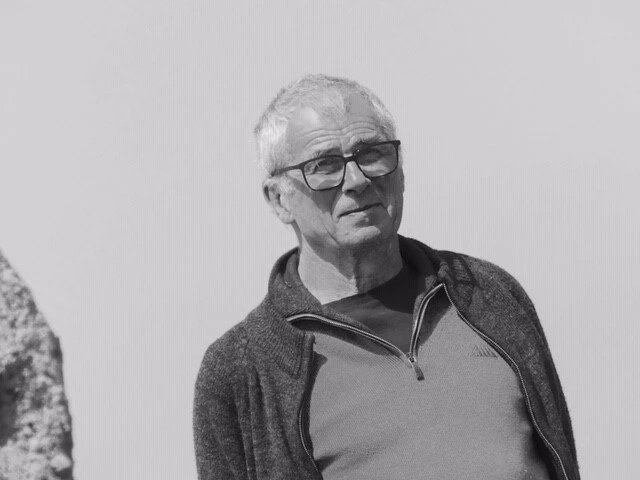
Pierre Le Caër
Pierre Le Caër is a
Judo first, Japan next
He left Brest in 1968 for Japan, where he stayed three years, alternating with periods in San Francisco and Reno. Judo was not a hobby, it was a trade and a daily discipline. In 1989 he opened his own dojo in Paris, in the 18th arrondissement.
That passage through the tatami is not biographical trivia, it is the key to the sculpture that followed. A judoka spends his life looking for the point at which a mass tips over. A sculptor setting a twenty-kilo stone on a metal rod is looking for exactly the same thing. We devoted an article to that continuity, from judo to sculpture, one and the same discipline.
Tatemono, the word brought back from Japan
He calls his work by a Japanese word, tatemono, from tate, to stand, and mono, the object. The thing that stands. That says it all: what each piece is after is not the depiction of something, it is standing itself, achieved by a narrow margin. The origin and reach of that word are explained in tatemono, the word at the heart of the work.
1995, a sliver of oak and two nails
Artistic expression revealed itself in Paris, in the spring of 1995: a thin sliver of oak, two magnificent old nails, and a composition was born. He was forty-eight. Since that day he has made work daily, assembling materials gathered on walks: metal, Breton stones, bark, shells.
Starting that late is no handicap in this trade, it is often the opposite. The subject is taken up in starting sculpture at forty-eight.
2017, losing the dojo and the studio on the same day
In 2017 he lost his dojo and his studio on the same day. It is the central break in his path, the one that ended the double Parisian life and brought him back to Brittany for good. That year is told in 2017, losing your dojo and your studio on the same day.
From Parisian metal to Iroise granite
The return to Brittany changed the material before it changed the form. In Paris he worked with what the city leaves lying about: scrap, workshop offcuts, salvaged metal. Facing the Iroise, it is granite, wood rolled by the sea, shells and bark that reach the studio. That shift is told in from Parisian metal to Iroise granite, and the behaviour of each material over time in our guide to materials.
Part of his work also takes in what the age throws away: dated objects, industrial parts, recognisable fragments. That is the subject of the news that ended up in the scrap.
The Ploudalmézeau studio
He works today in a seven-hundred-square-metre studio in Ploudalmézeau, facing the Iroise Sea. The scale of the place allows large formats and the storage of raw material, which piles up walk after walk before finding its use, sometimes years later.
Exhibitions
His works have been shown at the Crédit Mutuel de Bretagne, at the French Judo Federation, at Brest City Hall and at the Galerie Bastien in Brussels.
Seeing and acquiring his works
The available pieces are presented one by one in the catalogue, with their dimensions, their materials and a written note. The price is displayed, set with the artist, the same for everyone.
If this is your first acquisition, the guide to buying a contemporary sculpture answers the questions in order: price, placement, delivery, insurance, certificate. A specific question about a piece goes through the contact page, and we answer.