An artist agency’s website is not a shop with paintings where the shoes would be. It is a reading tool. Here is how ARTDELION’s is built, and how to use it depending on what you are looking for.
Two complete catalogues, published in full
The heart of the site is not the shop, it is the catalogue. Each represented artist has their own, published in full, work by work, including the pieces that are not for sale.
Pierre Le Caër’s catalogue holds 137 pieces in six groups, from early works of the 1990s to the suspended stones. Gabriel Lemaire Sicre’s holds 163 works in thirteen chapters, and none is for sale: Le Paradis des Machines is a collection.
Both are reachable from the catalogues page. Each catalogue opens on a navigation by group, so that you can jump straight to the series that interests you instead of scrolling through a hundred and fifty thumbnails.
The work listing, and what it must contain
Click on a piece and you arrive at its listing. It is the most important page on the site, and the one that takes the most work upstream.
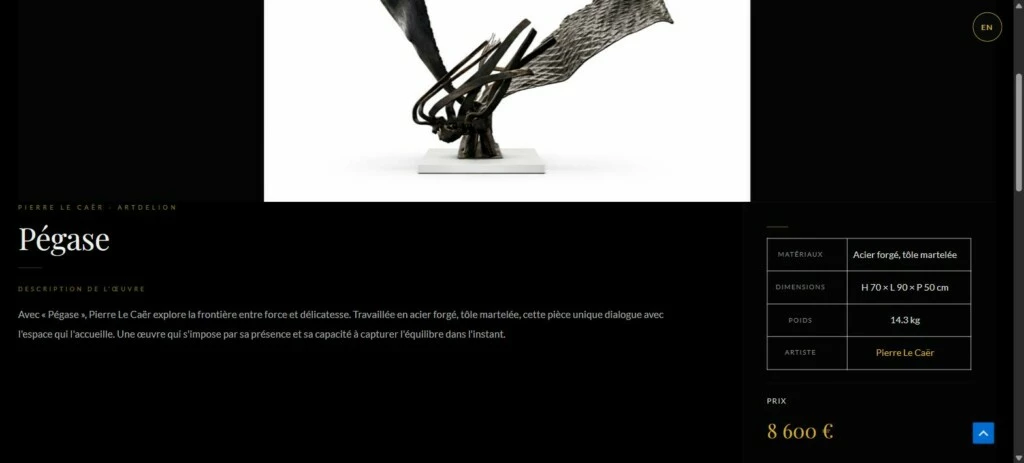
Each listing gives the exact title, the real materials, the dimensions in height, width and depth, the piece’s place within a group, a short text saying what you are looking at, and a reminder about the artist. When the piece is available, the price is displayed and a button lets you request information without creating an account.
This exactness is not documentary vanity. It is the information needed by someone who has to decide where a piece will stand, how it will be moved, and at what budget.
The shop, for what is genuinely
The shop shows only the works currently offered for acquisition. Displayed price, no auction, no opaque negotiation. The price is set on criteria that can be explained, and the acquisition process is written down from the first message to delivery.
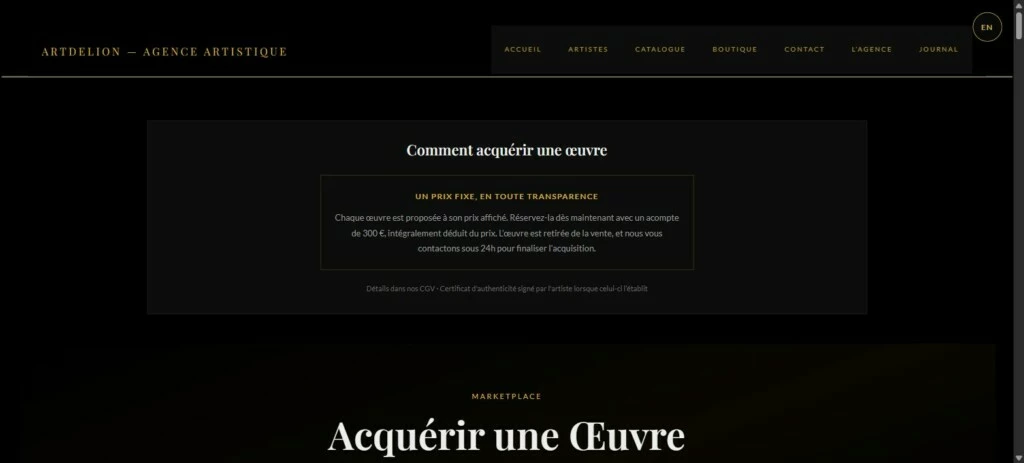
The distinction between catalogue and shop is deliberate. A catalogue documents a trajectory, a shop offers stock. Confusing the two reduces an artist to whatever they have left to sell.
The journal, to understand before buying
The journal gathers the longer pieces: the role of an artist agency, the differences with a gallery, what a certificate of authenticity contains, how a sculpture is delivered, and portraits of the represented artists.
These articles are not there to fill space. They answer the questions someone considering a first acquisition actually has, and does not always dare to ask.
The whole site exists in English
A button at the top right switches the entire site to English: both catalogues, the 300 work listings, the biographies, the shop and the journal. This is not machine translation laid over the page, it is a written version, work by work, with the right technical vocabulary.
That is a decision of substance. A collector in Brussels, London or New York should be able to read the same thing as a reader in Paris, with the same precision.
For artists
The application page is for artists who wish to be represented. The criteria are published, including the one that rules out the most submissions: accepting that every piece be measured, photographed, named and made public.
Three ways to start
If you are looking for a particular work, go straight to the shop.
If you want to understand an artist, open their complete catalogue and read the biography before looking at prices.
If you are still hesitating, start with the agency page, then write to contact. A person answers, not an automated form.