Complete catalogue of the works of Pierre Le Caer, born in Brittany in 1947 and working since 1995. Every piece is unique, shaped by hand from metal, wood and stone in a workshop of 700 square metres at Ploudalmezeau, facing the Iroise sea. Measurements below are in centimetres, height then width then depth.
Early Works
Sculptures made between the 1990s and the early 2000s, the founding period of Pierre Le Caer's visual world.
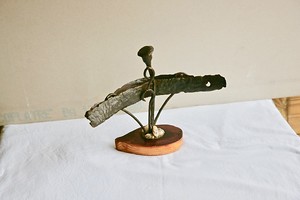
Welcome
Stone, metal
There are thresholds you do not cross without being changed. This sculpture is one of those passages, a silent invitation to enter a world where stone speaks and metal listens. Welcome is not a word here, it is a stance, an architecture of openness.
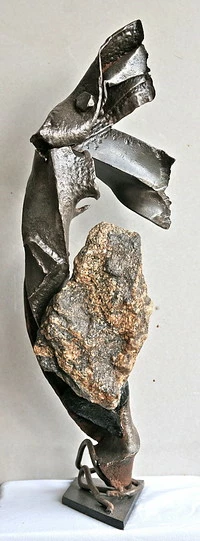
Basta
Metal, stone
Enough. The metal cuts, the stone resists, and out of that confrontation comes a form that is no longer either one of them, but something more final. Basta is the sculpture that says no and, in doing so, says everything.
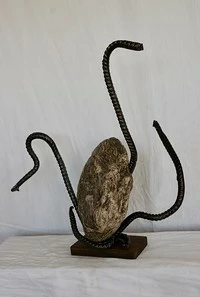
Nightmare
Stone, metal, wood
Night has forms that daylight does not know. This piece has captured them, the impossible interlacing, the weight that rises, the balance that gives way. A nightmare is not a mistake, it is a truth we dare to look at only while asleep.
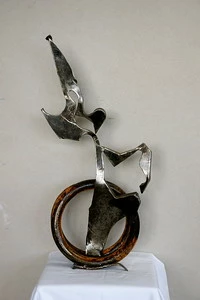
The Origin
Metal
Before the first figure there is zero. Before the first work there is the founding gesture. Composition 00 is that absolute beginning, metal still searching for its form, a hand still learning its language. A point of origin from which all the rest follows.
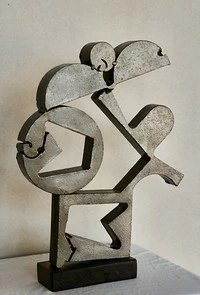
Composition 3
Metal
Three is the number of resolution. After the tension of opposites it arrives as a synthesis, a form found. Here the metal organises itself according to a logic that belongs to it alone, neither cold nor warm, but right.
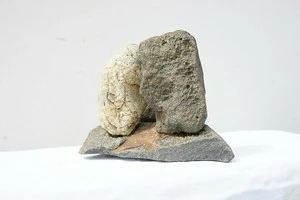
Consultation of Stones
Three stones
Three stones talking to one another. No metal, no artifice, only raw matter in dialogue with itself. They met here through the will of a
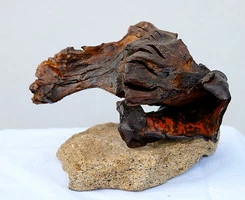
Coast of Legends
Wood, stone, metal
The wood comes from where the waves have always struck. The stone watched sailors and shipwrecks pass. Metal, for its part, never forgets. Together they compose an imaginary coast where Breton legends have the solidity of the real, and the real the transparency of legends.
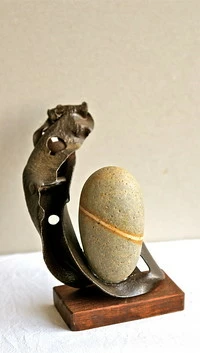
Discovery
Metal, stone
There is something beneath the surface, and that is always what you sense before you understand what it is. This sculpture is that moment of foreboding, the fraction of a second in which matter reveals itself and the gaze becomes something else.
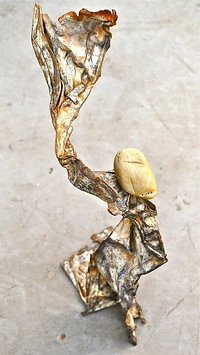
Distress 5
Stone, metal
The five is no accident, it is the fifth version of the same cry. The stone carries what words cannot. The metal holds what arms let go. Something here wanted to last longer than its own pain.
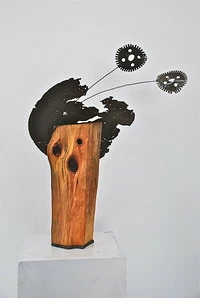
Summer 2003
Metal, stone
A particular summer, the one where the heat burned more than skin, where something in the world changed texture. The metal remembers that light. The stone had seen worse, and yet together they keep the trace of that summer.
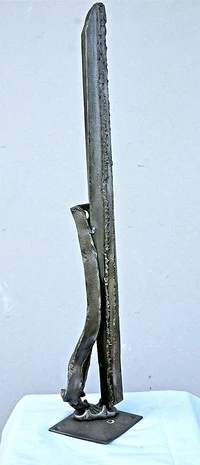
The Vertical of Summer
Metal
At the height of summer the sun stands at its zenith and shadows shrink beneath men's feet. This sculpture is that instant of absolute verticality, metal strained towards the sky like a plant out of season, like an idea that refuses to bend.
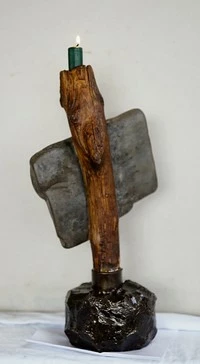
Lantern
Stone, wood, metal
It does not burn, yet it gives light. Le Caer's lantern is made of materials that have absorbed so many nights that they have become luminous of their own accord. Follow it, not to go anywhere, but so as to stop being afraid of the dark.
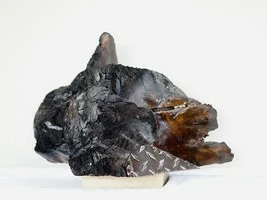
The Black Dogs
Wood, metal
Winston Churchill called his depression the black dog. Le Caer made two of them, and sculpted them in wood and metal in order to look them in the face. For what we name, we can tame. What we sculpt, we can overcome.
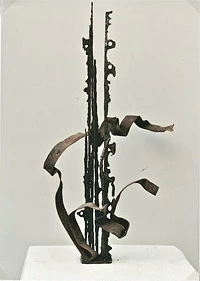
The Shreds of Leo Ferre's Desires
Metal
Leo Ferre sang anger and love with the same voice. Le Caer heard him and translated that voice into metal, crumpled, torn, still standing. Desires do not die whole, they come apart into shreds that go on living, each on its own, burning.
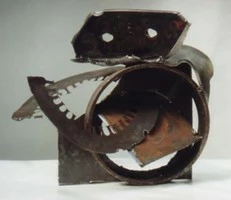
The Open Man
Metal
Openness is a chosen vulnerability. This man of metal has decided not to close himself off, to let the air through, and the light, and perhaps a little pain as well. That is the price of any true encounter.
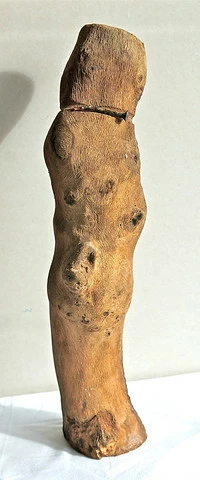
Slave Ship
Wood
Wood carries the memories we would rather forget. This piece does not allow forgetting, it forces us to look history in the face, in all its brutality, in all its dark and heavy wood. Art here is an act of memory and of resistance.
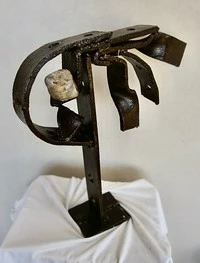
P for Pierre
Metal, stone
The letter P for Pierre, the first name and the material merged into one. An autobiography in a single form, a play on words that only sculpture can allow itself. The
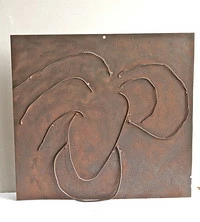
Metal Plate 2, Sorrow
Metal
Sorrow has the colour of oxidised metal, neither bright nor dead, but persistent. This second plate is an archive of feeling, a way of keeping the trace of what passed through without destroying. Sorrow, once sculpted, becomes bearable.
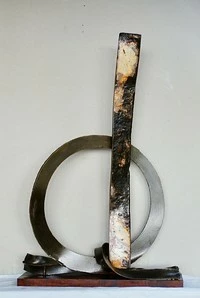
Plenitude
Metal, wood
There are moments when nothing is missing. Not noisy happiness, the other kind, the silent one, the kind that feels like a long and complete breath. This sculpture is made of that substance, metal and wood reconciled in a balance that no longer needs to justify itself.
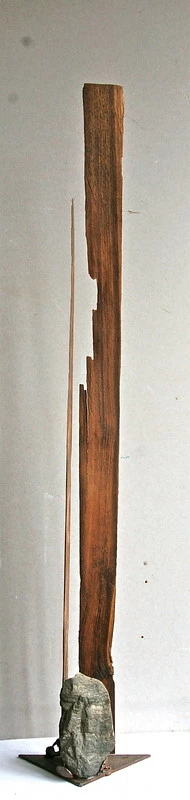
Starting Point
Metal, wood, stone
Every journey begins somewhere. This sculpture is that somewhere, a knot of materials from which possibilities take flight. The metal points a direction, the wood anchors in the earth, the stone recalls where we come from. Together they form the condition of all movement.
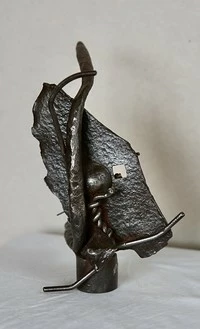
Headache
Metal
There are problems that take up all the room inside a skull. Questions that go round and round until something gives. This sculpture is that tension, metal twisted by a mind that searches, insists, and ends up finding an unexpected form.
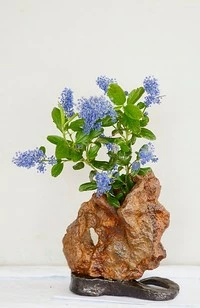
Ancient Vase
Stone, metal
Ancient vases held oil, wine, ashes. This one holds something else, time itself, fixed in stone and metal. A form thousands of years old reinvented in a contemporary vocabulary, as though humanity had always carried the same gestures.
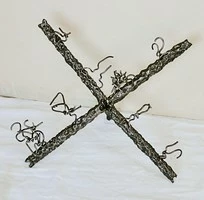
X
Metal
X is the unknown, the crossroads, the signature of those who cannot write and the name of mysteries. This sculpture reveals nothing, it asks the question. The metal draws an intersection between two destinies, two forces, two presences. What happens at that meeting point is for you to name.
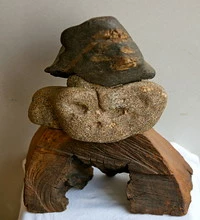
The Assembly
Stones, wood
The stones have gathered. Not by chance, by necessity. The wood holds them together like a speech that unites disparate voices into a single discourse. This assembly deliberates in silence on questions we shall never hear, but whose importance we sense.
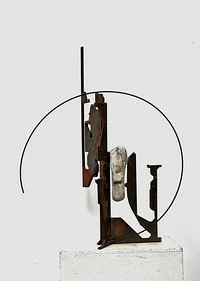
The Observatory
Metal, stone
From here you can see far, not into space, but into time. Stone is an archive, metal an instrument for reading it. This observatory is not watching the stars, it is scrutinising matter itself, searching its folds and its strata for what history has left behind.
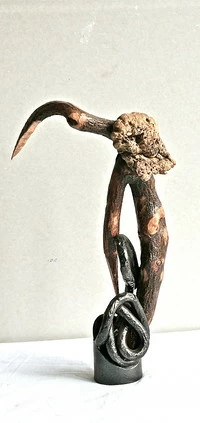
The Guardian
Cork, wood, metal
He does not sleep. He does not speak. He is there, as he always has been, as he always will be. Cork gives him lightness in spite of the task, wood gives him roots, metal gives him vigilance. Le Caer's guardian does not protect a place, he protects a state of mind.
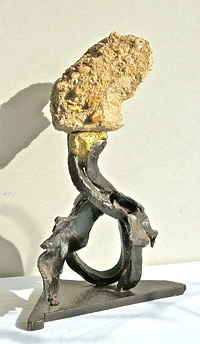
Balance
Stone, metal
Balance is not a position, it is a perpetual movement. Stone and metal negotiate here without pause, each giving a little so that the whole may hold. It is the image of every successful relationship, not stability, but a dance.
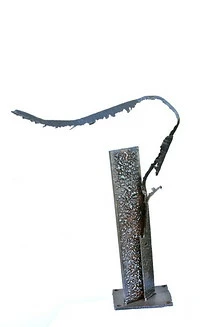
Taking Flight
Metal
Metal does not fly. And yet, look. In the curve of this piece, in the surge that runs through it, something has decided to stay on the ground no longer. Taking flight is not a question of material, it is a question of will.
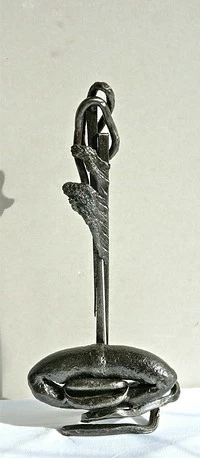
The Mast
Metal
Every ship has its mast. Every life has its vertical axis around which everything else is arranged, direction, resistance to the wind, the pride of standing upright. This mast of metal carries no sail, but it sets the course.
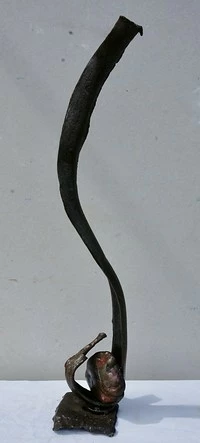
The Spiral
Metal, stone
The spiral is the form of growth, from the galaxy to the seashell, everything alive turns as it widens. This sculpture is a hymn to that fundamental movement, not the repetition of the circle, but the advance of the spiral that returns to the same point, only higher.
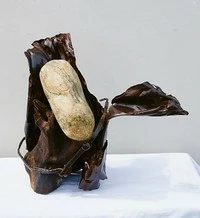
The Nest of Stones
Stone, wood, metal
A nest is not a shelter, it is a promise. The stone gives the floor, the wood the warmth, the metal the protection. In this hollow, so carefully built, something is waiting to be born. The most fragile of constructions, and the most necessary.
Collection
Works from the studio collection, sculptures in which several materials are set in dialogue, witnesses to a period of exploration and of encounters between materials.
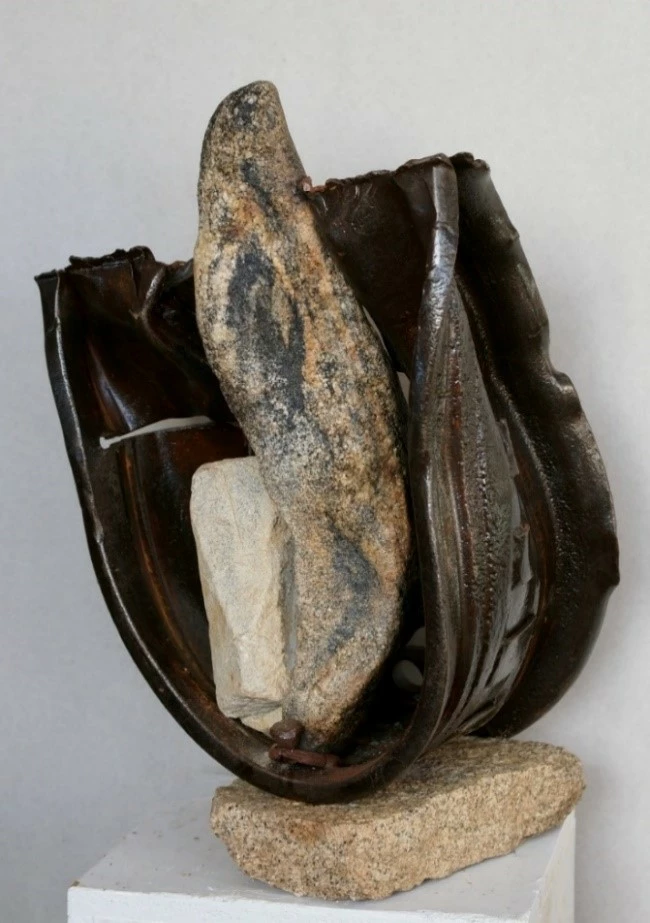
Alcove
Metal, stone
The alcove is the place of intimacy above all others, the withdrawn space where at last one is oneself. The metal creates the enclosure, the stone occupies the heart. Between the two, a precious emptiness, the one that makes presence possible.
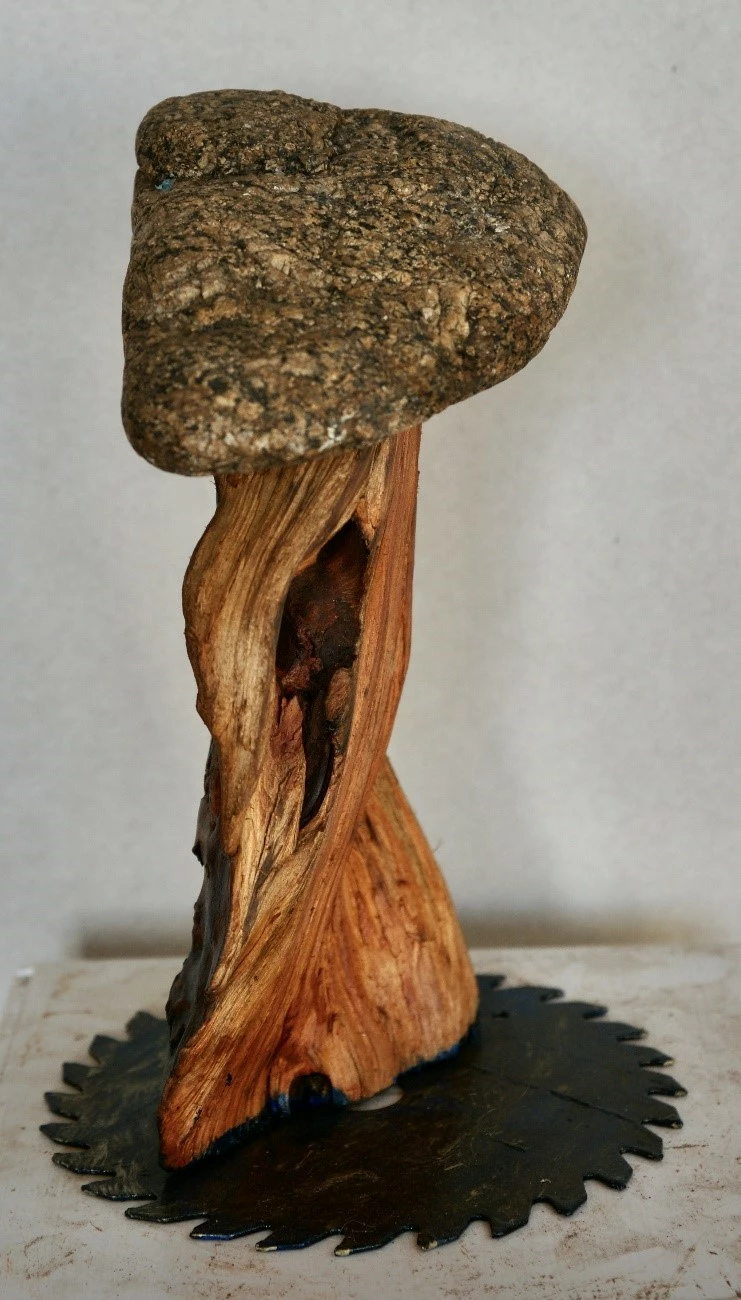
Arrogance
Wood, stone, metal
Arrogance is a stance, a way of taking up room, of refusing to shrink. This sculpture embodies it without condemning it, for in all arrogance there is a share of legitimate revolt against being erased. The question is, in the service of what?
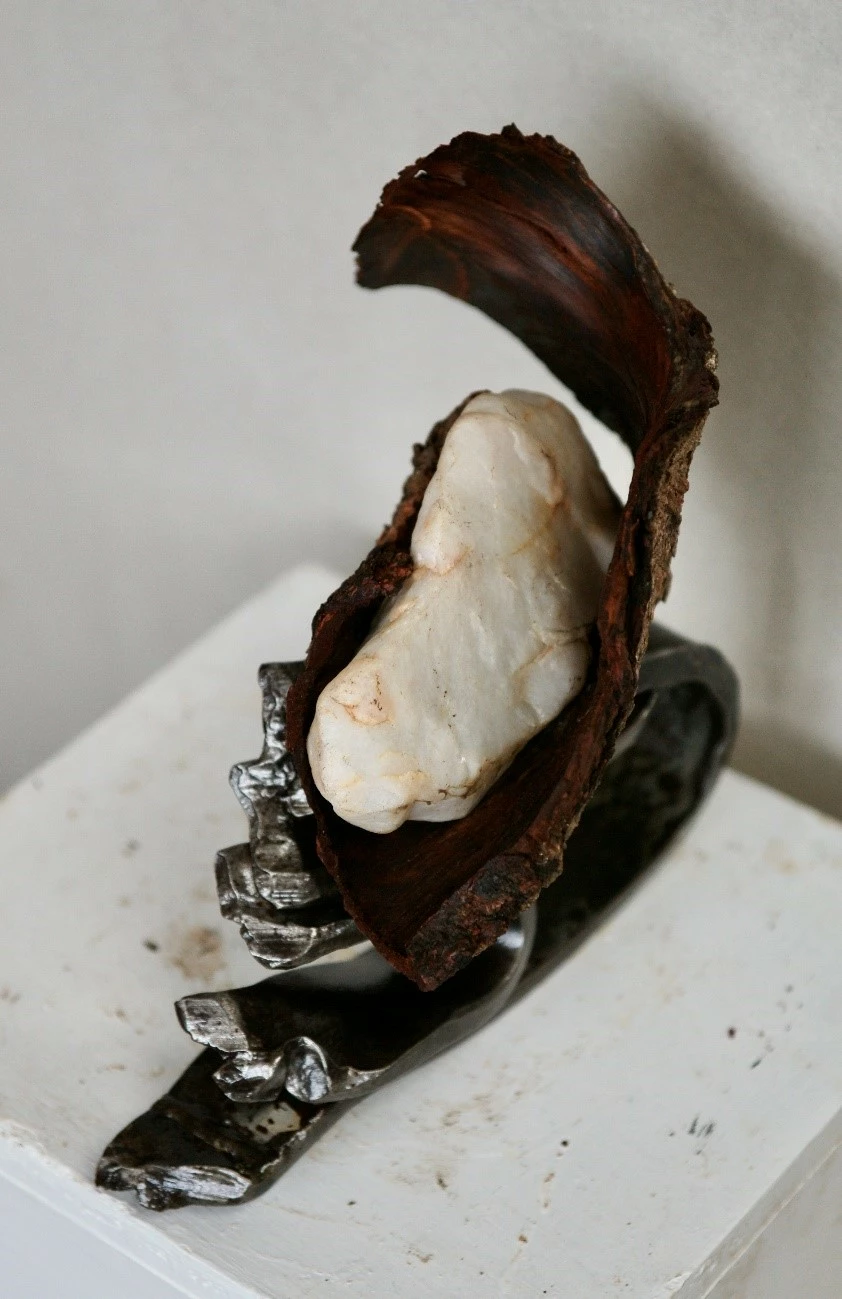
Association
Wood, stone, metal
Three materials, one work. No hierarchy, no subordination, an association in the strict sense of the word, in which each brings what the others lack. It is the very definition of complementarity, not resembling one another so as to fit together the better.
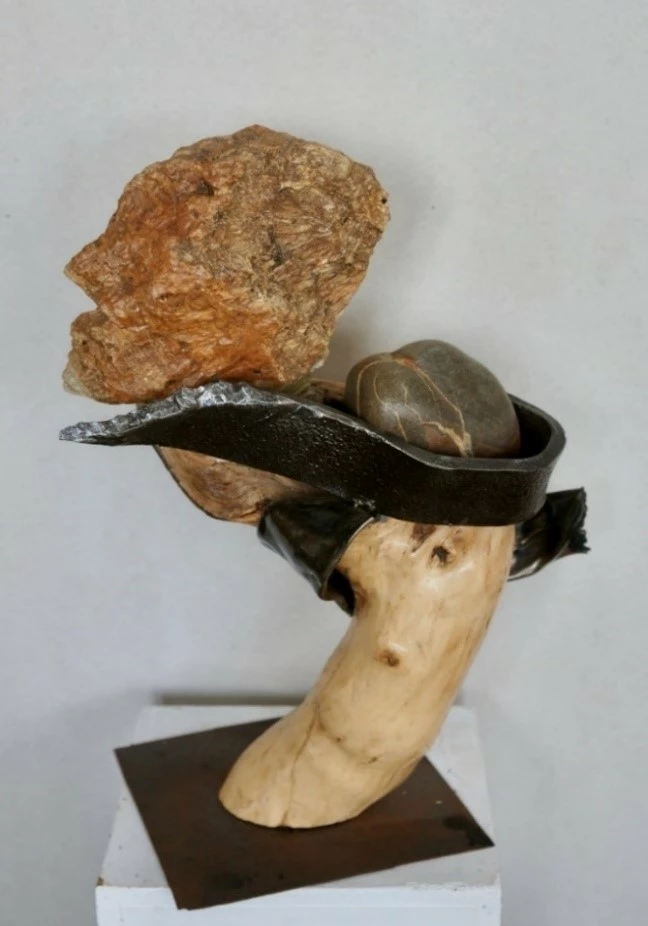
Ballade of Protection
Metal
A ballade is a musical journey, a form that wanders before finding its resolution. This sculpture travels the same road, the metal sets off in every direction, explores, coils, returns. And in that perpetual movement it protects something invisible but essential.
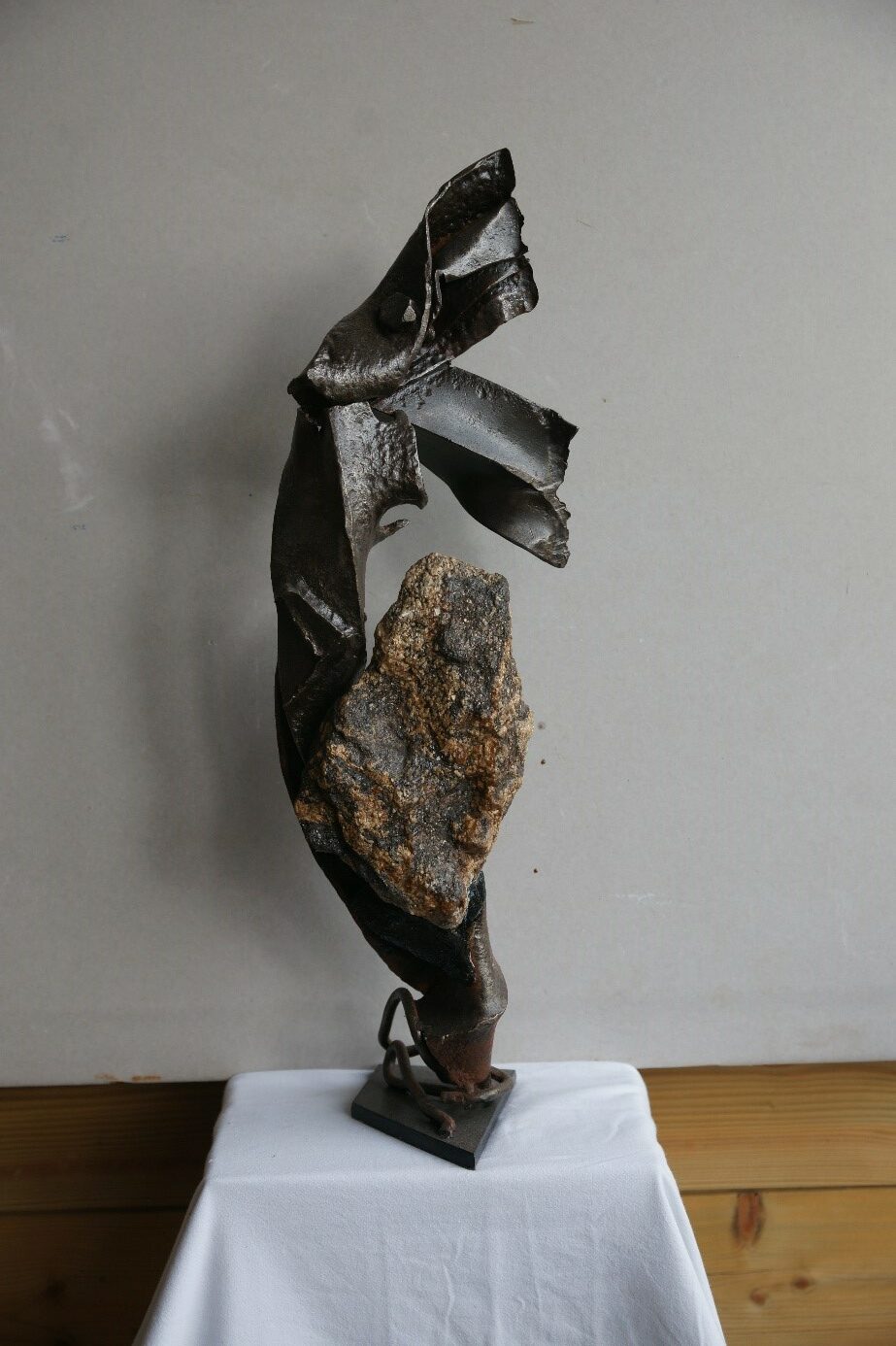
Basta, alternative view
Metal, stone
Another light, another angle, the same intransigence. Basta seen head on or from the side, it always says the same thing with the same conviction. Some works have no bad profile.
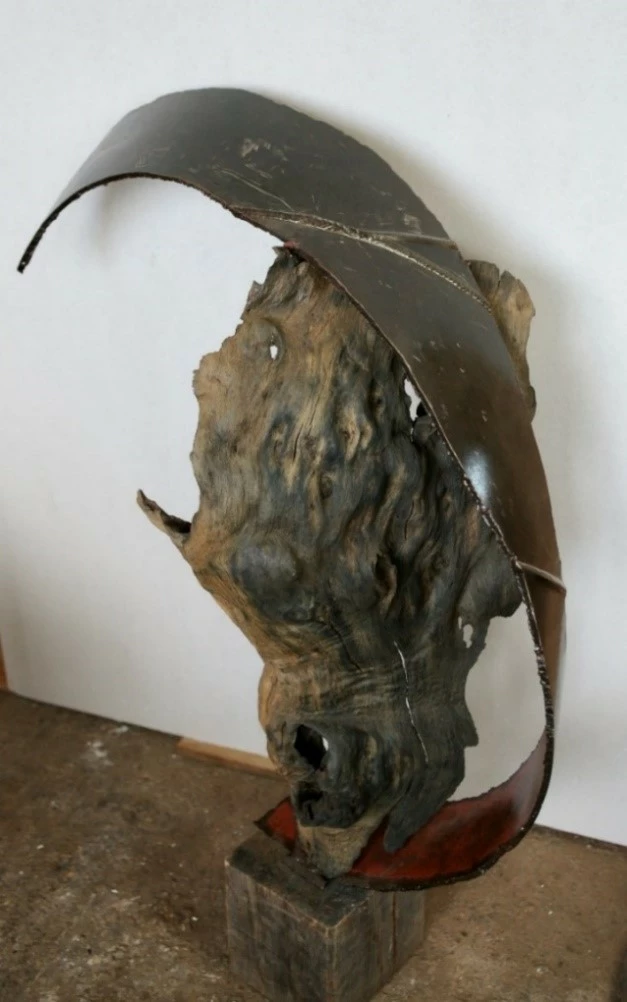
Capture
Metal
What do we capture when we sculpt? A movement, an emotion, an instant that would otherwise escape. This metal has captured something elusive, a breath, a tension, the fraction of a second before everything changes.
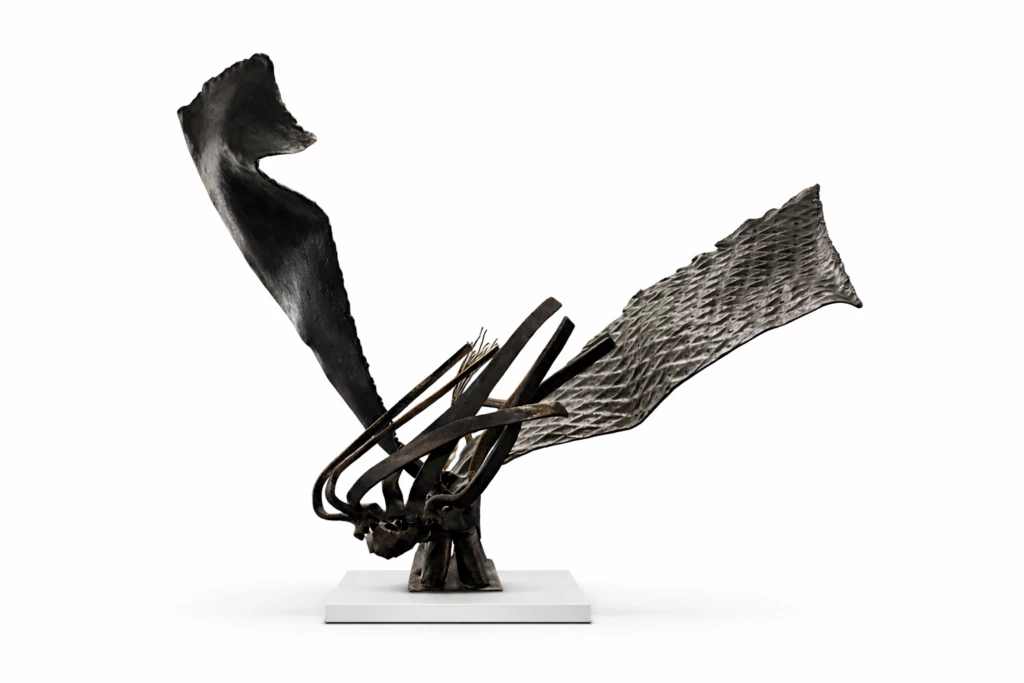
Pegasus
Forged iron
With « Pegasus », Pierre Le Caër explores the border between strength and delicacy. Worked in assembled and welded steel with hammered sheet, this
Recent Work
Pierre Le Caer's contemporary production, sculptures inhabited by a growing freedom of materials and forms, where forged metal, found wood, raw stone and natural elements come together.
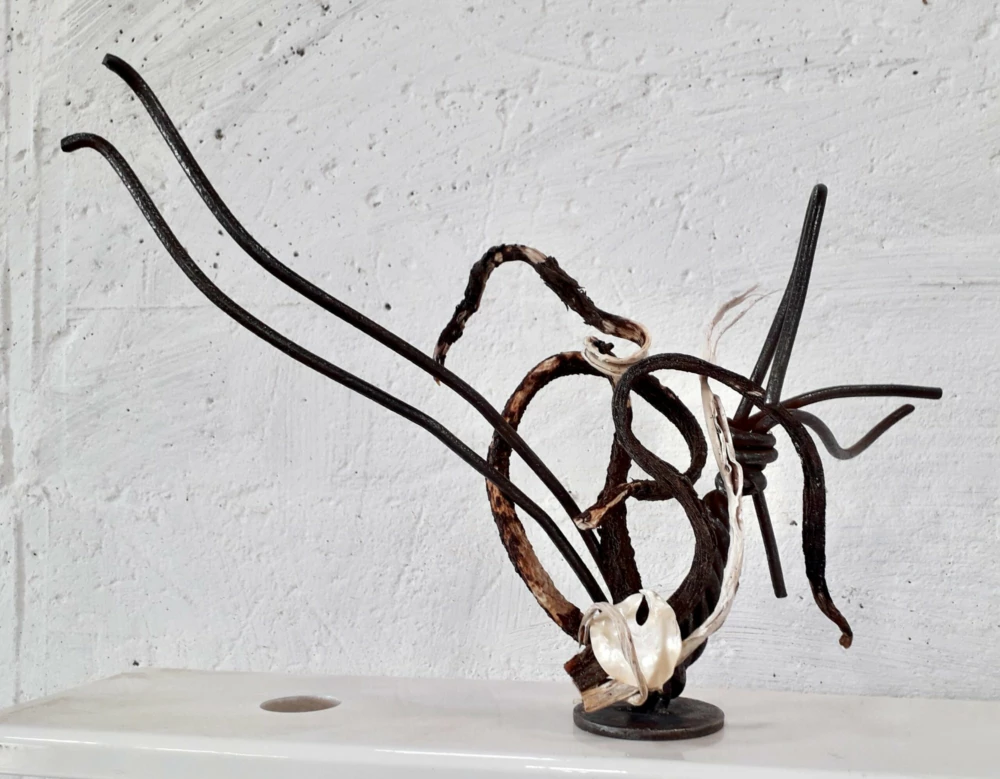
Iron Spider
Forged metal, whitened steel wire
She spins her threads between black and white, between the raw and the bleached. This iron spider does not capture prey, she captures space itself, turning it into a web of taut lines. Her centre, that organic knot, is the heart of a labyrinth whose way out she alone knows.
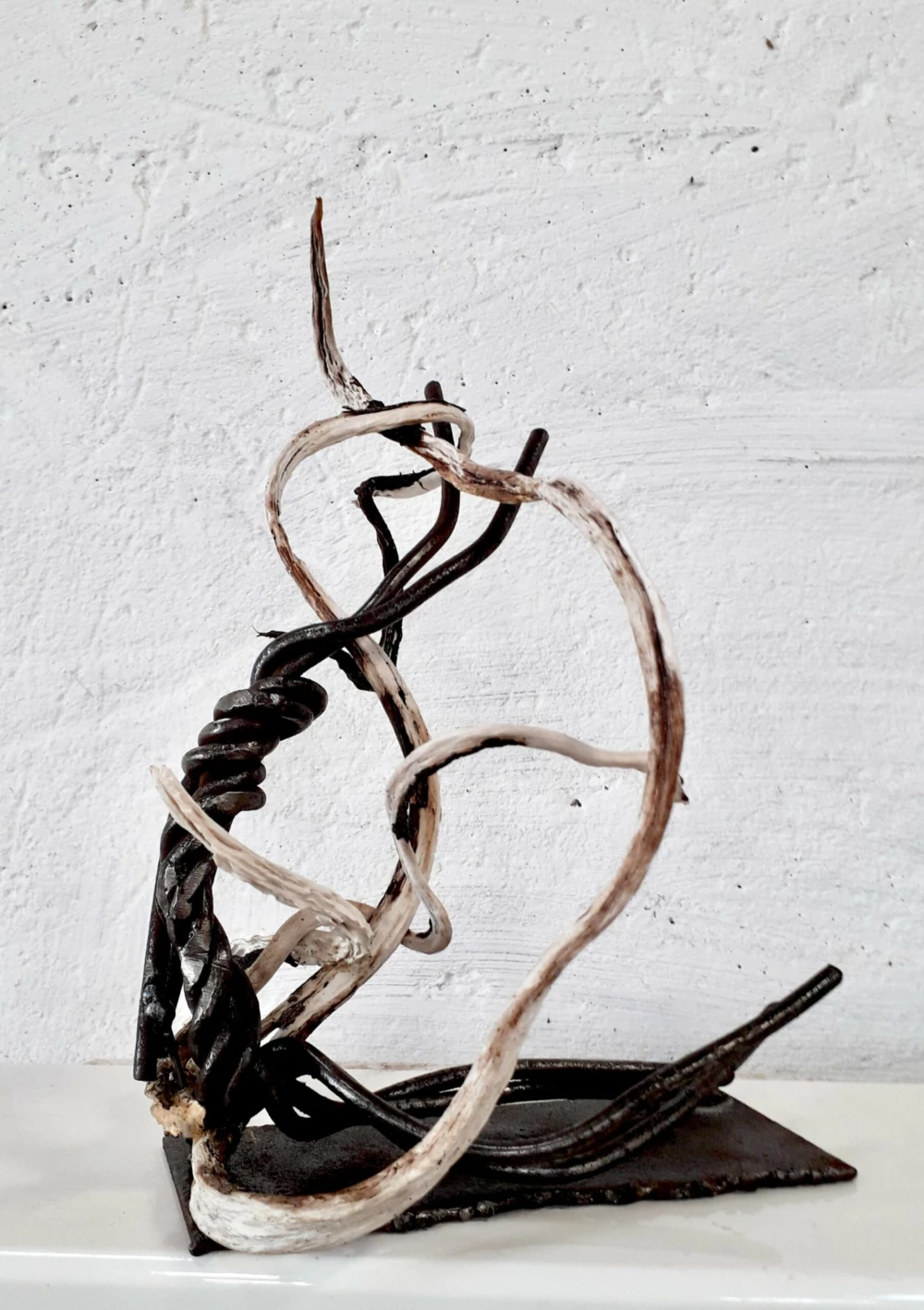
The Melee
Metal, whitened steel wire
Everything touches, everything intertwines, black and white, rigid and supple, dense and airy. The melee is not confusion, it is the meeting of all the forces in the same place at the same moment. Out of that organised chaos comes a form no plan could have foreseen.
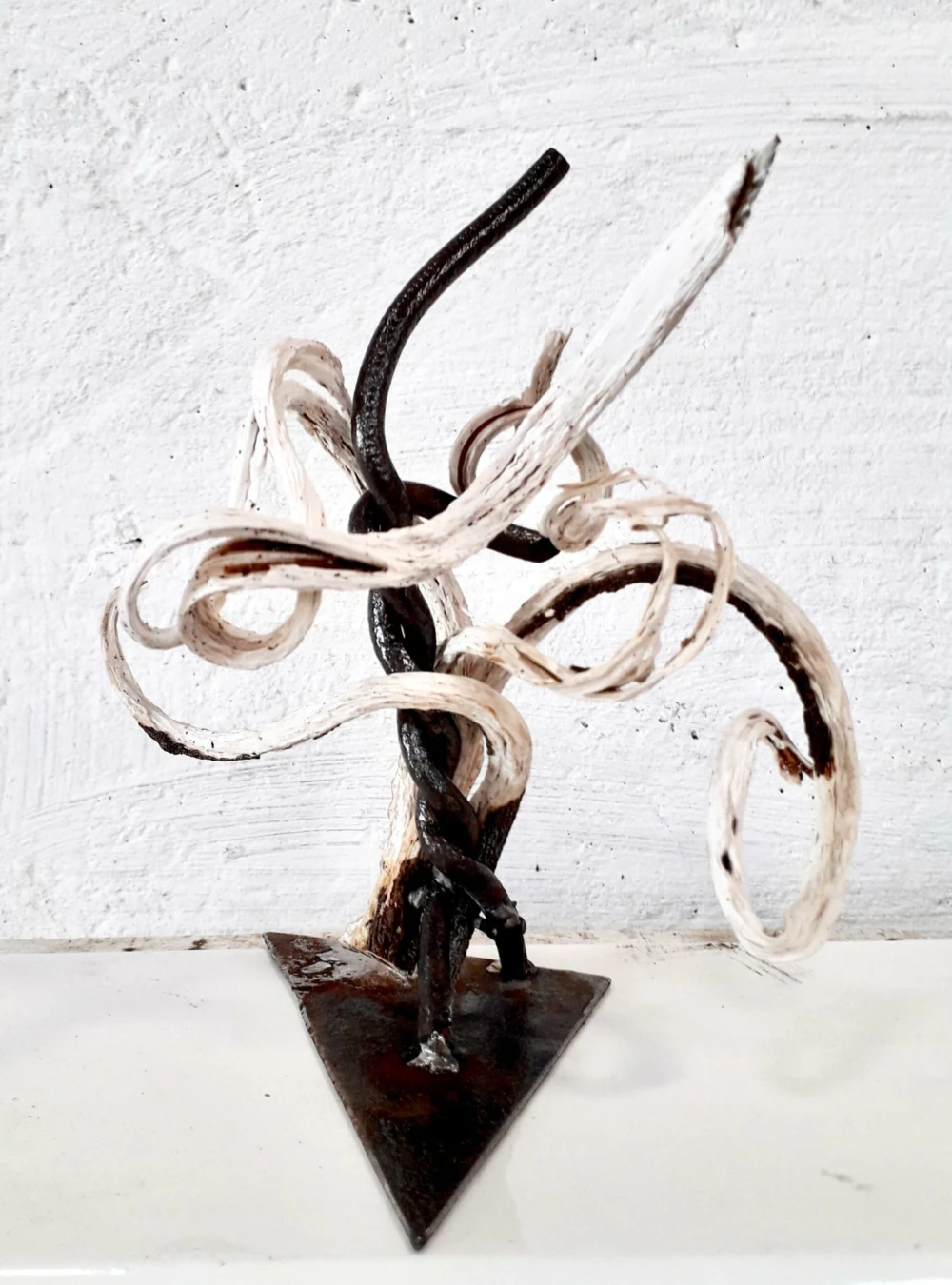
Momentum
Metal, whitened steel wire
Momentum cannot be demonstrated, it is felt. This sculpture throws metal into space with an urgency that leaves no one indifferent. The white threads unwind like thoughts that have finally been given permission to escape. Momentum always begins somewhere motionless.
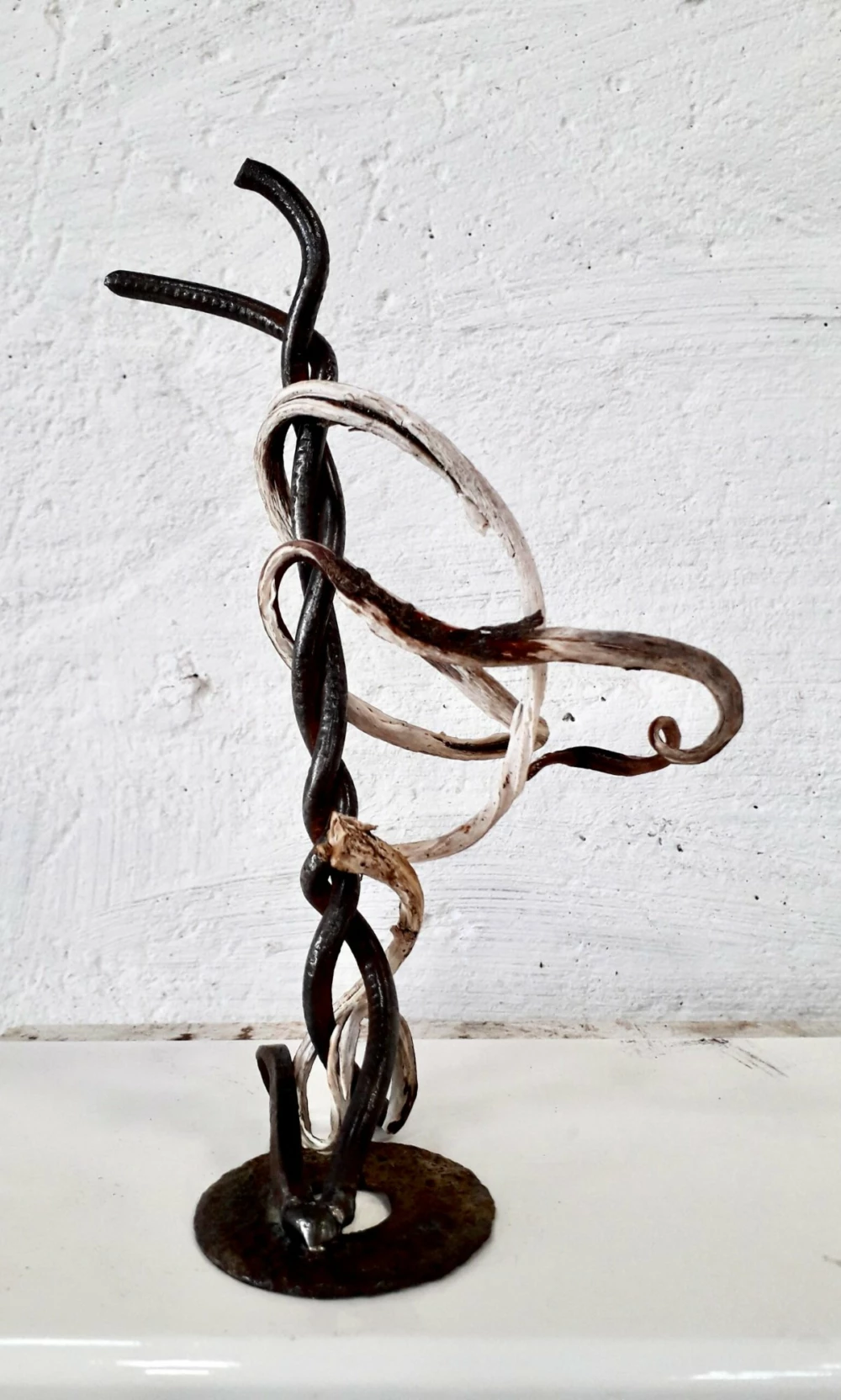
The Caduceus
Forged metal, whitened wire
Two serpents coil around an axis, the ancient symbol of medicine and of the message. This caduceus of metal speaks a language older still, that of the balance between opposites, of healing through tension, of life that passes by way of death.
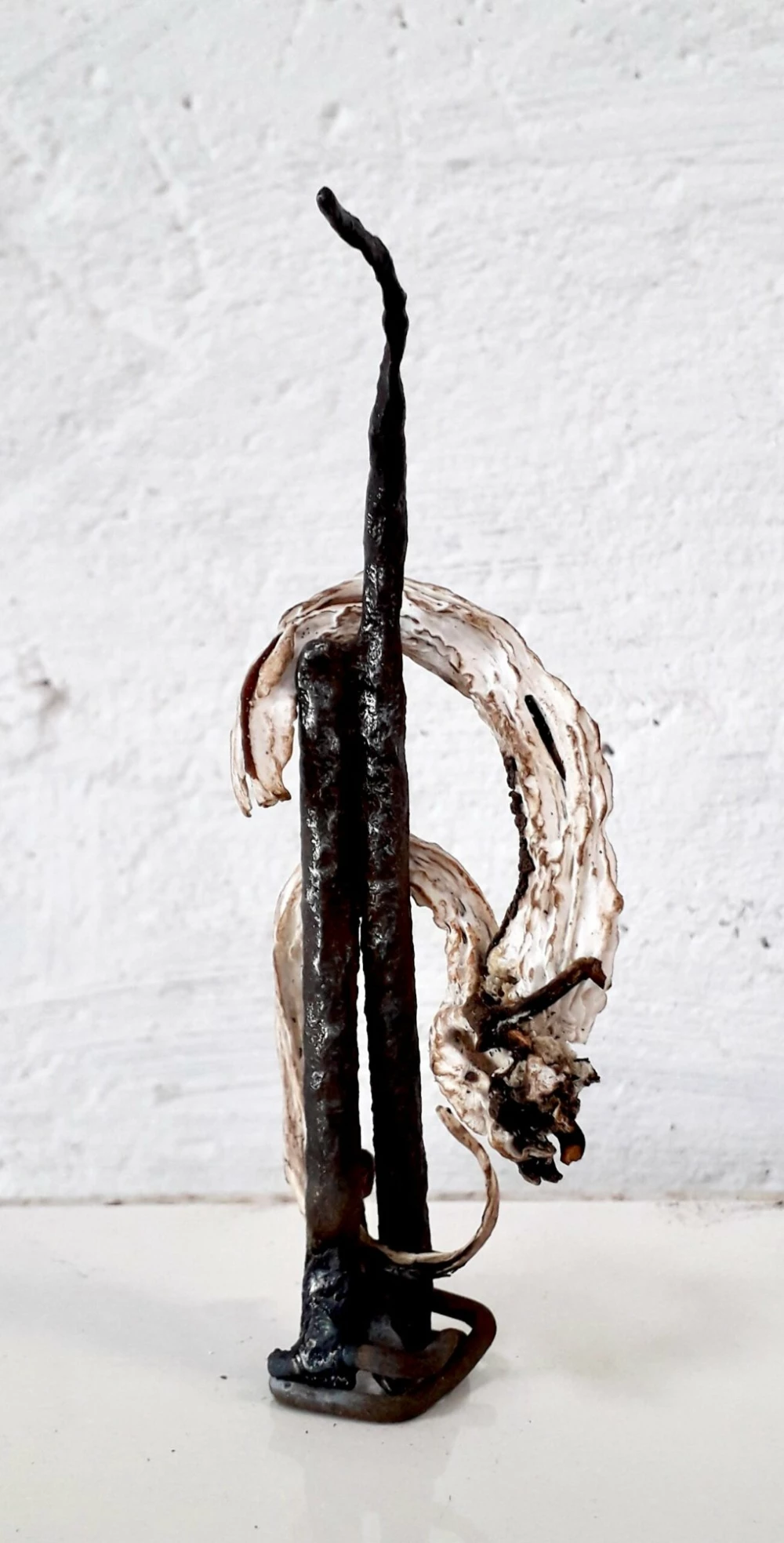
The Lighthouse
Forged metal, whitened wire
Vertical, solitary, luminous in its very essence. This lighthouse does not turn, it simply is. The white spiral that wraps around it is its permanent beam, the one that needs no night in order to be seen. It is there for those who know how to look.
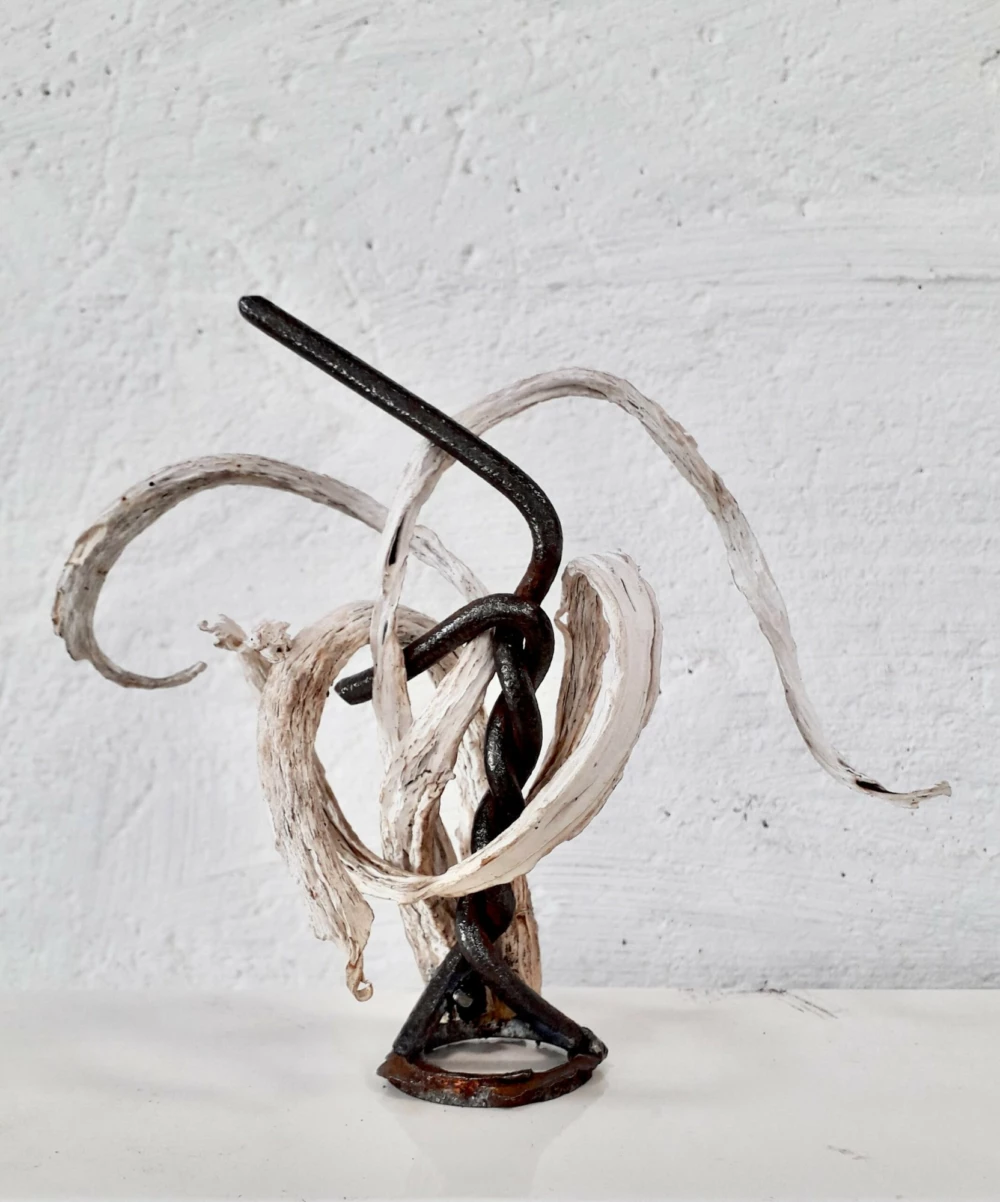
The Comet
Metal, whitened steel wire
She has passed, and in her wake she left these white ribbons that the metal has fixed for eternity. The comet does not wait. She crosses. And what we remember of her is always the luminous tail, never the core of iron and ice.
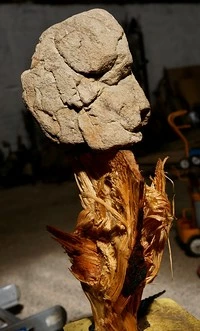
A King's Pain
Stone, metal, wood
Kings suffer too, perhaps more than others, because they cannot show it. This head of stone carried by a body of shredded wood says what the crown forbids anyone to express, the loneliness of power, the weight of decision, the pain of standing alone at the summit.
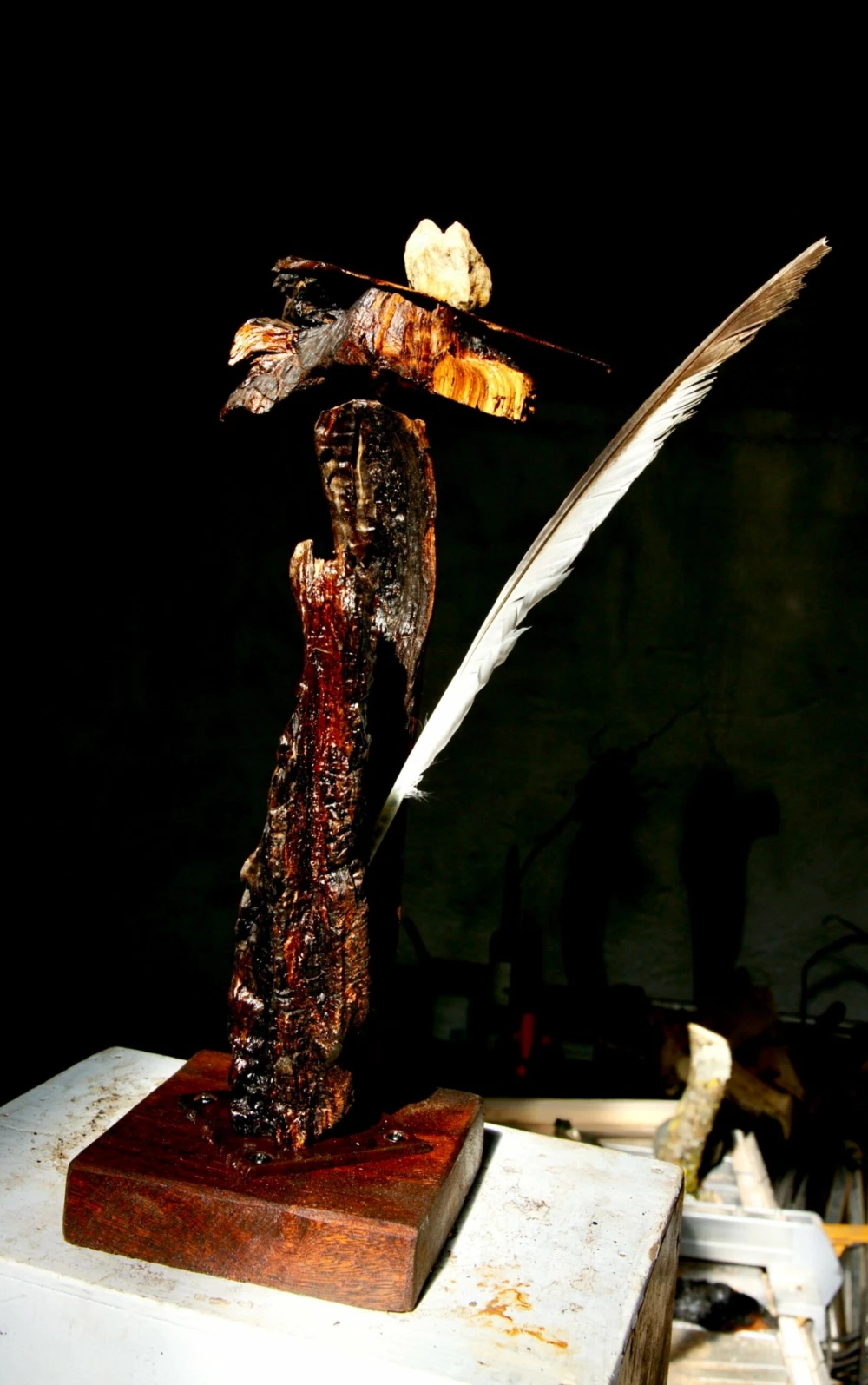
The Oracle
Burned wood, stone, feather
You must come at night, alone, with a sincere question. Le Caer's oracle gives no answers, it offers a presence, wood burned with accumulated wisdom, stone as white as a fragment of truth, a bird's feather like a breath of possible revelation.
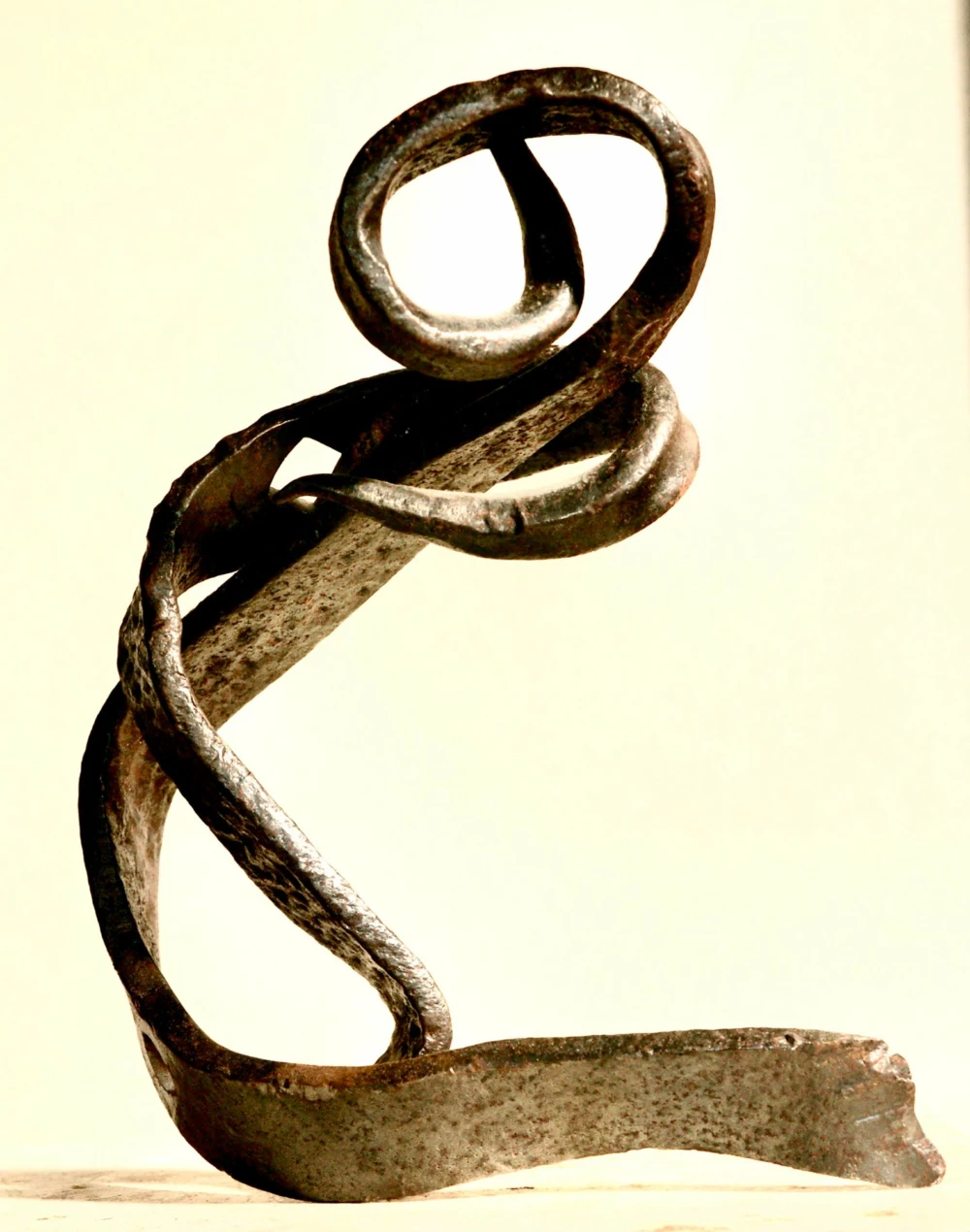
The Gordian Knot
Forged metal
Alexander cut it. Le Caer, for his part, forged it. For perhaps true courage is not to cut the knot but to contemplate it, to accept that some questions have no simple solution, and that the beauty of the knot is sometimes worth more than its undoing.
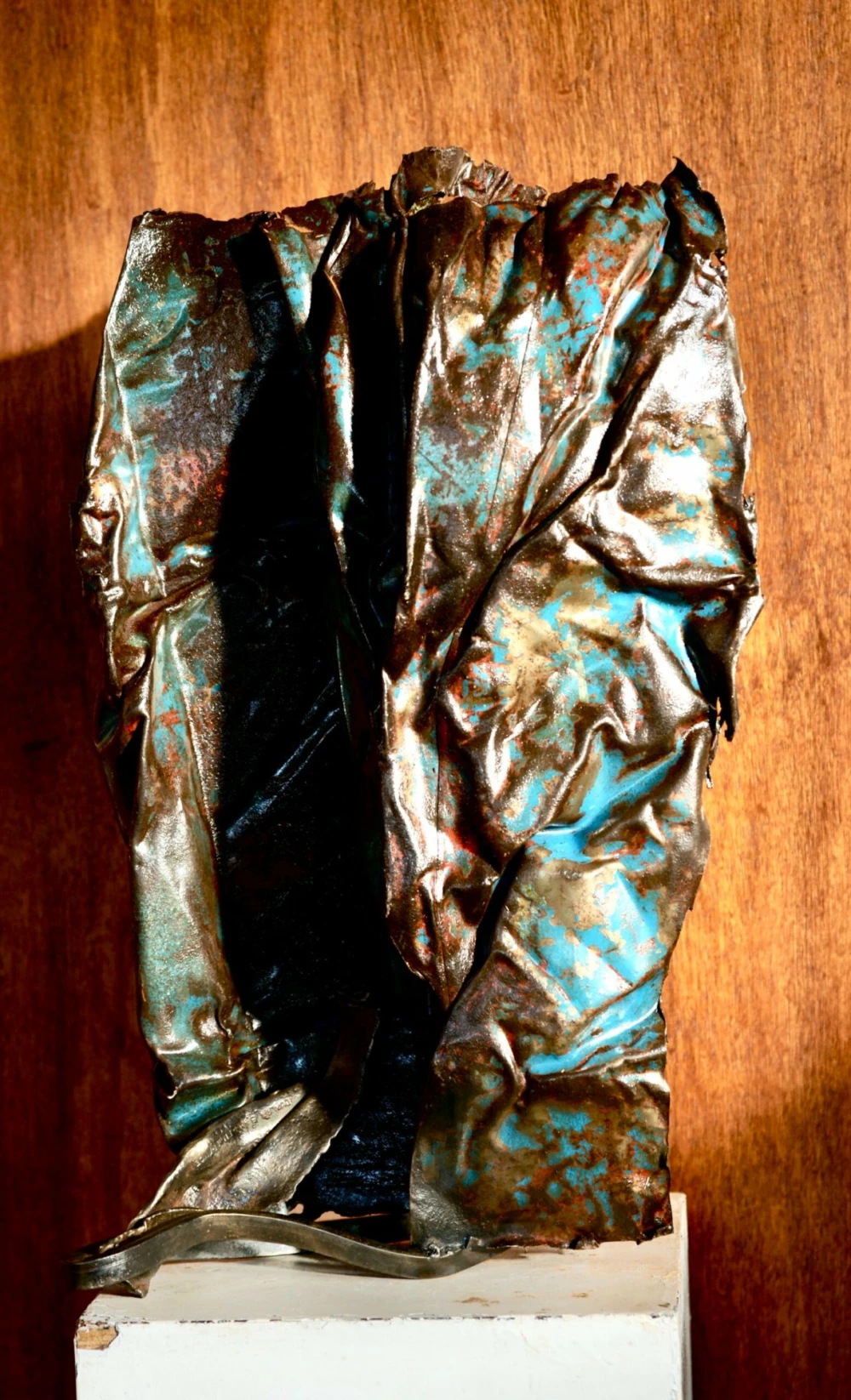
The Armour
Patinated sheet steel
This armour does not protect a body, it is one. The crumpled sheet metal, iridescent with blue and green, has taken on the consistency of living skin. In that metamorphosis Le Caer asks the question, where does protection end and identity begin?
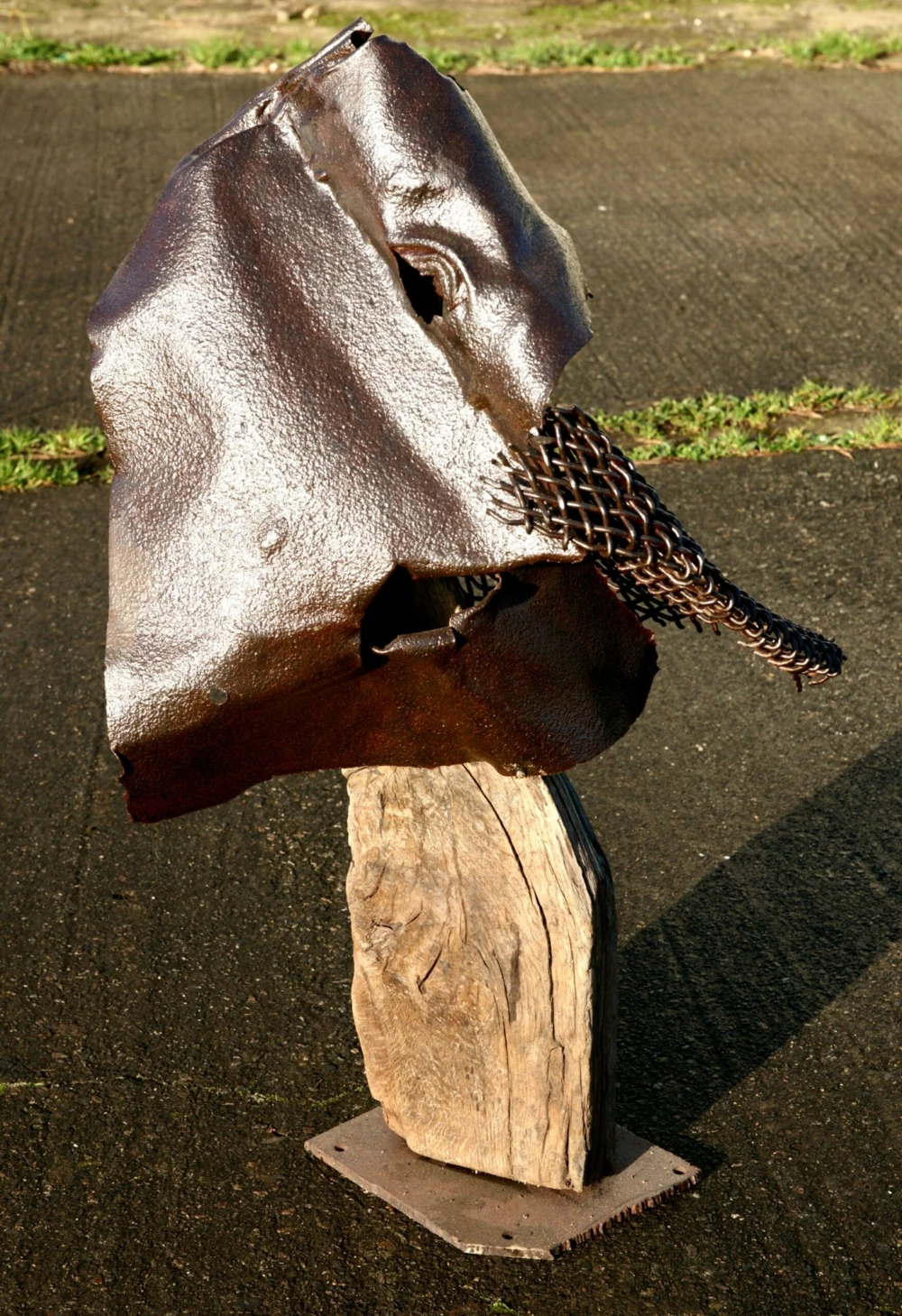
The Colossus
Sheet steel, driftwood, metal mesh
He stands in the light from outside, immense, patient, made of materials gathered over years. The colossus does not crush, he welcomes. His head of draped metal is looking at something we cannot see yet. His trunk of wood has centuries in its veins.
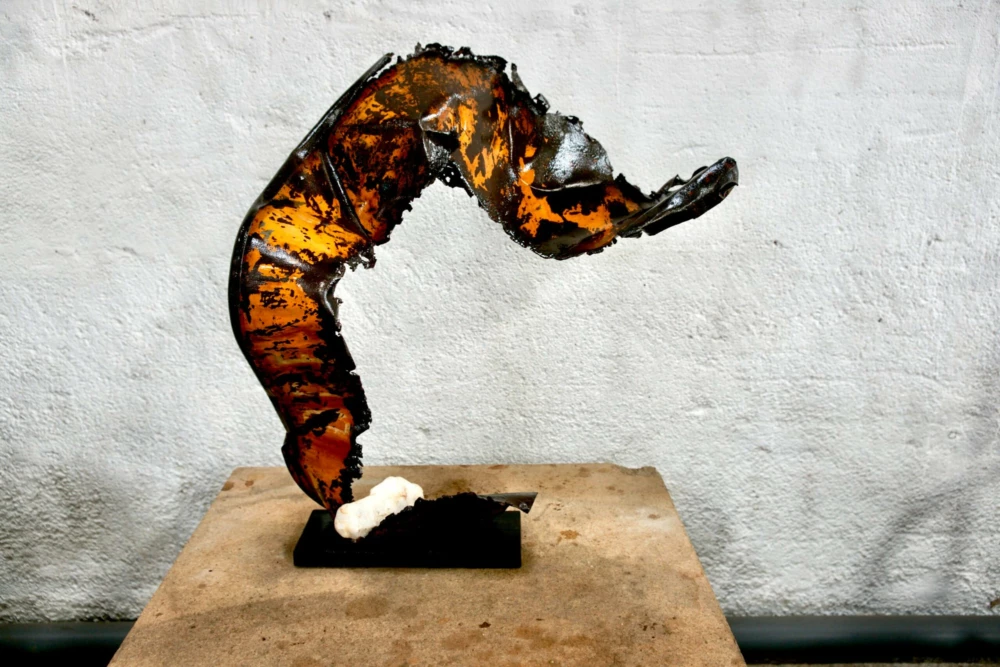
The Arc of Fire
Sheet steel, stone, metal
The sheet metal was heated to the point of transformation, and in that burning it found its form. Orange and black fight over the surface as life and death fight over a battlefield. At its foot, a white stone, the peace that becomes possible after the war of fire.
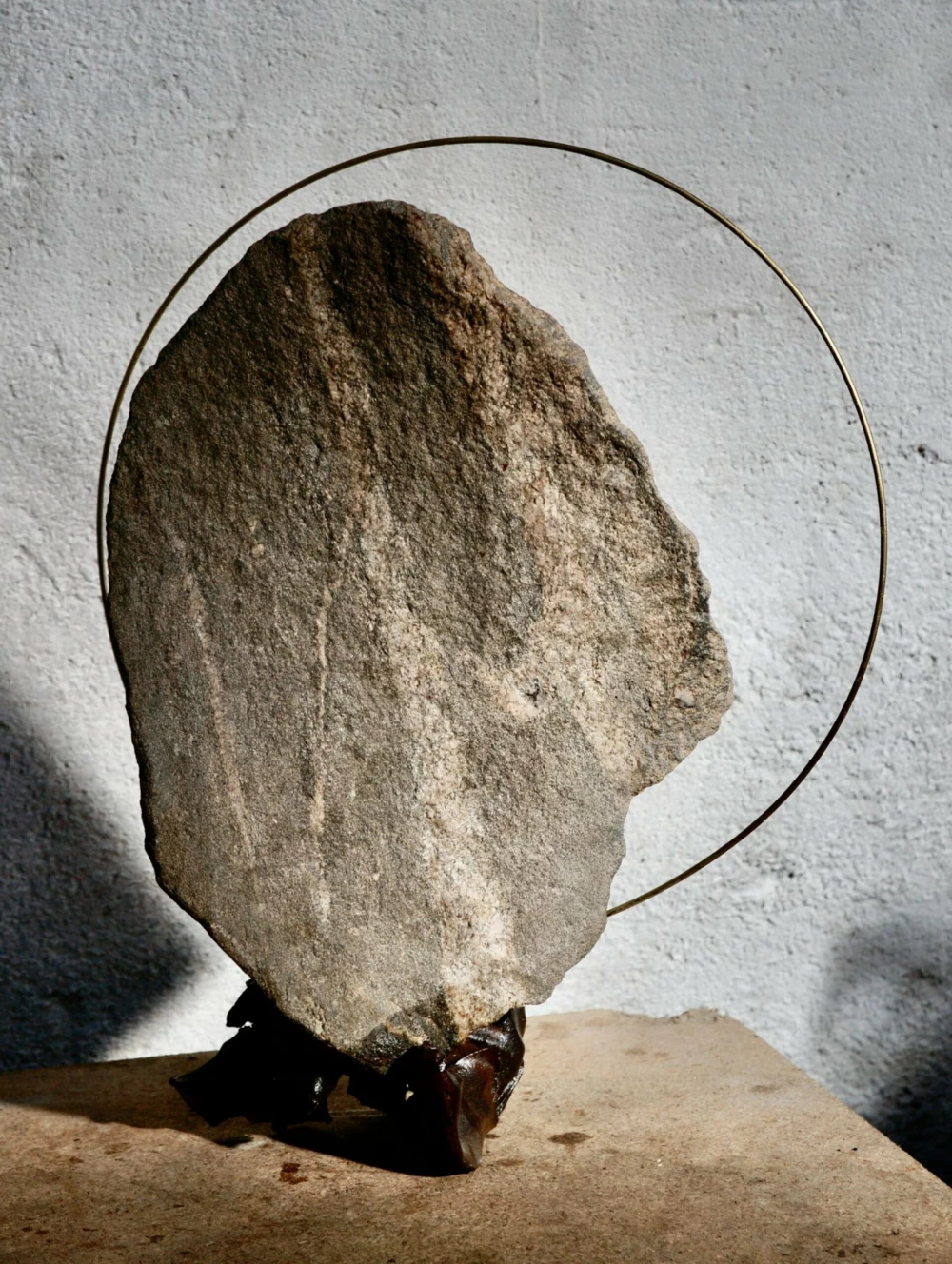
The Halo
Stone, brass wire
A perfect circle of gold around a slab of raw granite. Holiness is not in what is polished and soft, it is in rough matter crowned by a minimal gesture. This halo says that the sacred can inhabit what appears ordinary.
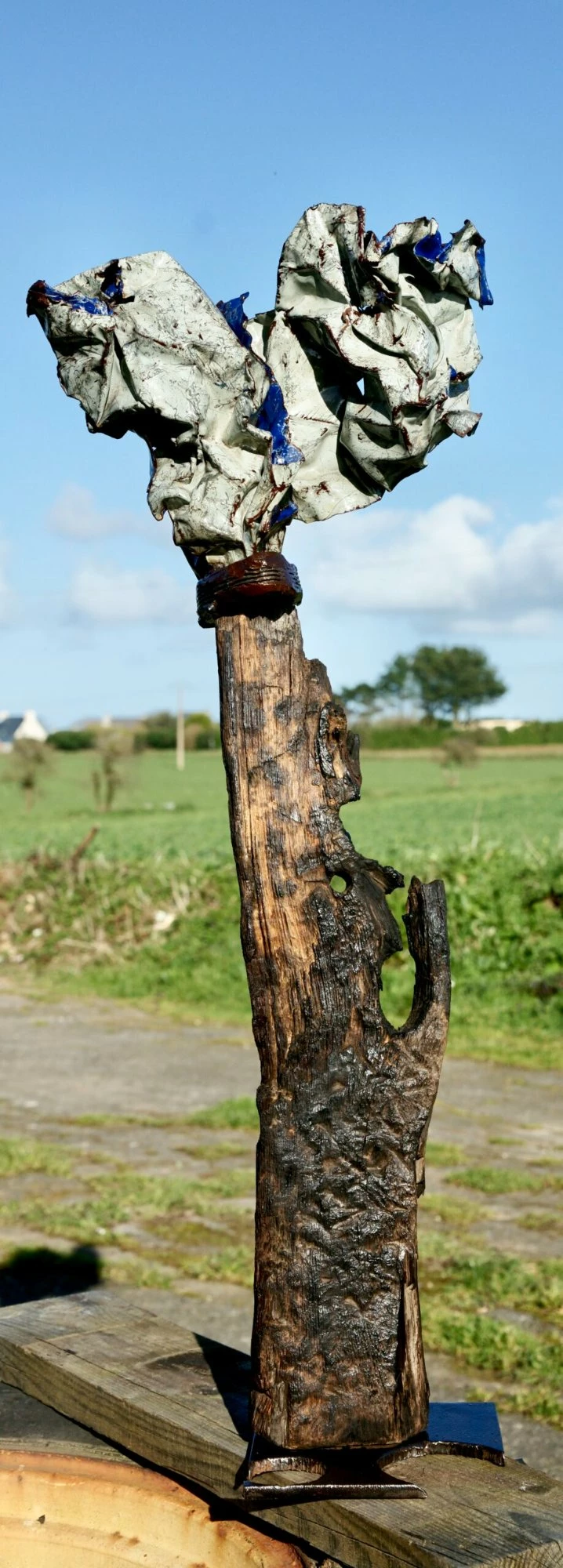
The Storm
Driftwood, crumpled blue sheet metal
The Breton wind has turned itself into sculpture. The wood, shaped by years on the coast, carries on its shoulders a corolla of blue and grey metal that resembles the precise moment when sky and sea become one. After the storm, the form remains.
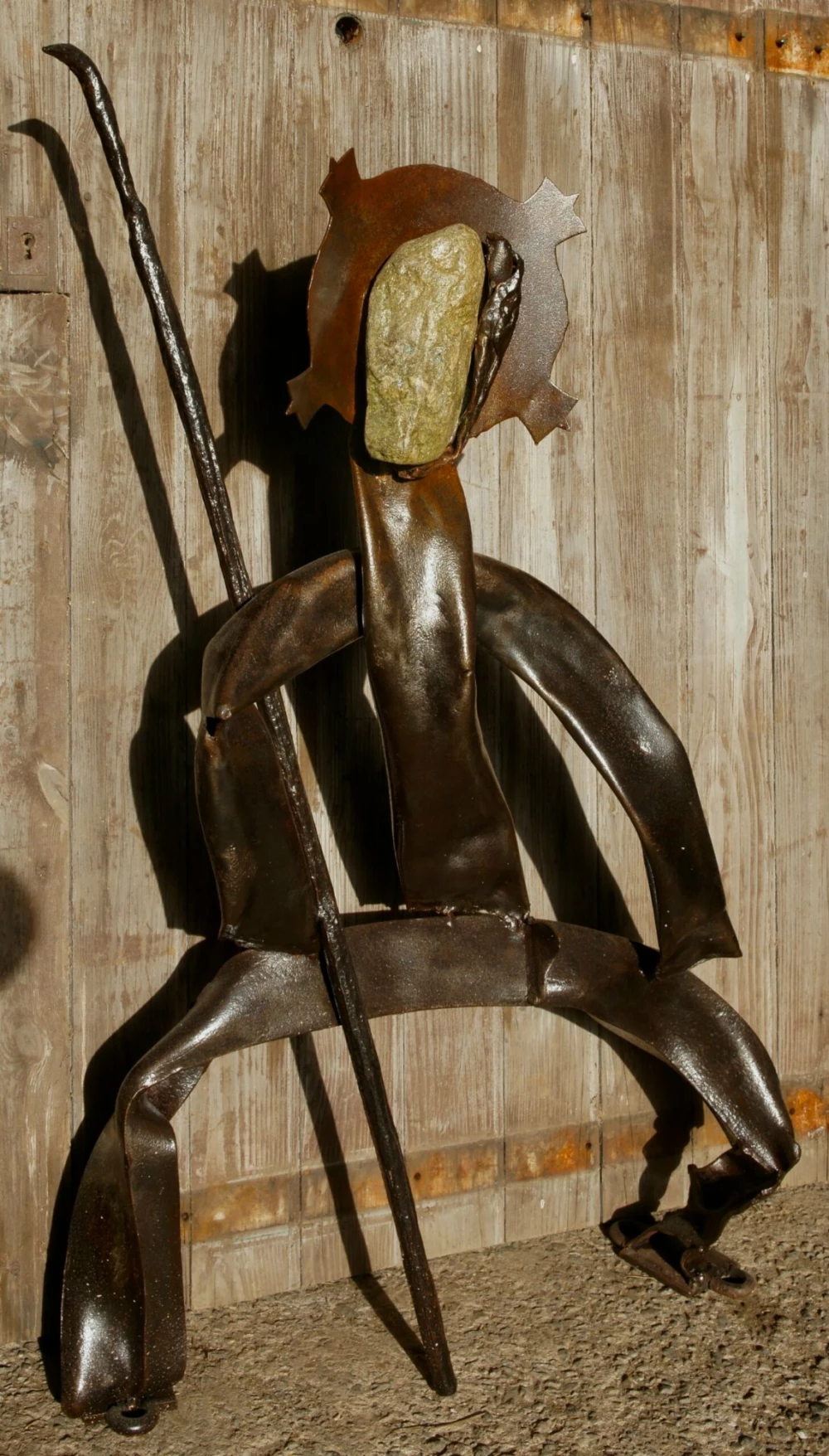
The Armed Guardian
Metal, stone, forged rod
Seated but ready. His head is a green stone set in a serrated crown of metal. His spear is not a threat, it is a statement. This guardian watches over something that does not yet belong to history, but that already has its weight.
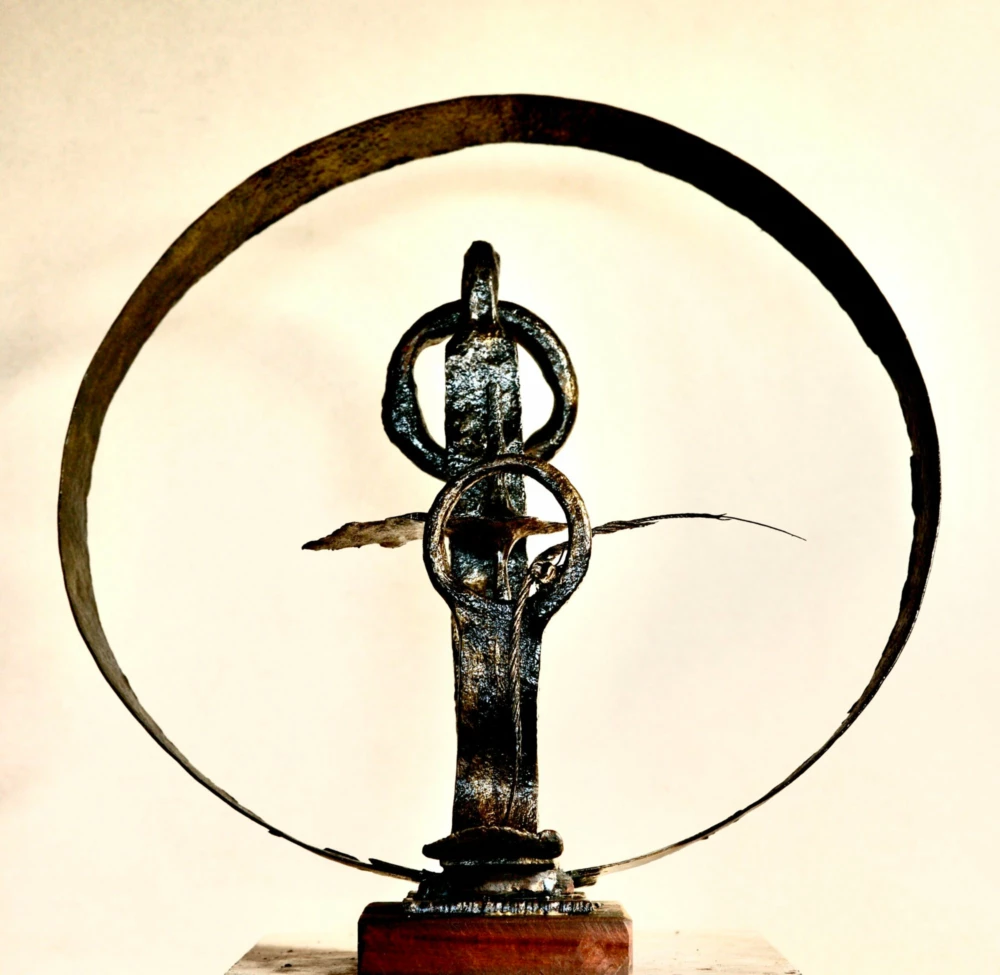
The Equinox
Forged metal, rings, wood
Twice a year, day and night become equal. This sculpture captures that instant of perfect cosmic balance, the great circle of metal like the movement of the spheres, the central column like the axis of the world. The equinox is the moment when everything is right.
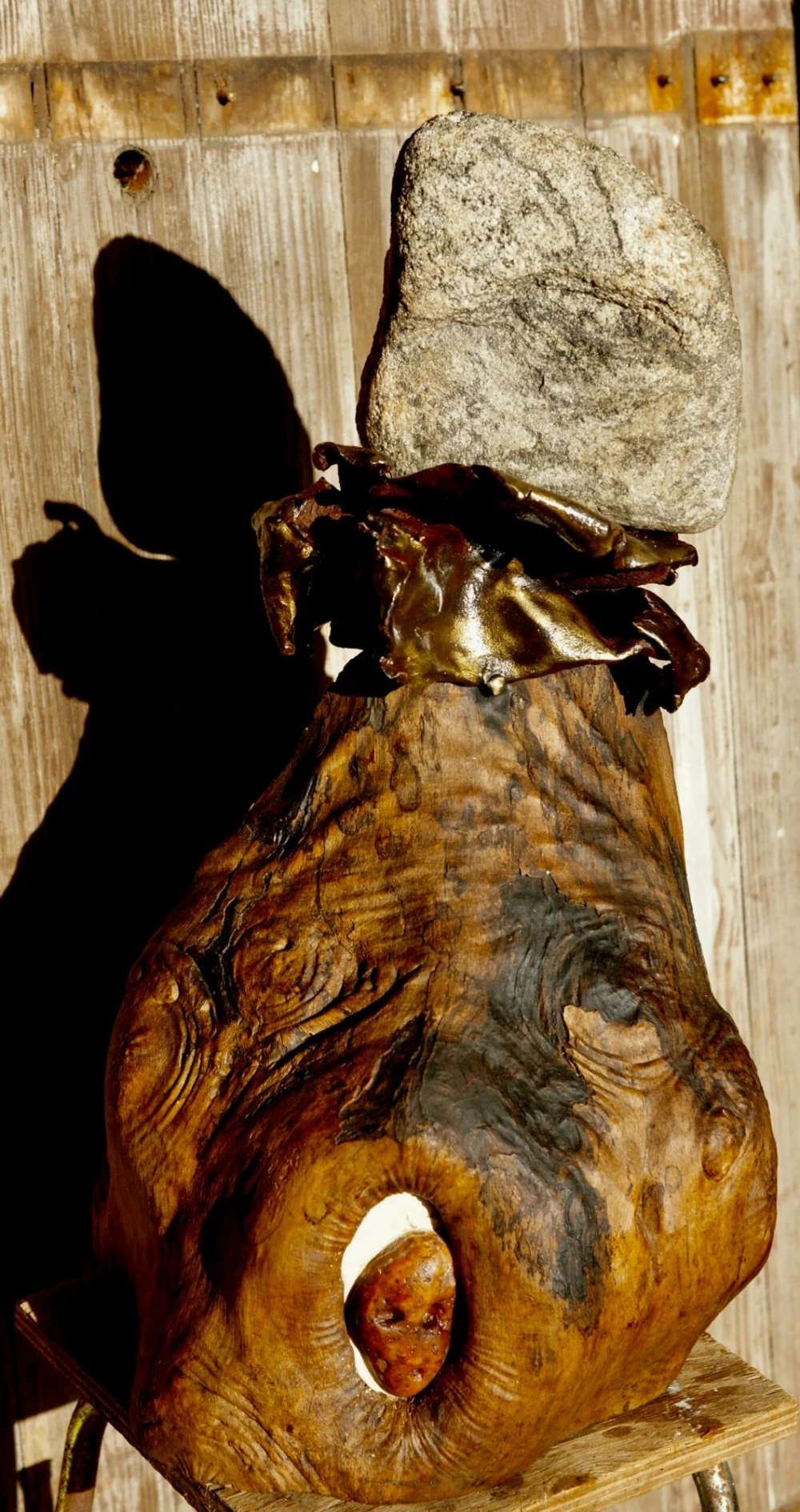
The Patriarch
Burl wood, stone, metal
He is as old as the wood makes him, centuries of growth in a spiral, of resistance to the seasons. The stone on his head is his crown, not of a king but of a wise man. The metal that rings his neck is the memory of every wound he has survived.
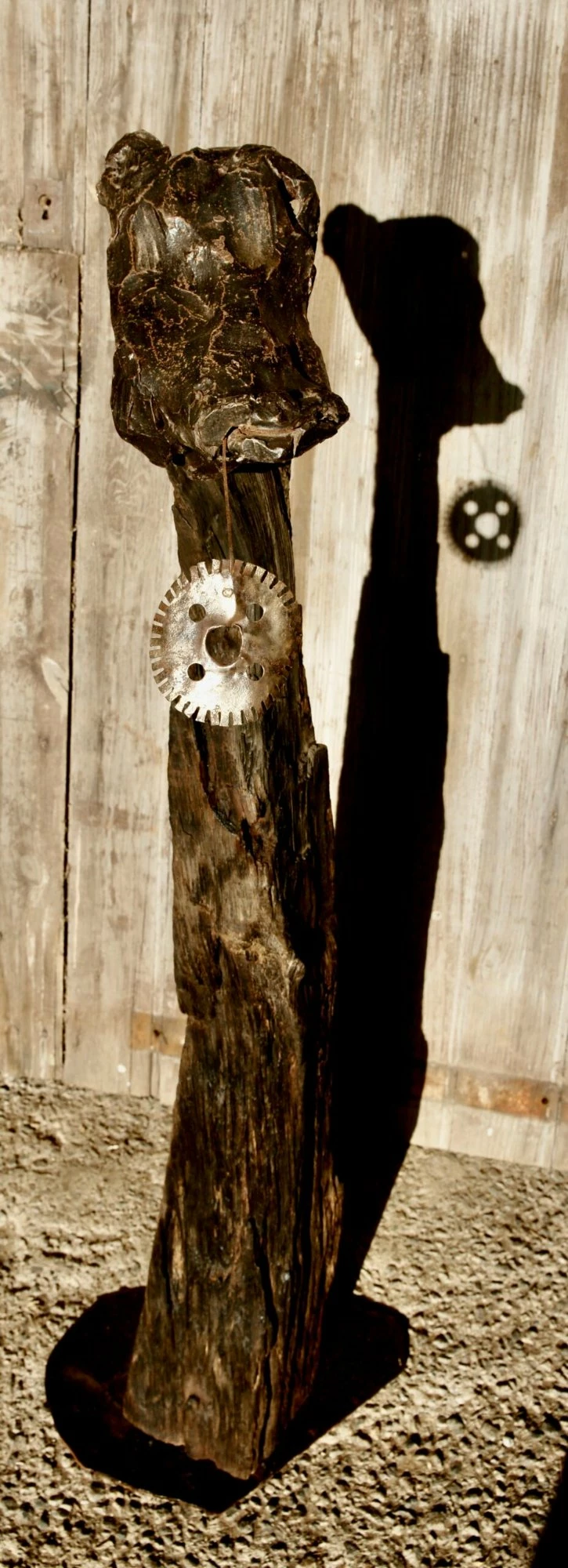
The Watchman
Driftwood, steel gearwheel
His toothed wheel is his heart, a mechanism suspended between two states. The dark wood is his body, worn out by one vigil after another. He is not waiting, he is watching. The difference is essential, the watchman does not hope that things will change, he makes sure that they last.
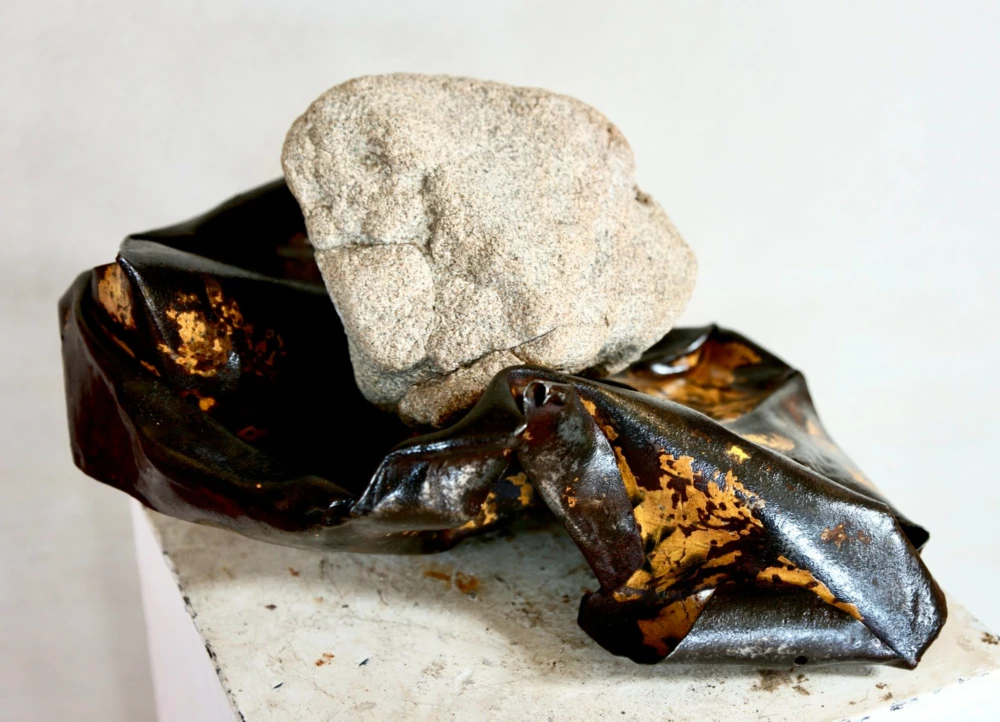
The Bed of Stone
Gold and black sheet steel, granite
The sheet metal unfolded to receive the stone, an improbable gesture of tenderness in materials that have no reputation for softness. Set directly on the ground, this bed of stone says that even the hardest matter needs, sometimes, to let itself be carried.
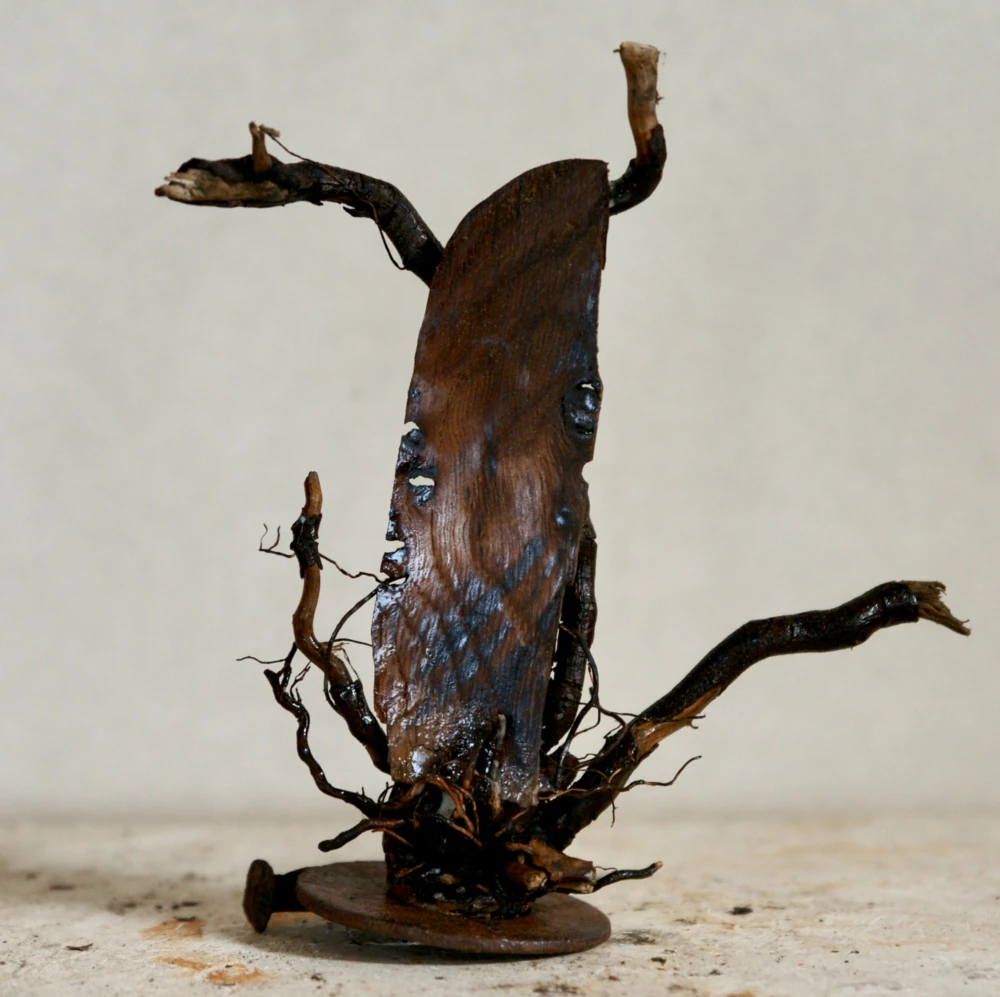
The Face of Sap
Wood, roots, metal
In wood there is always a face waiting to be released. The roots that spring from its base are its thoughts, tangled, alive, impossible to unravel. This face of sap was born of the forest and it keeps within it the memory of everything it has been through.
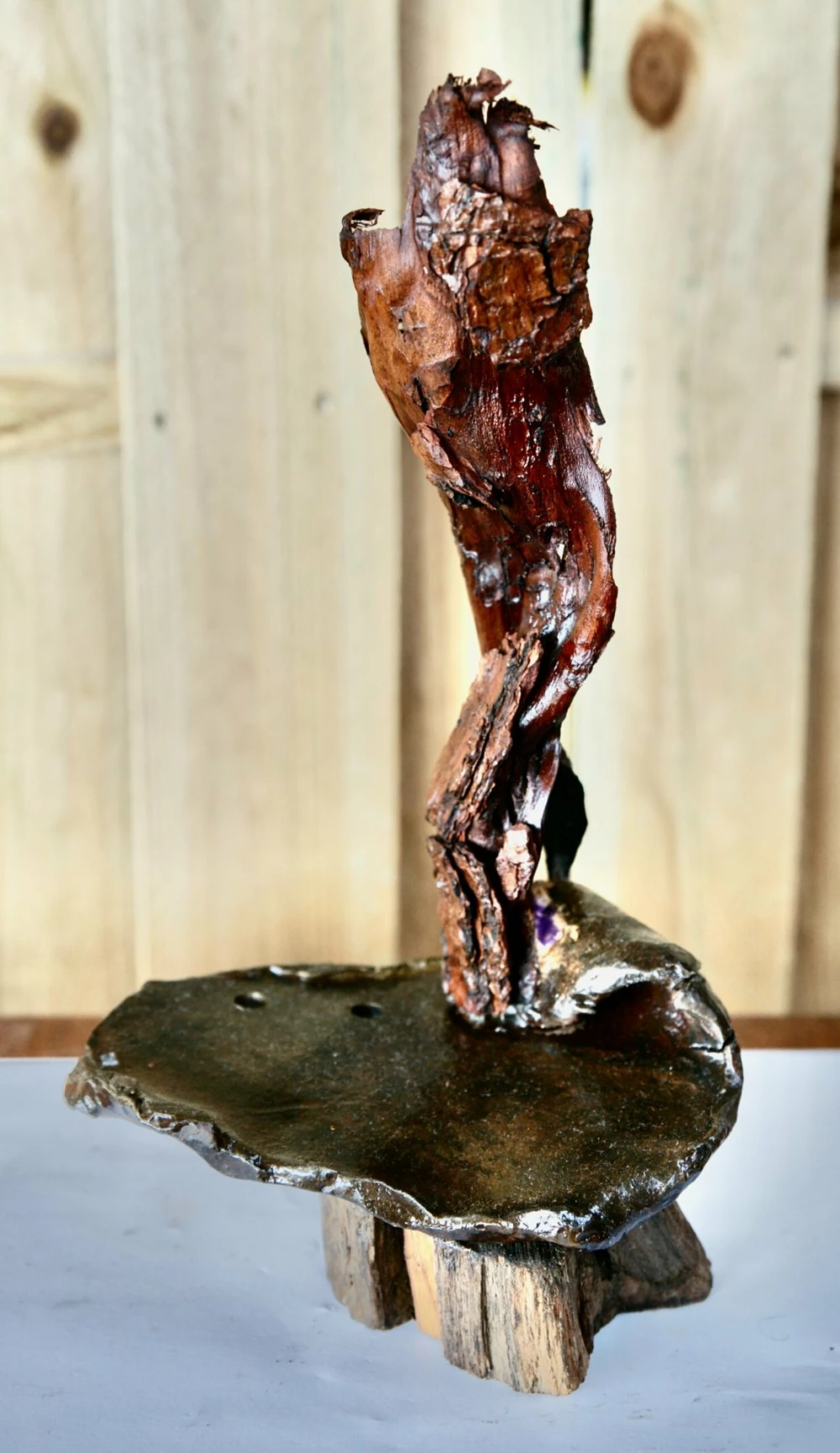
The Ascent
Twisted wood, schist, amethyst
The wood rises in a spiral from the slab of black schist. In the hollow of the stone a violet amethyst shines like a hidden secret. Ascent is not a vertical movement, it is a gradual transformation, like wood twisting upward towards a light it will never see but always seeks.
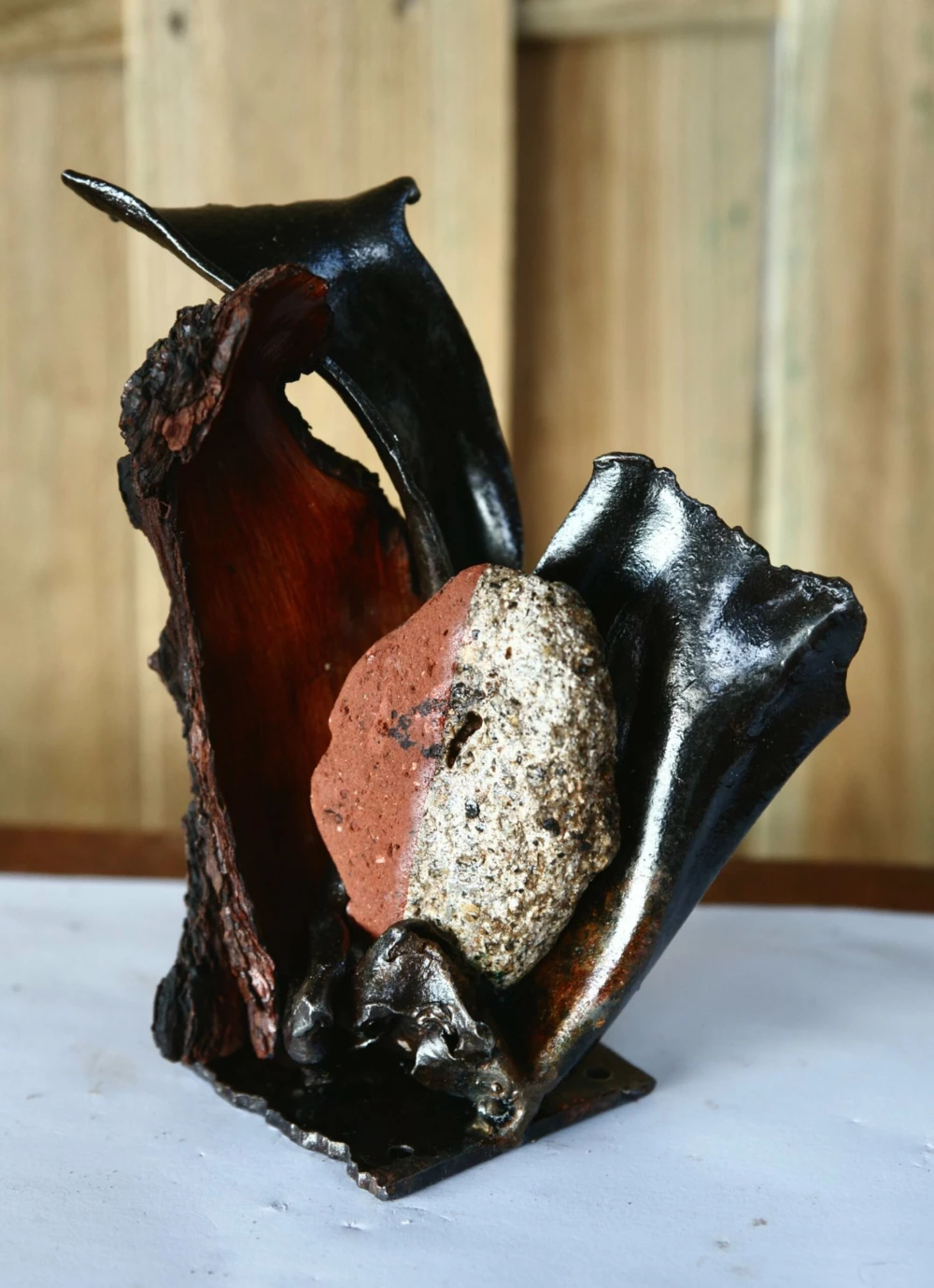
The Meeting of Materials
Wood, lacquered metal, red sandstone
The wood comes from the forest, the sandstone from the beach, the metal from the forge. They had no reason to meet here, and yet, under Le Caer's hands, they found a common language. The meeting of materials is a lesson for men.
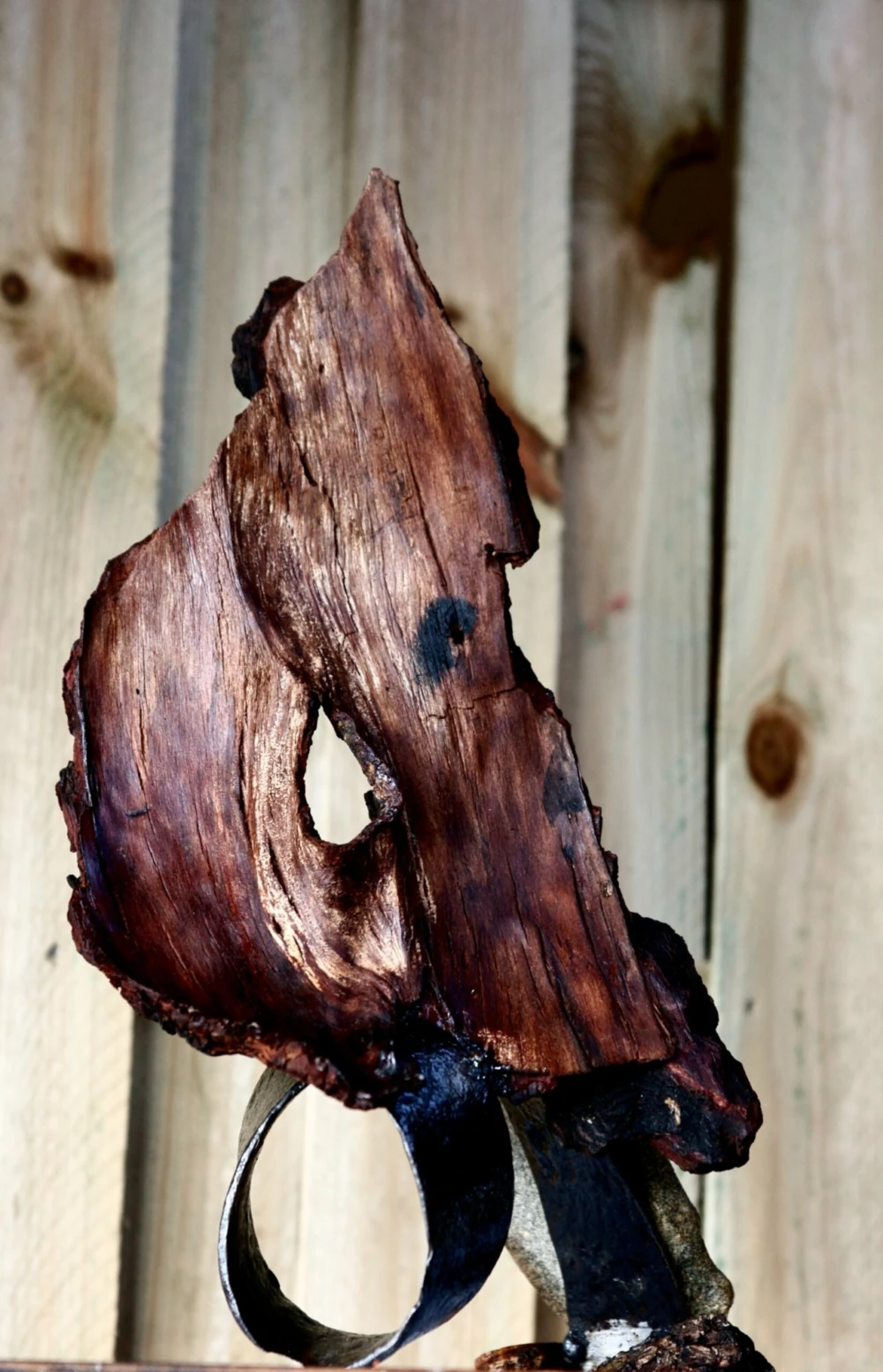
The Vault
Wood, curved metal
The vault is the architectural invention that made cathedrals possible, force distributed around the circle, lightness obtained through tension. This sculpture is its distilled soul, wood pierced like a window onto the infinite, metal curved like a prayer.
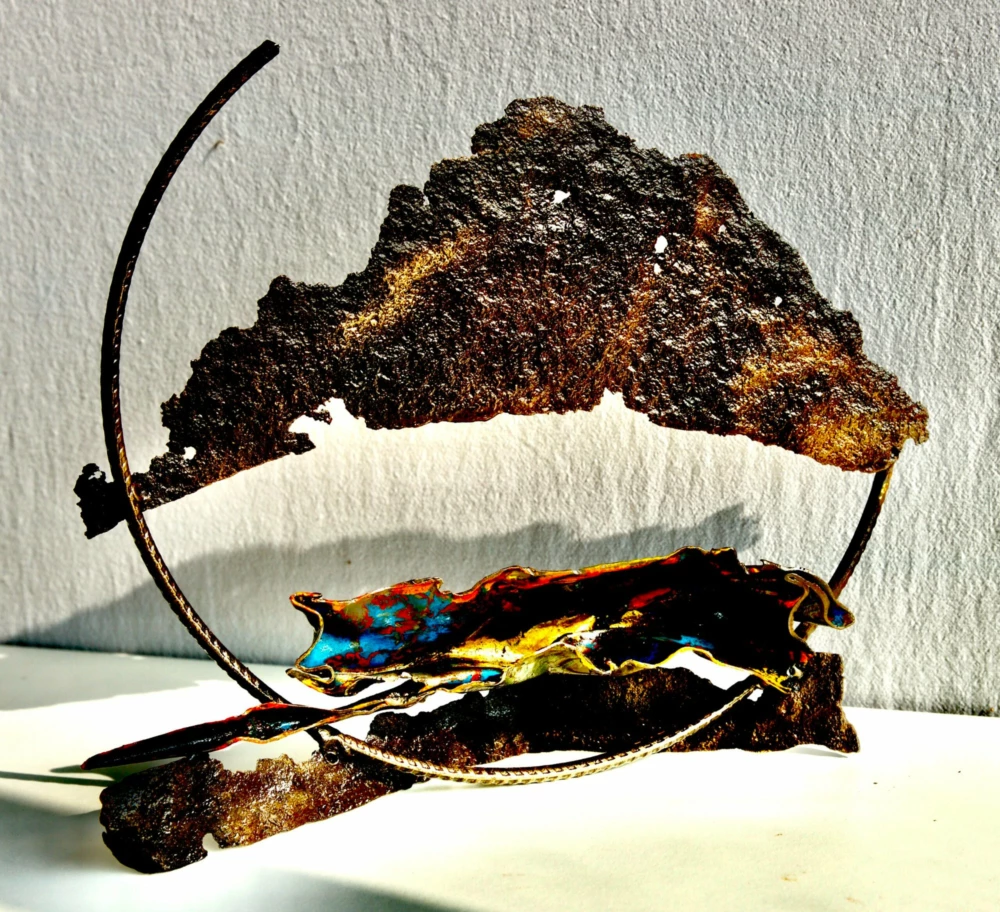
The Horizon
Rusted metal, multicoloured enamel, steel rod
The horizon is not a border, it is a promise. The crust of oxidised metal floats above the enamelled glow like sky above a troubled sea. Blue, red, gold, all the colours of the end of the day. The steel rod traces a line that no one will ever truly cross.
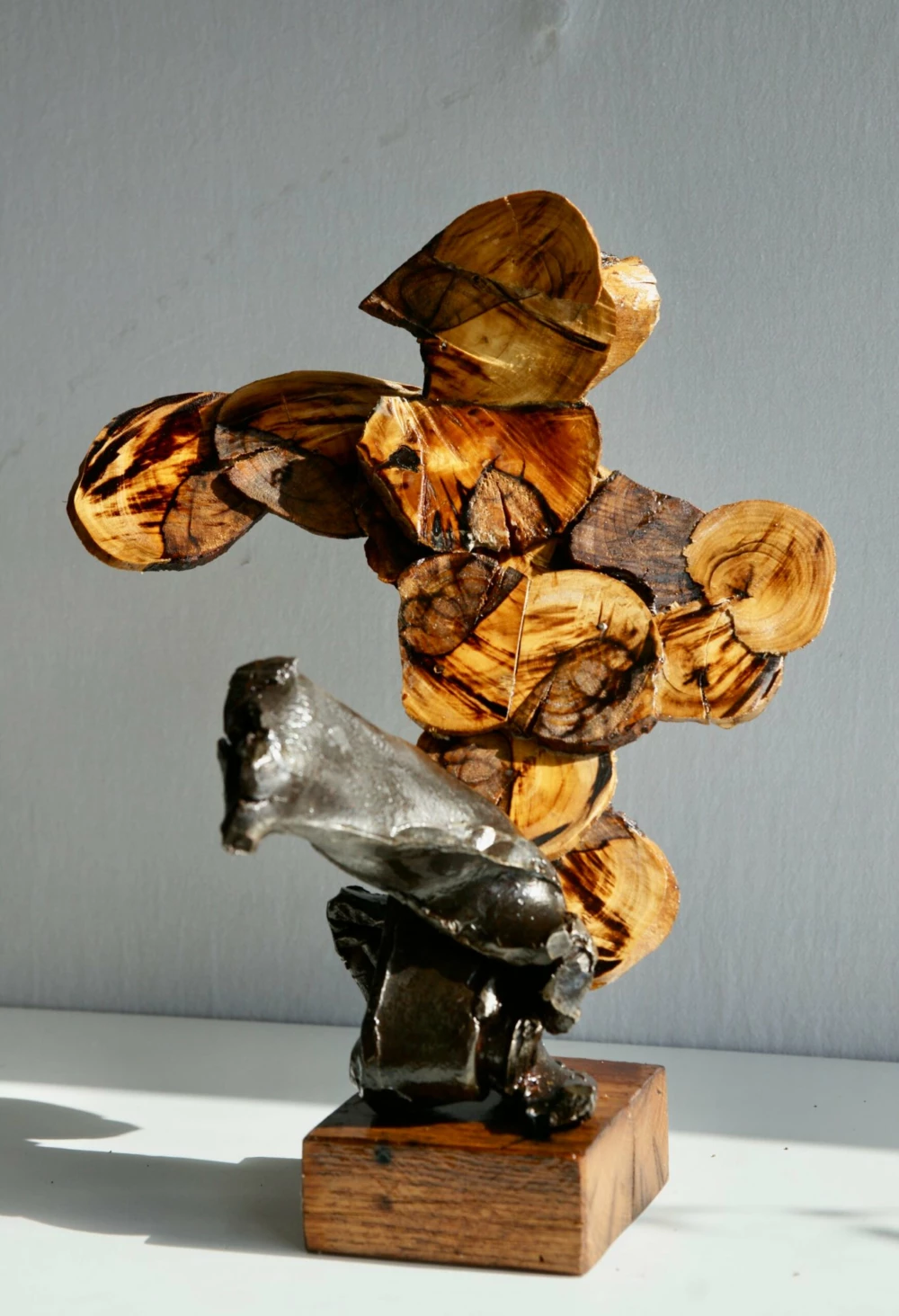
The Wrestler
Wood discs, cast metal
Each disc is a section of life, a slice of time the tree has lived through. Assembled into the body of a wrestler, they form a composite being whose strength comes not from muscle but from accumulation. The metal gives him his feet, the earthing of one who does not intend to fall.
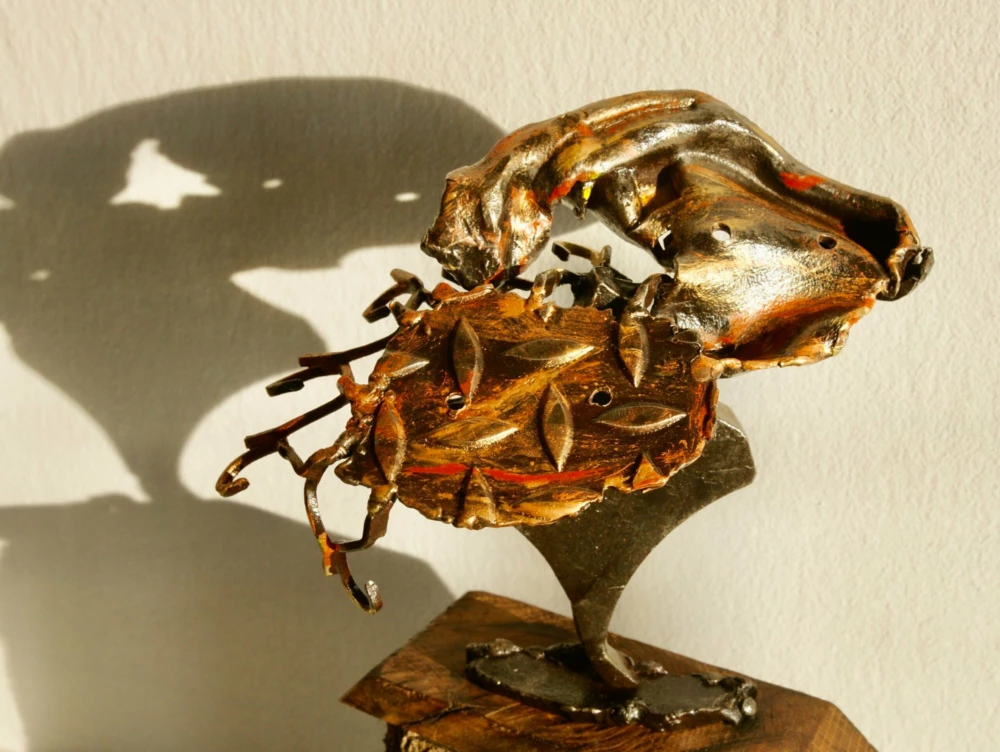
The Golden Beast
Gold and orange sheet steel, chiselled metal
She tilts her head with a grace that belongs to predators alone. Her coat of orange steel burns like heated metal, and the patterns chiselled into her flank look like eyes that never learned to blink. The golden beast is beautiful and dangerous, as all true beauty is.
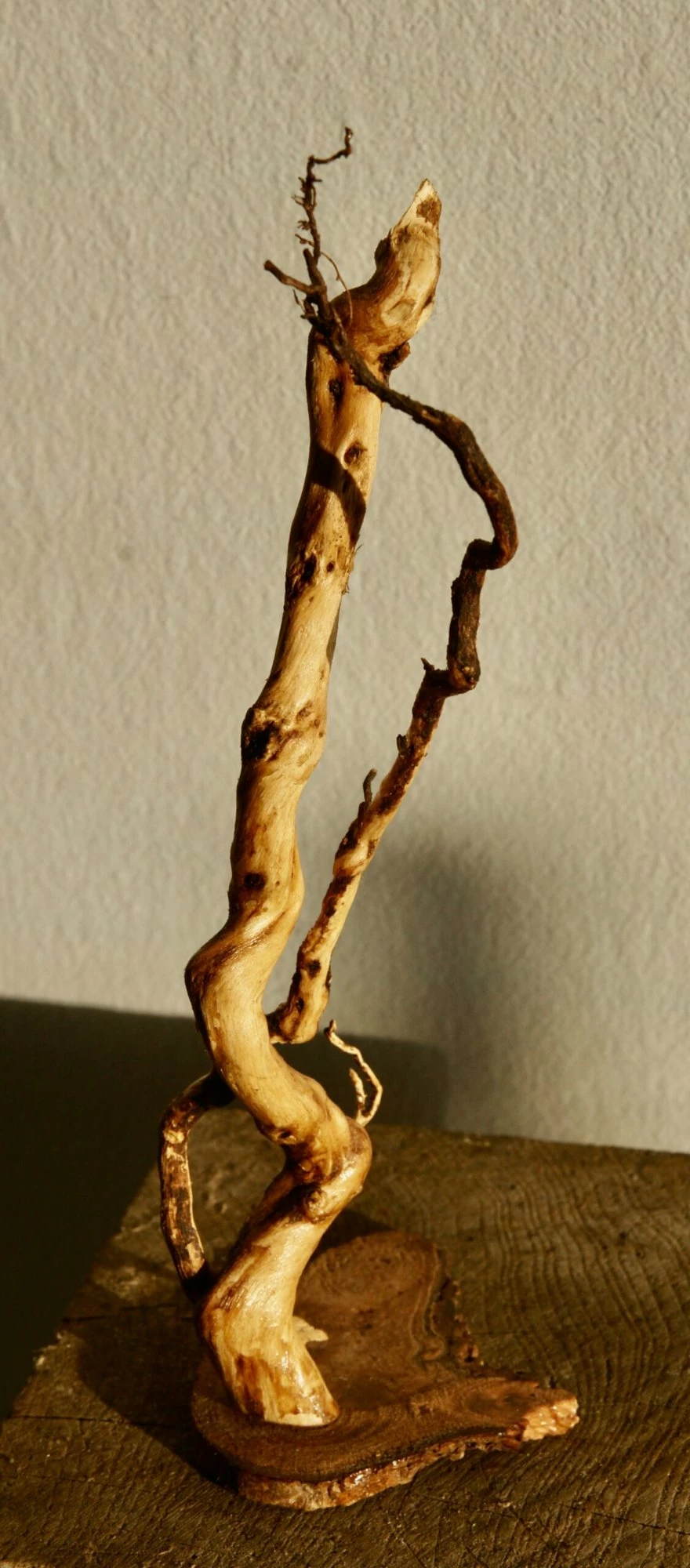
The Dance of the Roots
Natural wood, twisted roots
No one sees roots dance, they do it in the darkness of the earth, in silence, over decades. Le Caer brought them up out of the ground and revealed that secret movement. This twisting is not suffering, it is the choreography of underground life.
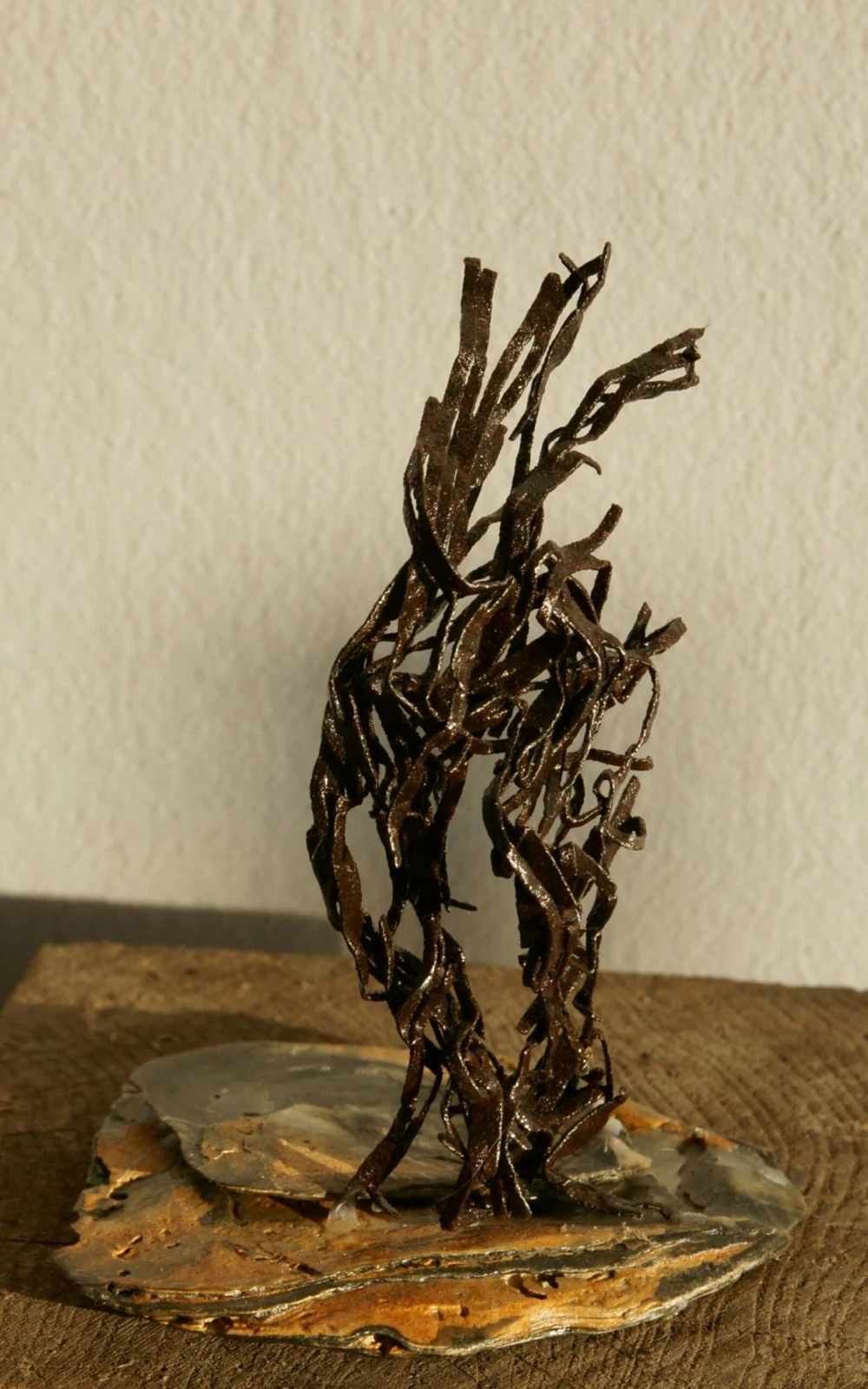
The Iron Forest
Metal strips, schist
Each strip is a tree. The iron forest knows no seasons and fears no fire, yet it carries within it the same stubborn verticality as a real forest. From the slab of black schist, these stems of rust rise towards nothing but the light.
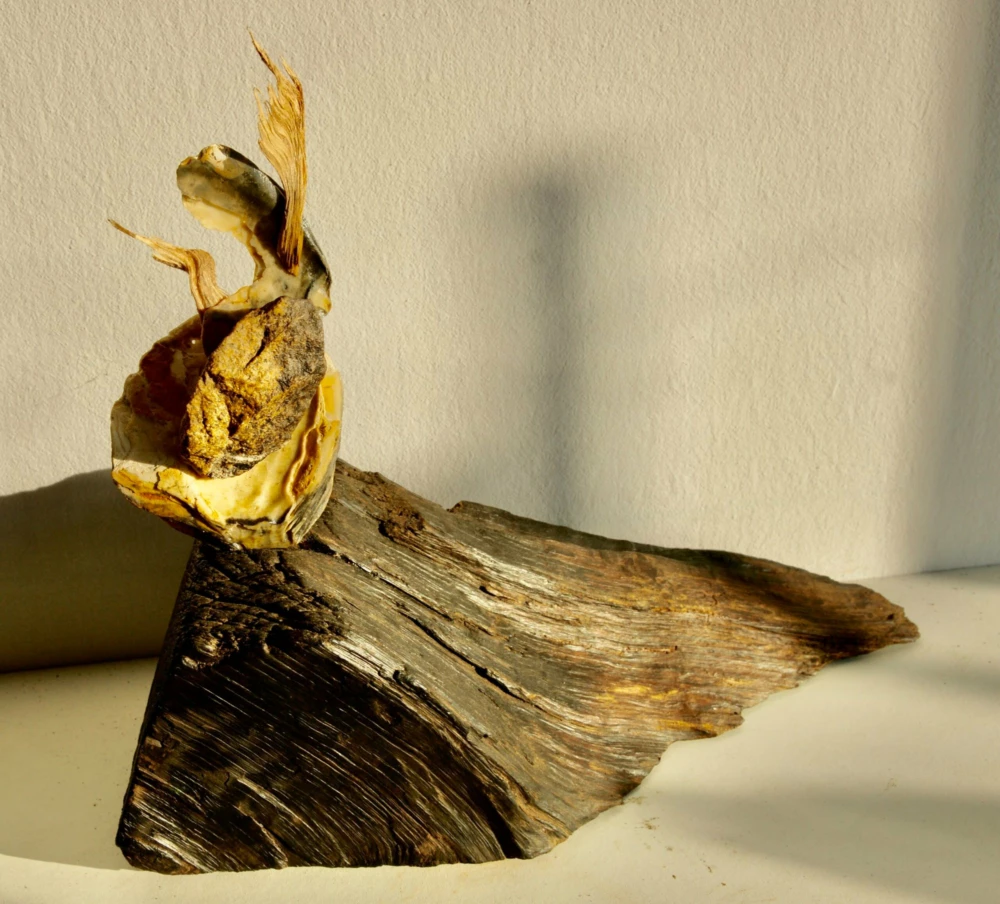
The Offering
Driftwood, oyster, golden fibres
On wood that has known every sea, an oyster has been placed the way one places an offering on an altar. The golden fibres that spring from it are the flame of that willing sacrifice. To give something precious, that is the opening gesture of every sincere relationship.
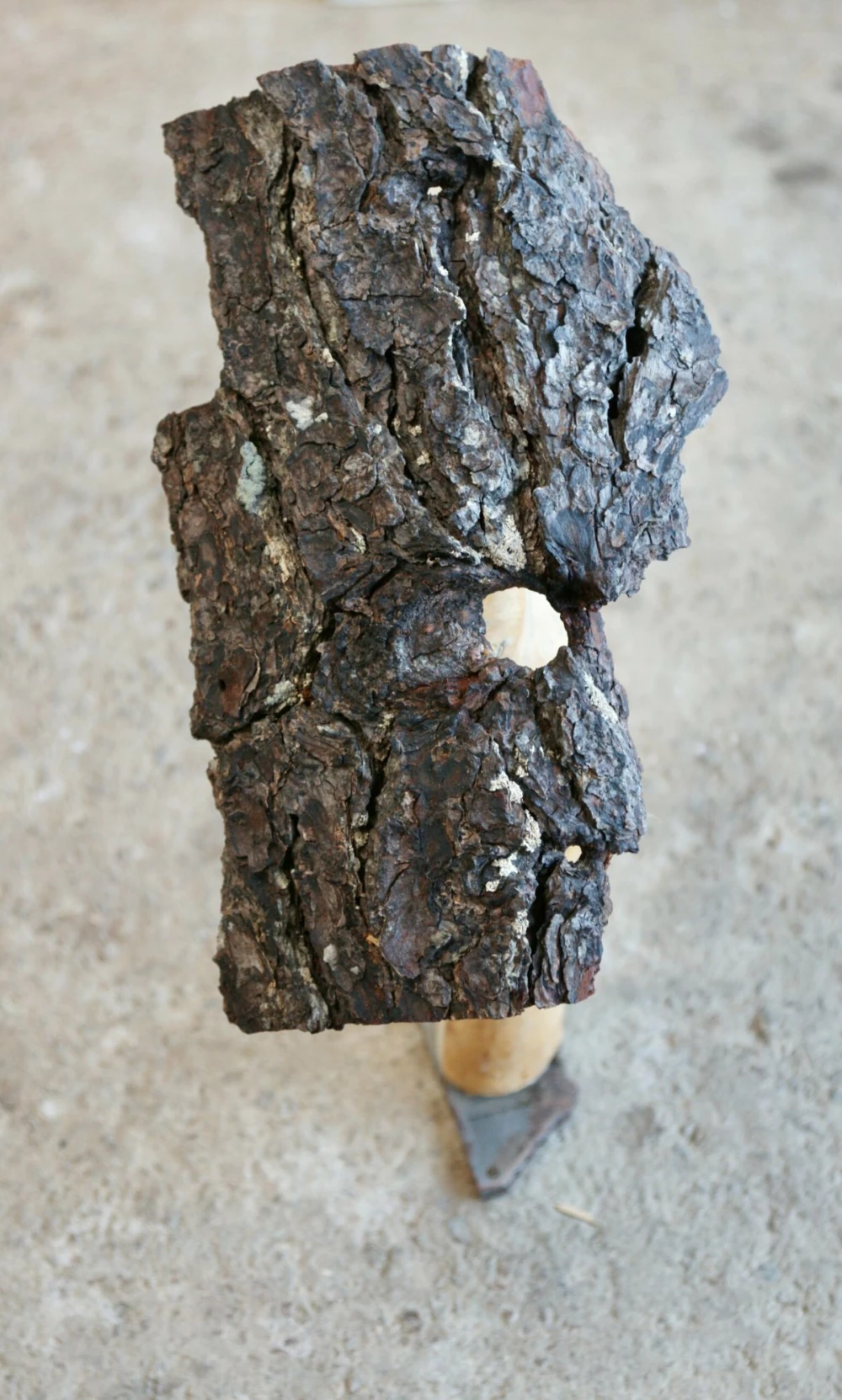
The Bark
Cork, wood, metal
« The Bark » is an original sculpture by Pierre Le Caër. A
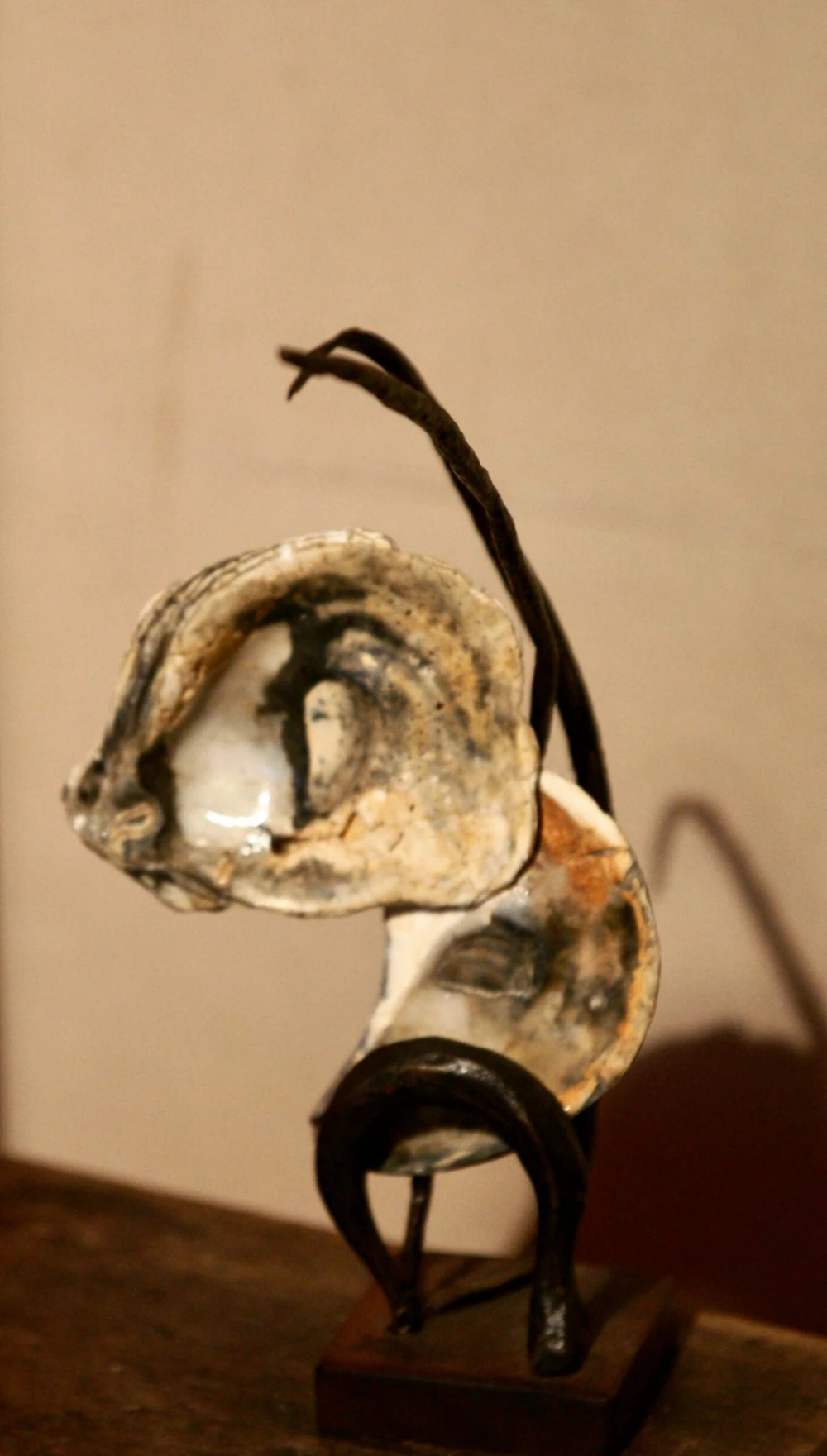
The Mother of Pearl Dancer
Oyster shells, forged metal
The oyster shells stack up with an unintentional grace. The metal lifts them and sets them turning. This dancer does not move, and yet something in her is perpetually in motion, as though the mother of pearl still held the memory of the waves.
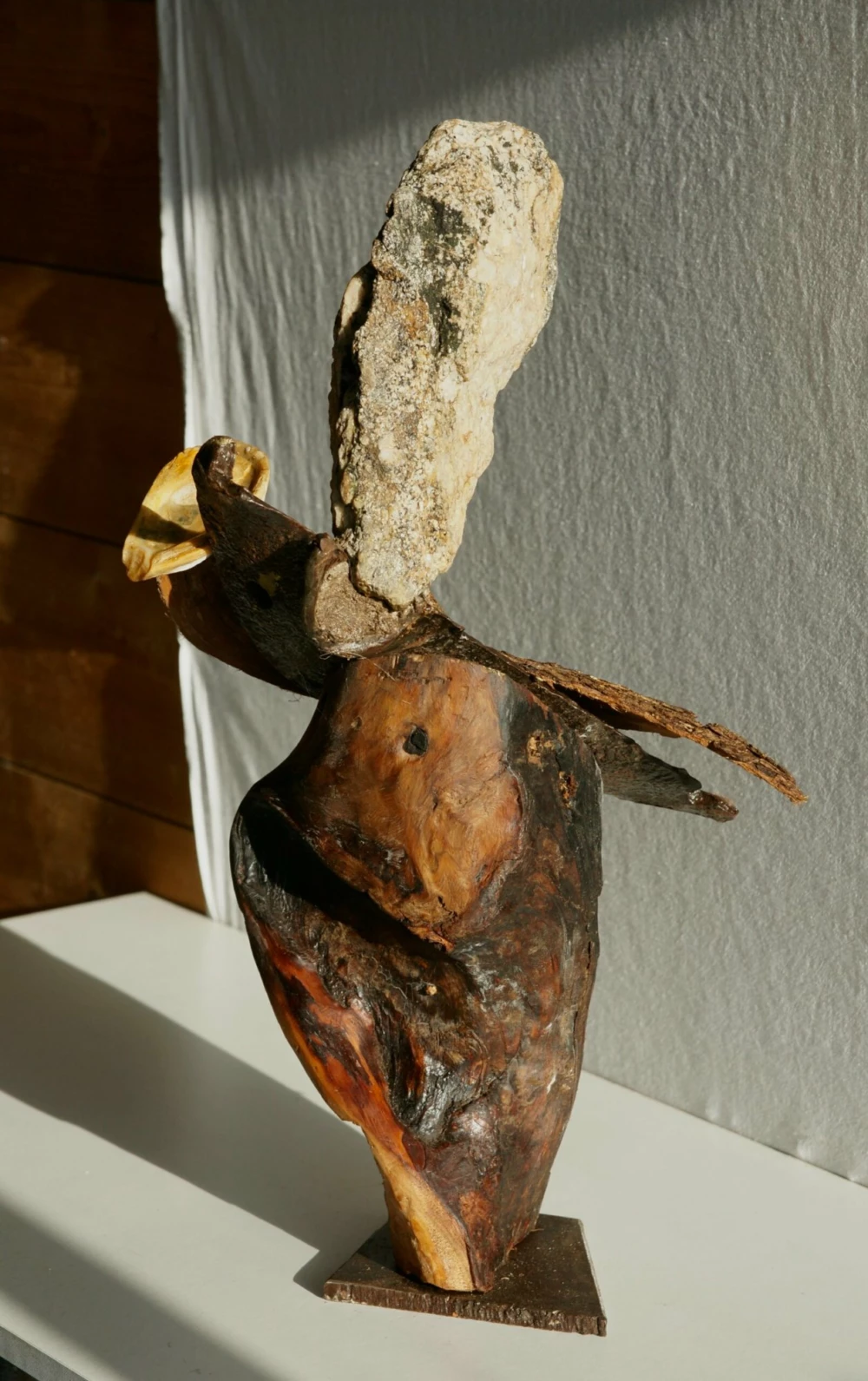
Atlas
Burl wood, stone, bark, metal
He carries the world, and that world is a stone standing in impossible balance on his shoulders of varnished wood. But unlike the titan of mythology, this Atlas does not suffer, he has accepted the weight as self-evident. Perhaps that is what real strength is.
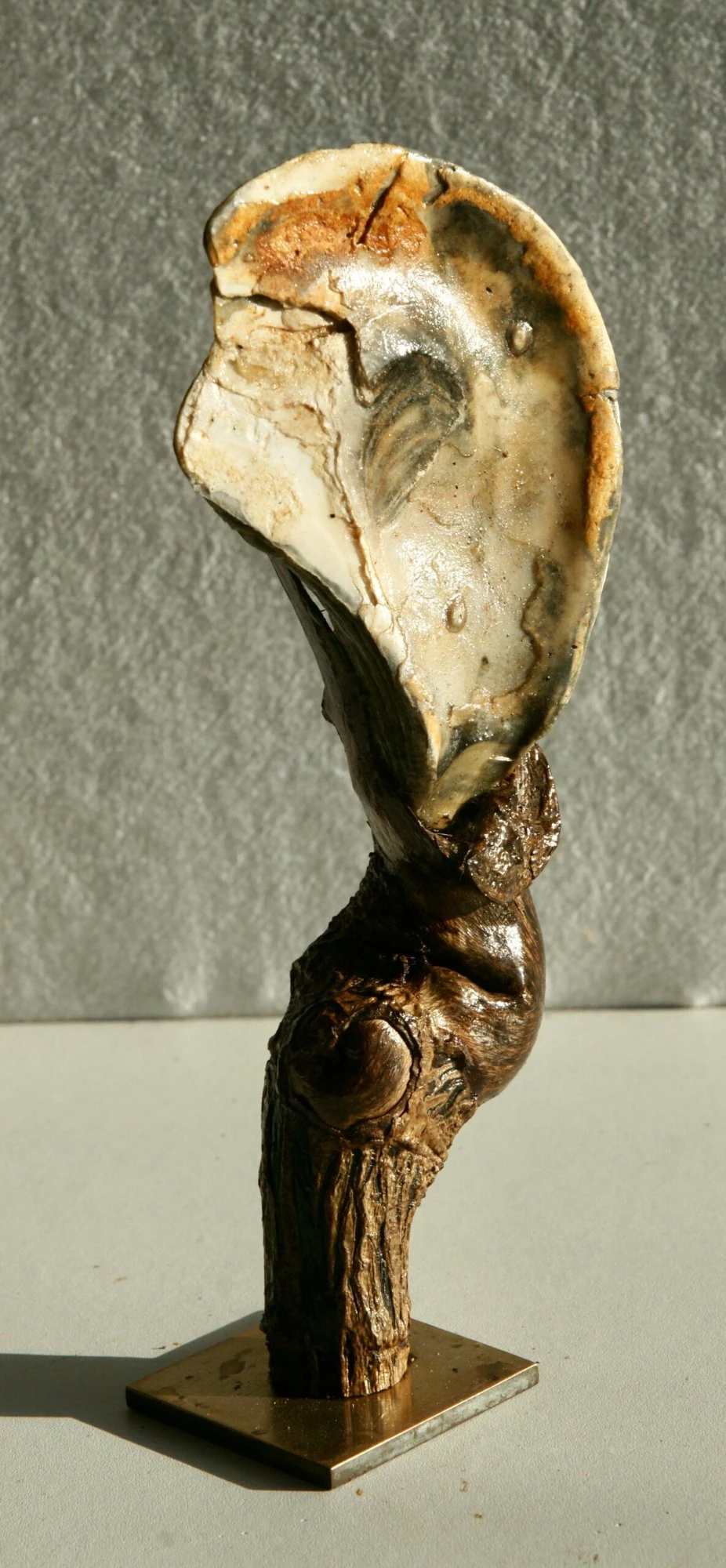
The Cup
Bronzed wood, pearly oyster shell
The oyster shell is the first natural vessel, the one prehistoric people used before inventing pottery. Here, set on a bronzed trunk like a chalice on an altar, it becomes again what it always was, a container for what is precious.
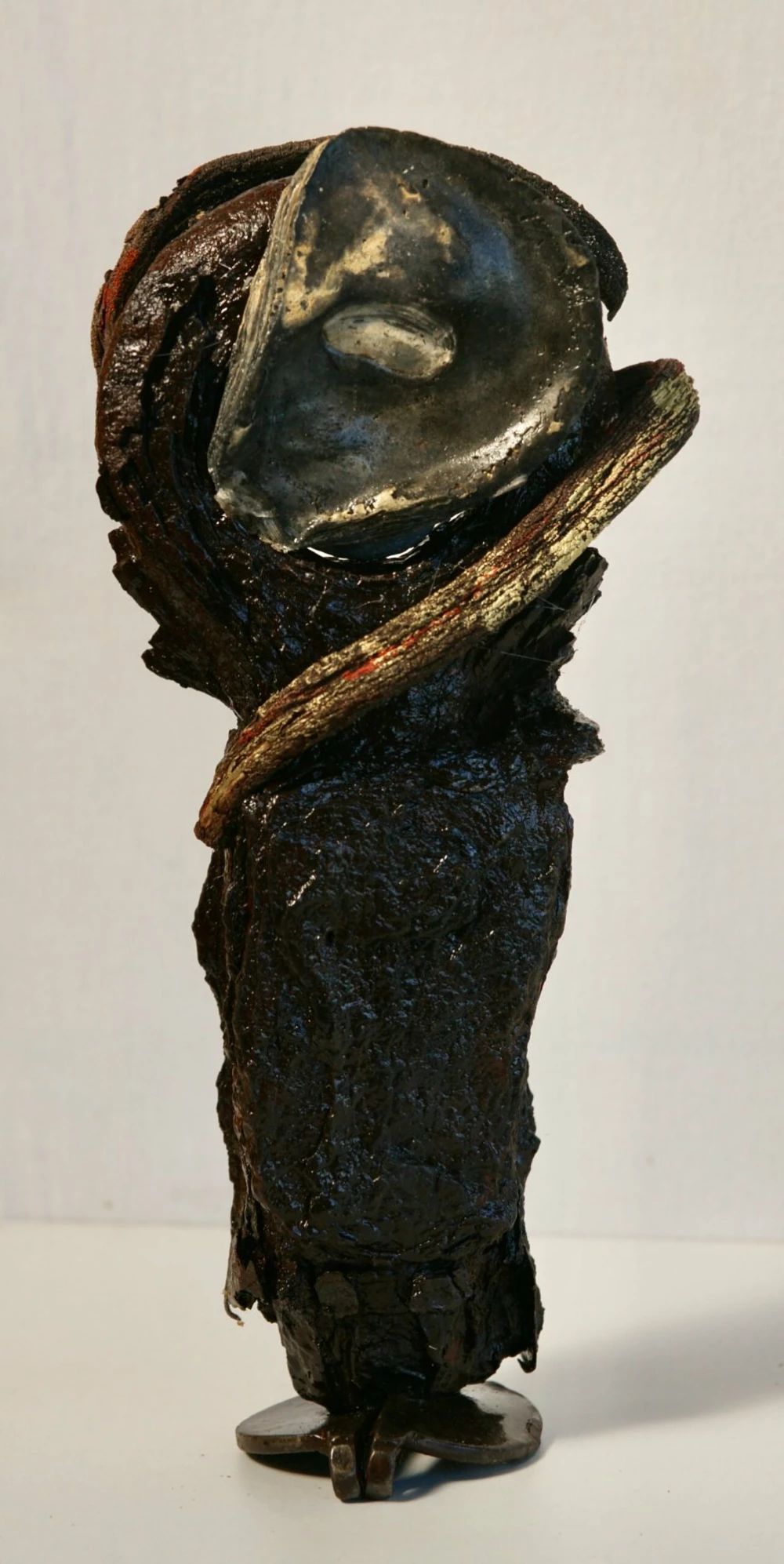
The Ferryman
Black lacquered metal, oyster shell, enamelled metal
There are figures whose role is to carry others across, across rivers, across nights, across grief. This ferryman of metal and shell wears his face of mother of pearl like a mask, or like a revelation. He is waiting for us on a shore with no name.
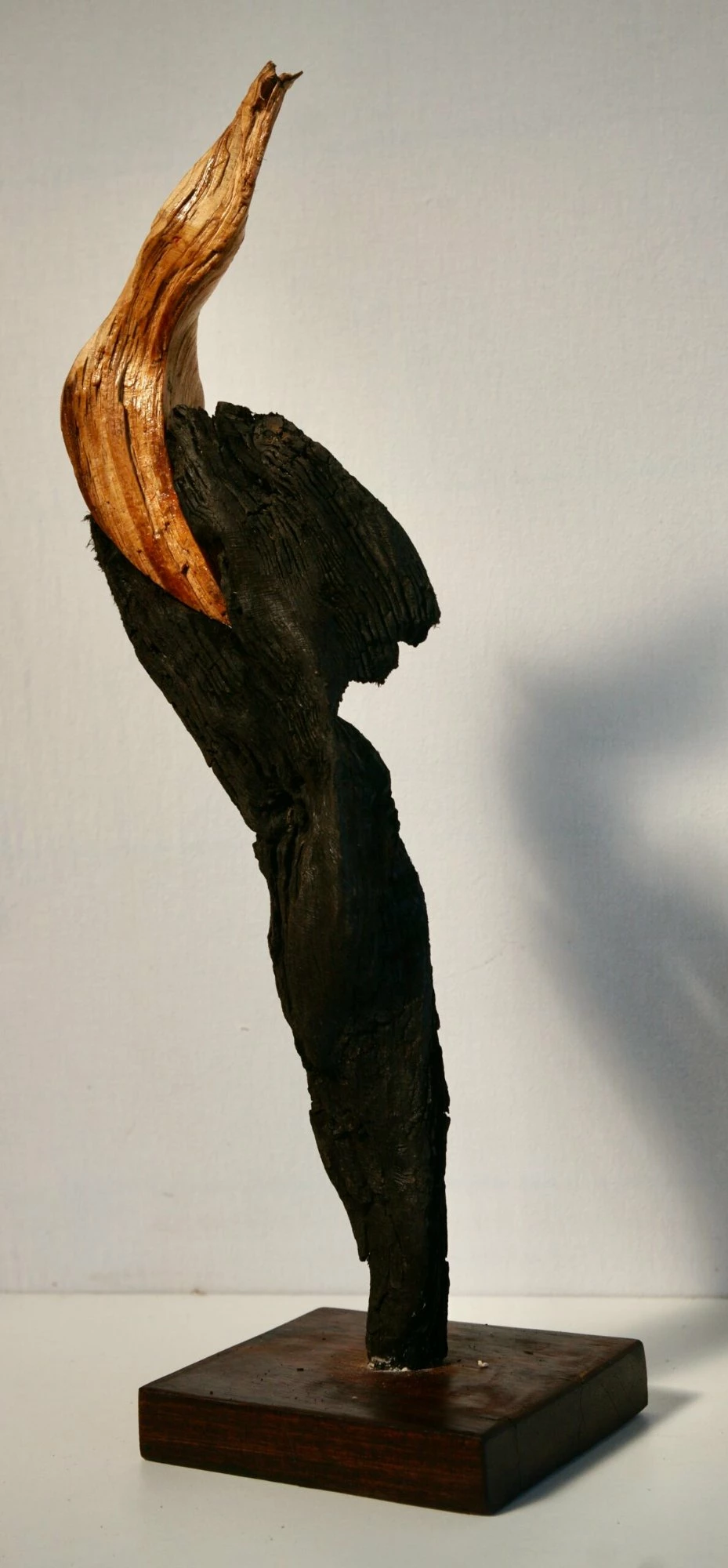
The Flame
Burned and natural wood
The wood burned, and in that burning it found its final form. The black part is the memory of the fire, the pale part is what came through it. Together they form that particular flame which is neither the blaze nor the extinction, but something between the two.
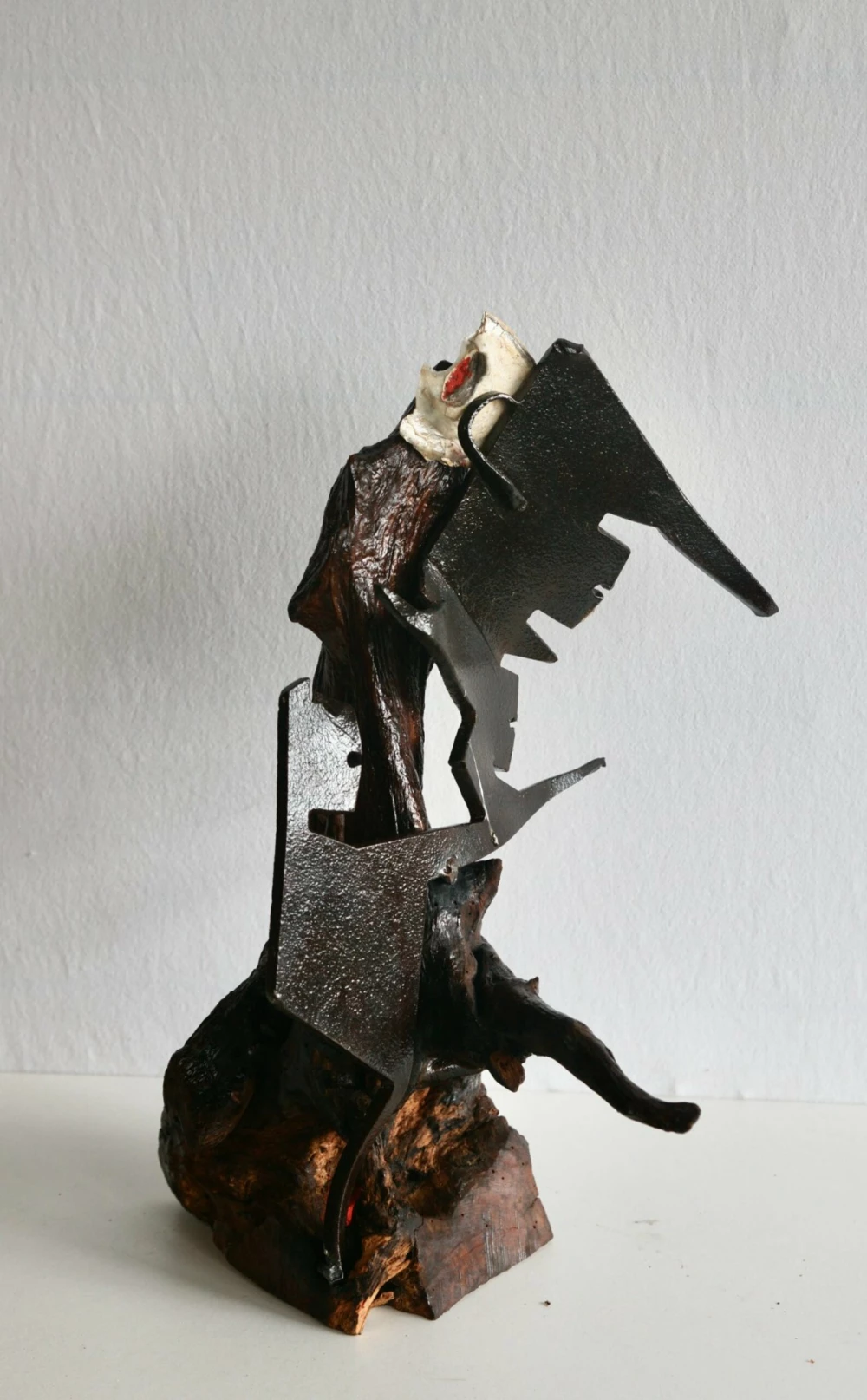
The Wounded City
Burl wood, cut metal, enamelled metal
The jagged skyline of a city that has known violence. The white mask with the red eye is the face of those who remain afterwards, neither quite alive nor quite dead, but present, stubbornly present. The wounded city does not disappear, it transforms itself.
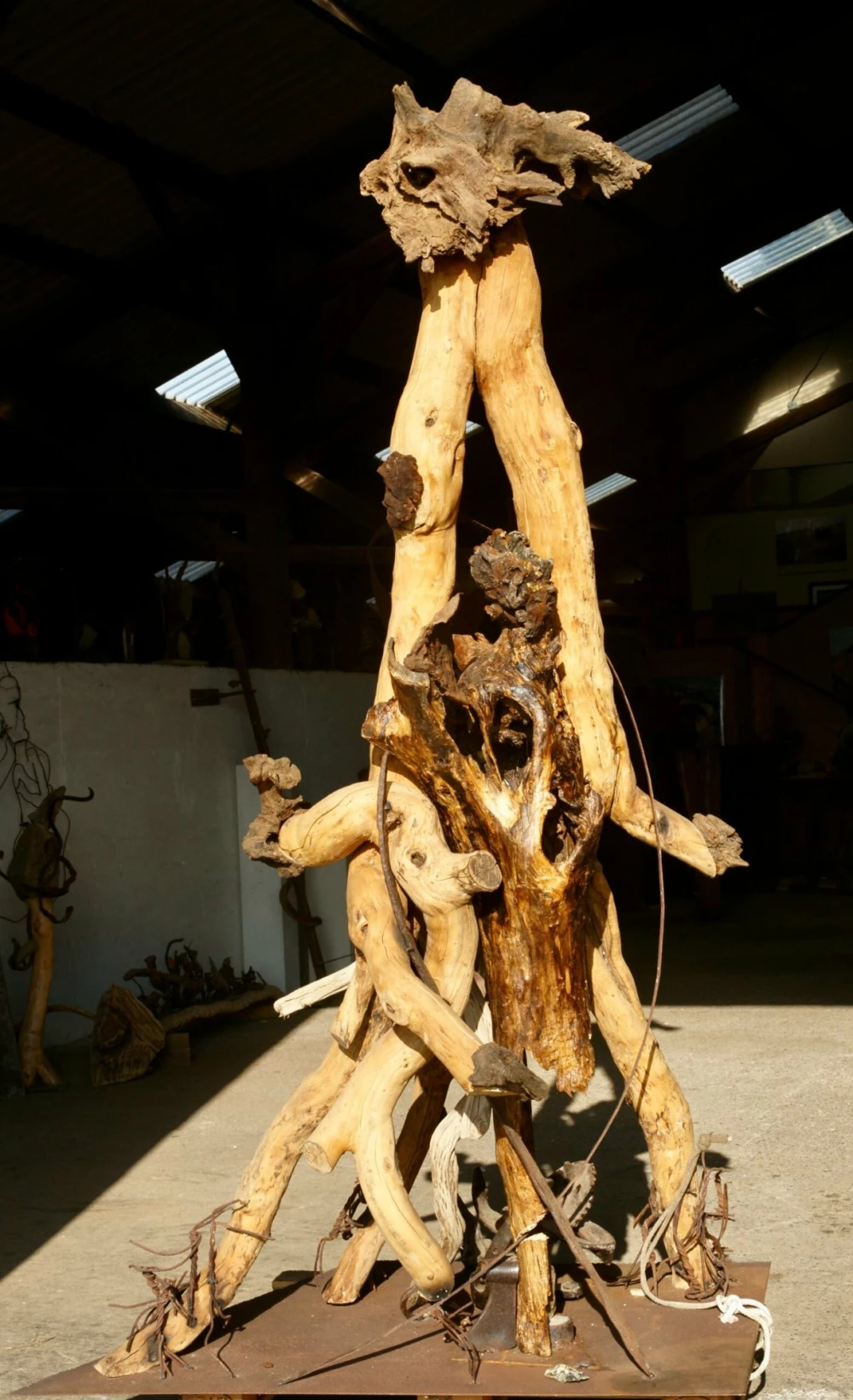
The Great Tree
Driftwood, oak, metal, wire
You have to step back to see it whole. This monumental sculpture gathers woods from every history, the coast, the forest, the hundred-year-old oak, into a tree that never existed in nature but that contains its essence. The metal branches are its dreams.
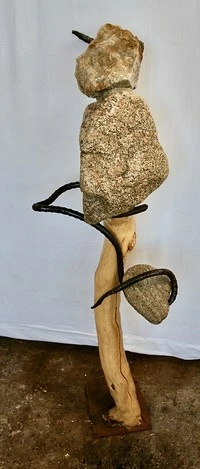
Dream of Stone
Driftwood, stones, twisted metal
Stones dream, of that there is no doubt for the man who has sculpted them. In this dream they thread themselves onto a twisted axis and float above the ground as though gravity had agreed to a truce. To dream of stone is to dream of permanence.
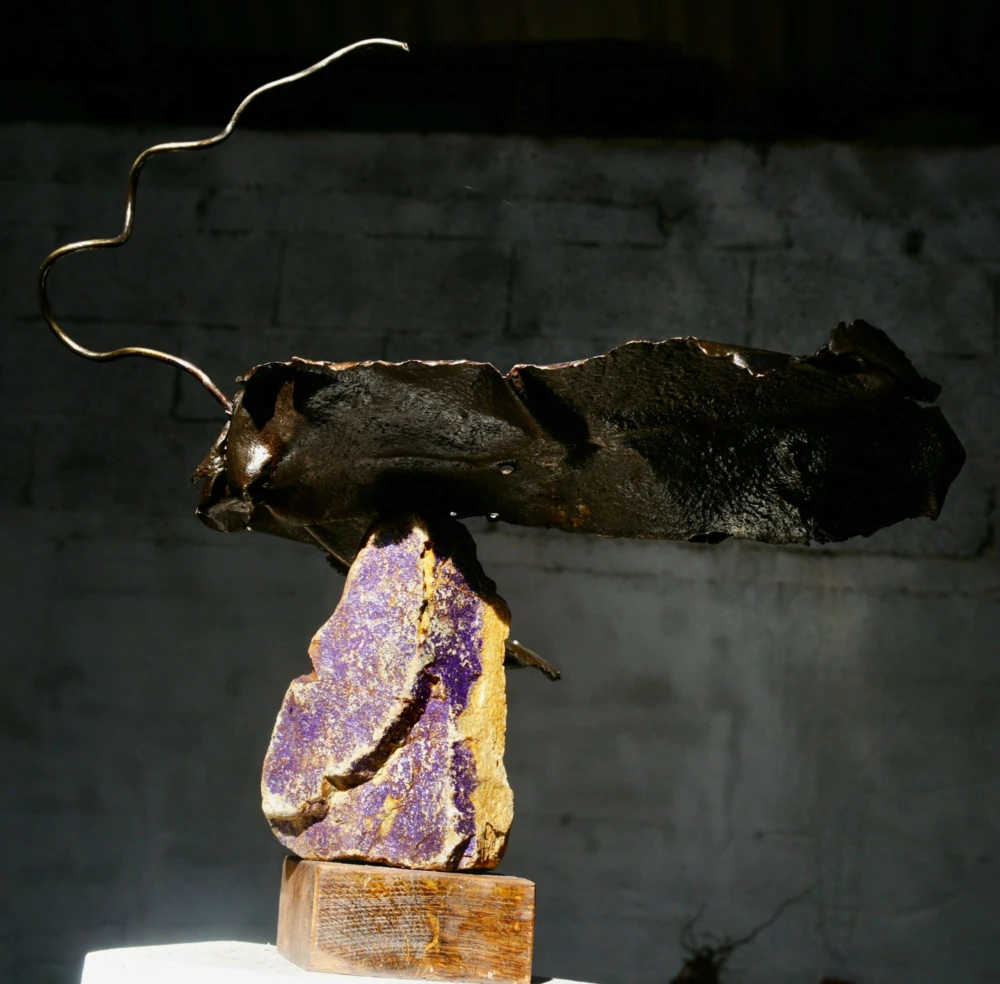
Hope
Amethyst, black sheet steel, copper wire
The violet stone is precious, the amethyst people once wore to keep the mind clear. Here it is carried by black metal like a horizontal flag, immense in relation to what holds it up. Hope is always larger than what carries it.
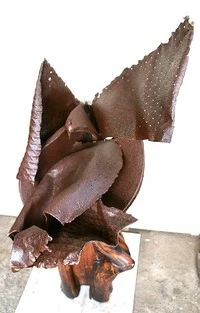
The Wounded Bird
Sheet steel, burl wood
The wings have crumpled, but they have not disappeared. Le Caer's wounded bird refuses to fall entirely. The sheet metal keeps the shape of flight even in the accident, even in the fall. It is perhaps the bravest of birds, the one that is still trying.
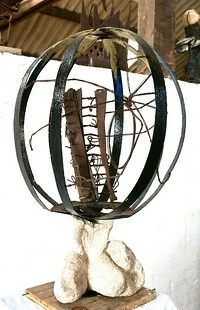
Prayer for the Suburbs
Metal, forged sphere, stone, wood
A sphere of metal suspended between stones, the image of a world seeking its balance between the brutality of concrete and the dignity of people. This prayer is not addressed to God, it is addressed to the men who have the power to change what the prayer asks for.
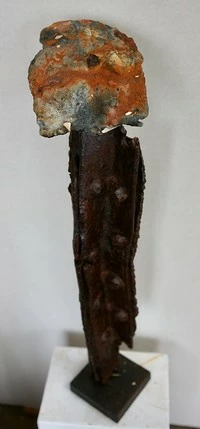
The Red Totem
Rusted metal, red ochre stone
Rust is not the death of metal, it is its moult, its patina, the colour it chooses when left in peace. The ochre stone, from the same family of reds, is its head. This totem does not protect a tribe, it bears witness to an era, to a chemistry, to a colour of time.
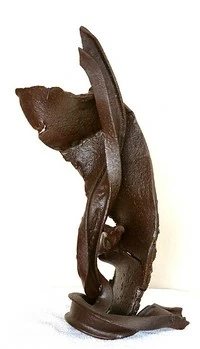
The Dive
Sheet steel, wood
The body of sheet metal curves downward, towards imaginary water, towards the bottom. This dive is an act of absolute trust, trust in momentum, in one's own capacity to pass through whatever waits below. Le Caer has sculpted the courage of the leap.
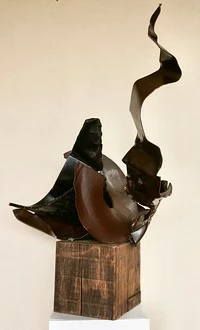
The Spiral and the Breath
Metal, cut sheet metal, wood
The metal spiral rises in a whirl while the cut sheet opens like a lung. There is something respiratory in this sculpture, an expansion, a contraction, the fundamental rhythm of everything that lives.
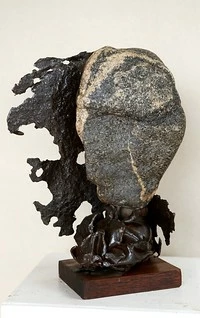
The Sentinel
Stone, wood, metal
Standing at her post for a long time, long enough for the stone to have become her head and the wood her body. The sentinel does not move. She observes. And in that stillness she accumulates a knowledge that movement will never reach.
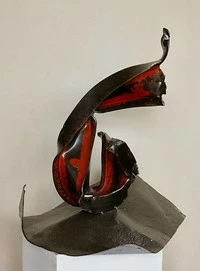
The Inner Cry
Sheet steel, red enamel
In the fold of the metal, something is burning. It is not a wound, it is a voice the iron captured before it could escape. The red bleeds between the folds like a truth held in too long. The inner cry is the loudest because it has nowhere to go.
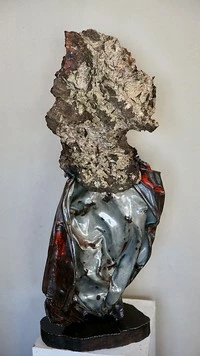
The Cloak of Stone
Cork, enamelled sheet steel
The bark has become armour, the metal has become skin. This faceless bust wears the world like a garment too heavy for it, and yet it holds. Dignity needs no face to be recognised from a hundred paces.
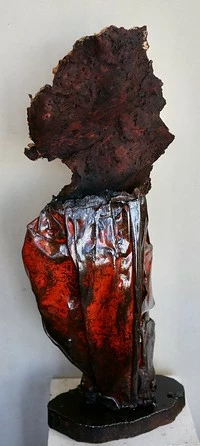
The Column of Fire
Lacquered sheet steel, burned wood
There are columns that hold up temples. This one holds up the invisible, the memory of a flame, the trace of a breath. The red does not shout, it radiates. The column of fire guides those who have agreed to lose their way.
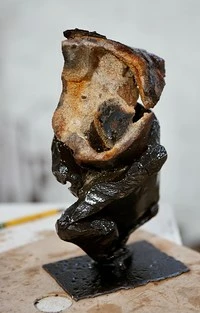
Thought
Stone, cast metal
The stone reflects. The metal supports it in that silent effort. Together they form what we call a question, the one we put to matter when we no longer know what to ask of people. Thought does not need a brain, it needs time.
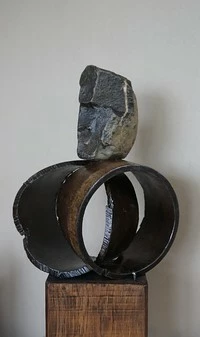
The Rings of Time
Stone, steel cylinders, wood
Two interlocking circles carry a stone the way one carries a memory. Time goes round in circles, but it carries something. This sculpture is a clock that measures nothing, except the length of a gaze resting on it.
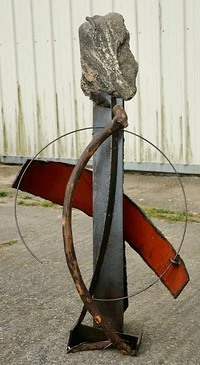
The Cross of the Winds
Forged metal, patinated sheet metal, wire
The four directions cross here, and at the centre, a raw stone like an oracle. Rust is a colour, orange is a season. This sculpture is a compass for those who have lost their bearings but not the wish to find themselves again.
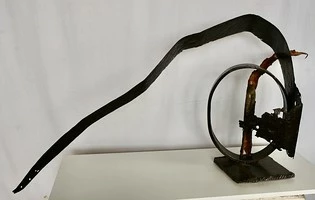
The Sickle and the Echo
Forged metal, steel ring
A gesture suspended between the harvest and forgetting. The curved blade searches for something it will not find, and it is precisely that unfinished movement that gives the piece its strange beauty. The echo always answers, even in silence.
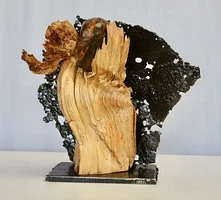
The Alliance
Pale wood, black lacquered metal
Wood remembers the forest. Metal remembers fire. Between the two lies the thing we sometimes call creation, and more often love. Alliance is the name we give to the accord between two natures that have no reason to resemble one another.
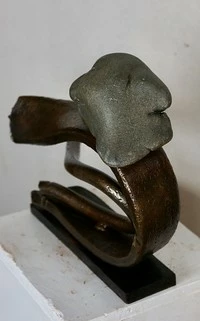
Suppleness
Stone, curved metal
The stone learns to bend. The metal learns to hold. In this improbable dialogue between rigidity and grace, Le Caer finds that rare moment when matter stops resisting and begins to dance. Suppleness is not a weakness, it is the intelligence of matter.
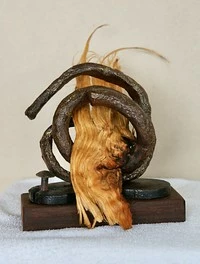
Shyness
Burl wood, twisted metal, feather
She does not step forward, she hesitates. This sculpture is a held-back step, a sentence half formed. The metal coils around the wood like a question around a certainty. The feather, light as it is, reminds us that shyness is not a weakness, it is a form of delicacy the modern world has forgotten to value.
Small Format
Pierre Le Caer's small format sculptures, intimate pieces that condense all the visual force of his large works into a restricted volume. Some are
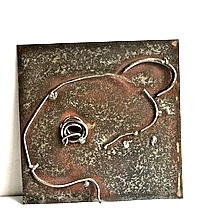
Anguish
Metal, plate
On the flat surface of the metal, a face escapes from itself. The metal wire draws the outline of a head that seems to want to come out of the plate and cannot. Anguish is not a cry, it is that silent tension between what one is and what one cannot become.
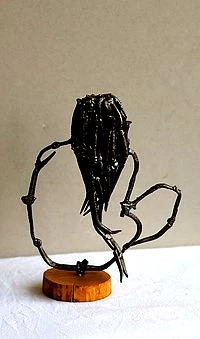
Head of Hair
Metal, wood
Each metal stem is a hair, each hair a thought. Le Caer's head of hair does not fall, it springs out, it branches, it invades the space like a consciousness overflowing. The wood anchors, the metal breaks free. This is the head that thinks too fast for its own good.
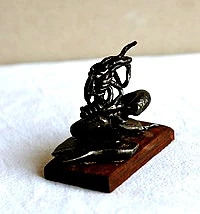
Crab
Metal
He moves sideways, not out of clumsiness but out of strategy. Le Caer's crab is a figure of cunning, of the oblique approach, of thinking that goes around rather than attacking. This small piece of metal, hunched in on itself, concentrates a lateral energy, unpredictable, irrepressible.
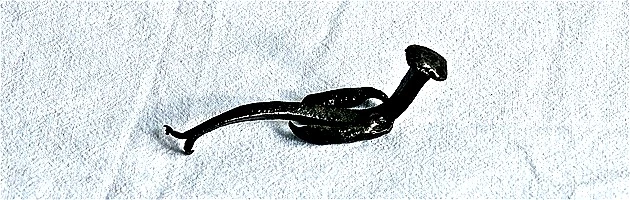
Relaxation
Metal
An elongated line, a body letting go. Le Caer's relaxation is the anti-sculpture par excellence, no verticality, no tension, no aspiration upward. Just a body of metal accepting the horizontal as its natural state. Resistance has ceased. This is peace.
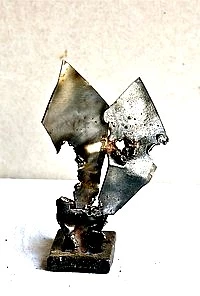
Lightning
Metal
Lightning does not last, and that is its power. These fragments of metal cut into sharp angles catch the instant of discharge, the moment when energy finally finds its path. Bright, cutting, unpredictable, this sculpture is a photograph of a lightning bolt stopped in mid-course.
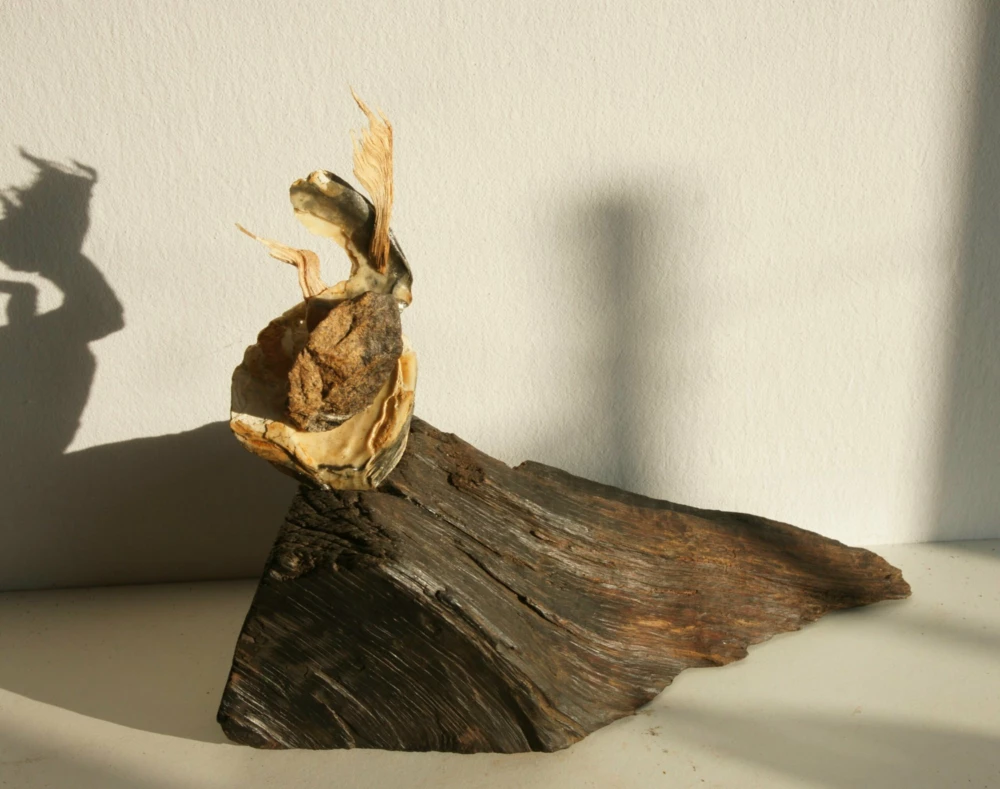
The Shaman
Forged metal
The body folded into a posture that reason does not understand but ritual recognises. The metal loop on the arm, the open wing, the twist of the trunk, the Shaman is in his trance, in that state of passage between worlds where matter stops obeying ordinary laws. Le Caer caught him at the exact moment of the tipping point.
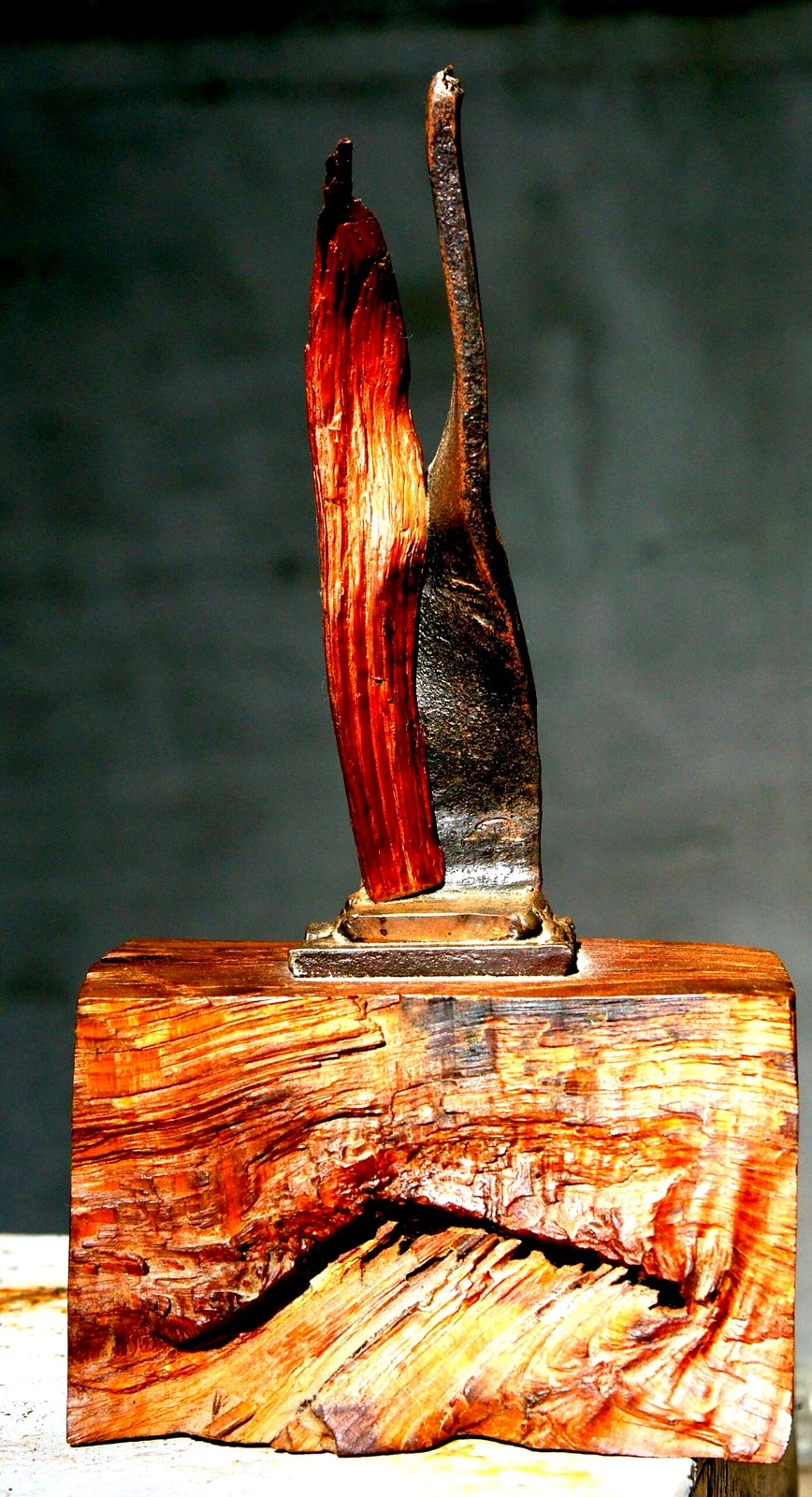
The Breakthrough
Wood, forged metal
The wood rises, the metal rises too, but they do not rise in the same way. One has the warmth of fibres, of years, of living things. The other has the rigour of the forge, the memory of fire. Together they form a double column that surges towards a point we cannot see but can sense, the breakthrough towards something else.
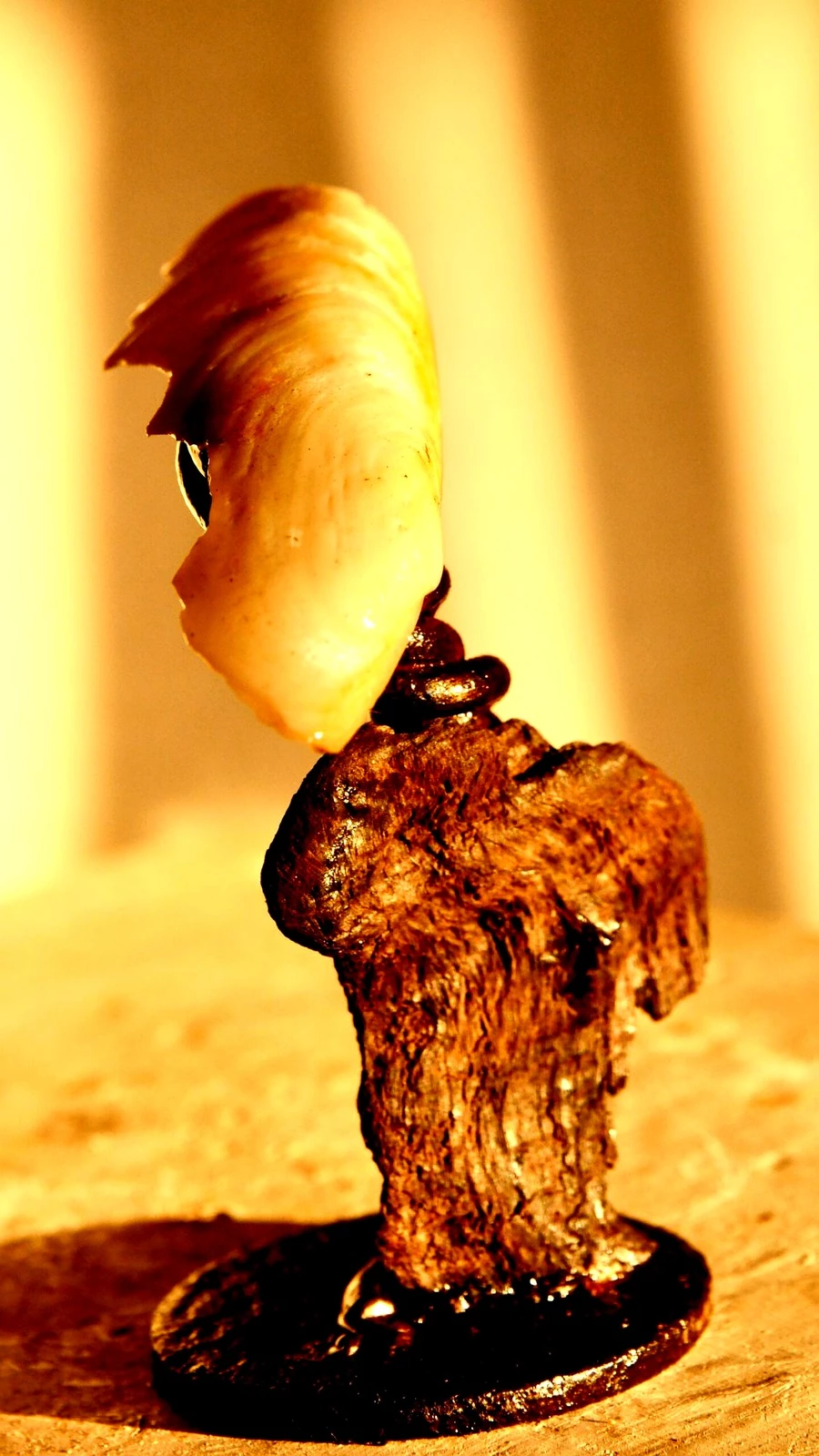
The Wild Child
Metal, shell, wood
The shell set on tormented metal is childhood laid upon the violence of the world. The dark matter, burned, saturated with tensions, and on it this white fragment, smooth, come from the sea. The wild child does not seek to be tamed, he carries both these irreconcilable natures within him, and that is precisely his strength.
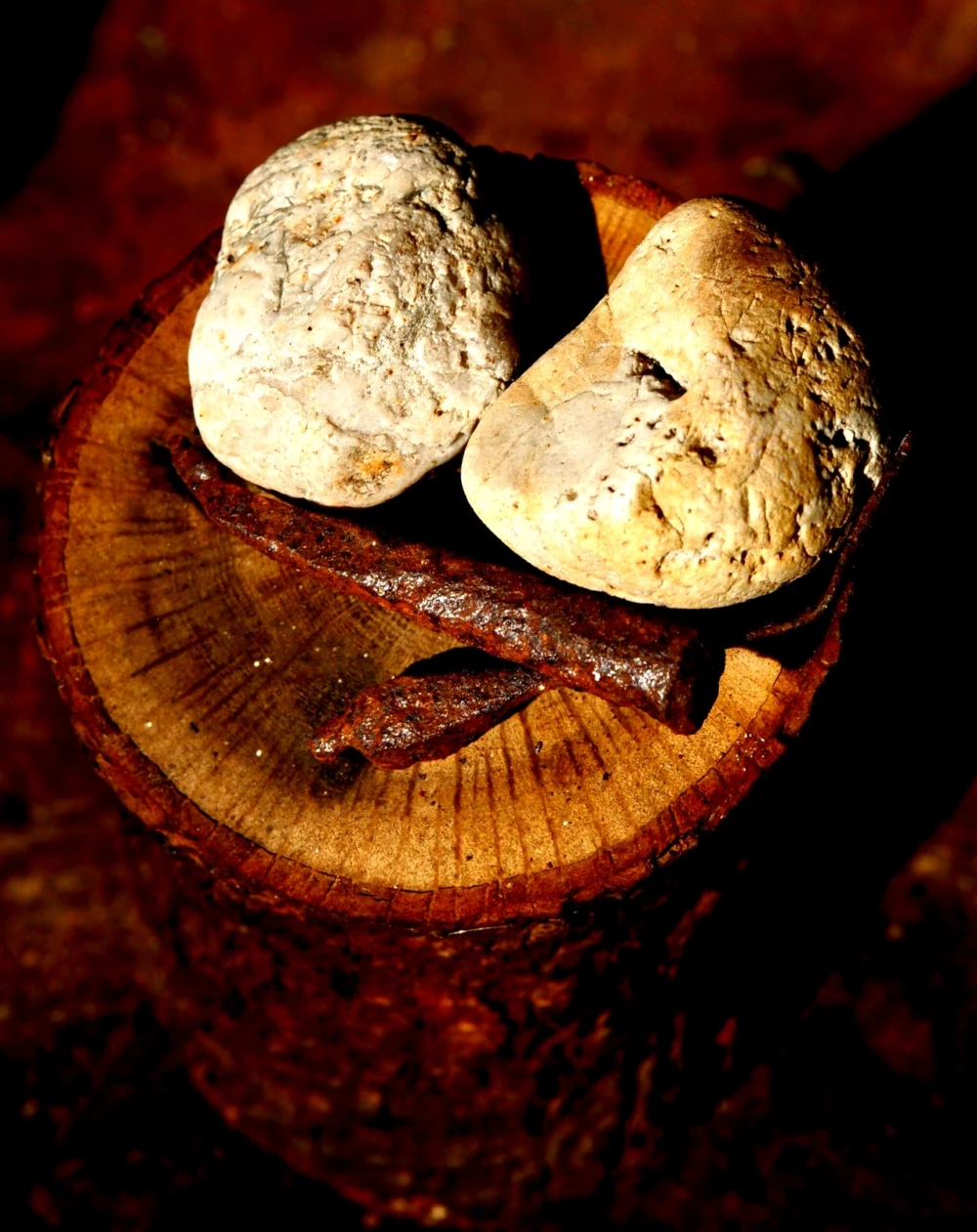
The Trio
Stone, metal, wood
Two white stones and a rusted metal nail, set on a section of wood, a freeze-frame in the geology of time. The stones travelled for millions of years, the metal was shaped by hand, the wood cut its ties with the tree. The Trio is the meeting of three histories that should never have crossed.
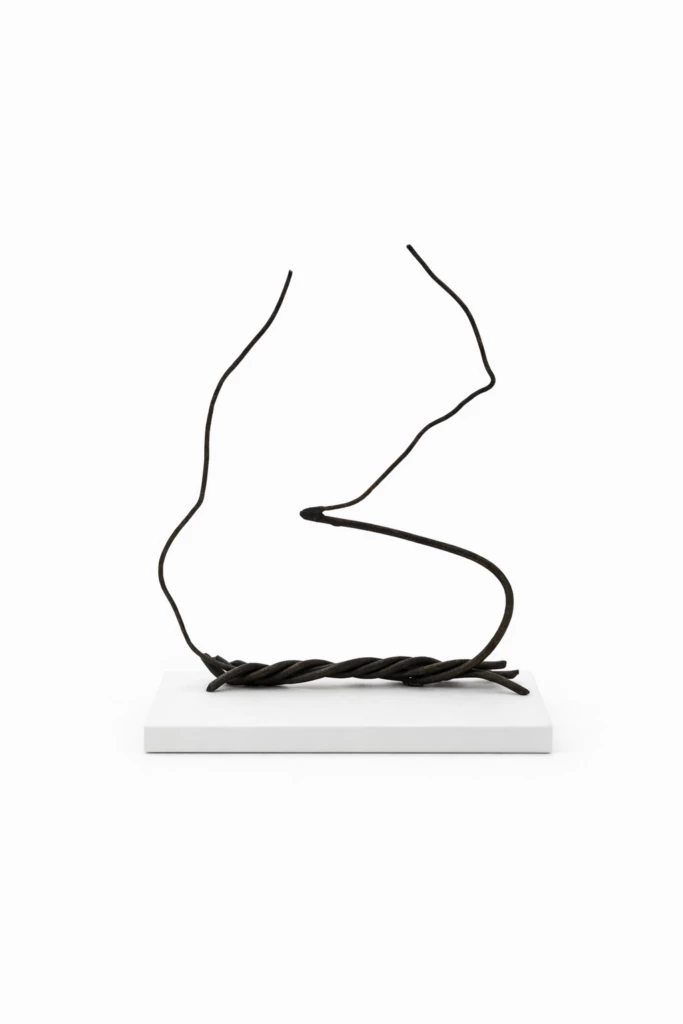
The Silhouette
Metal wire, twisted steel
Two lines rising without meeting, and yet the body is there. Le Caer's silhouette needs no volume in order to exist, it is nothing but line, space, suggestion. It is the lightest sculpture that can be made from metal, and perhaps the hardest.
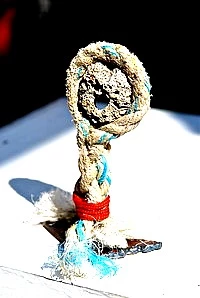
Hello
Cord, stone, metal
A ring of stone encircled with multicoloured cord, the primitive signal, the gesture of calling out. Hello comes before any elaborate language, it is the word before words, the hand held out before the sentence. Le Caer says it in cord, in stone and in metal, but the message has stayed the same ever since people first began to cross paths.
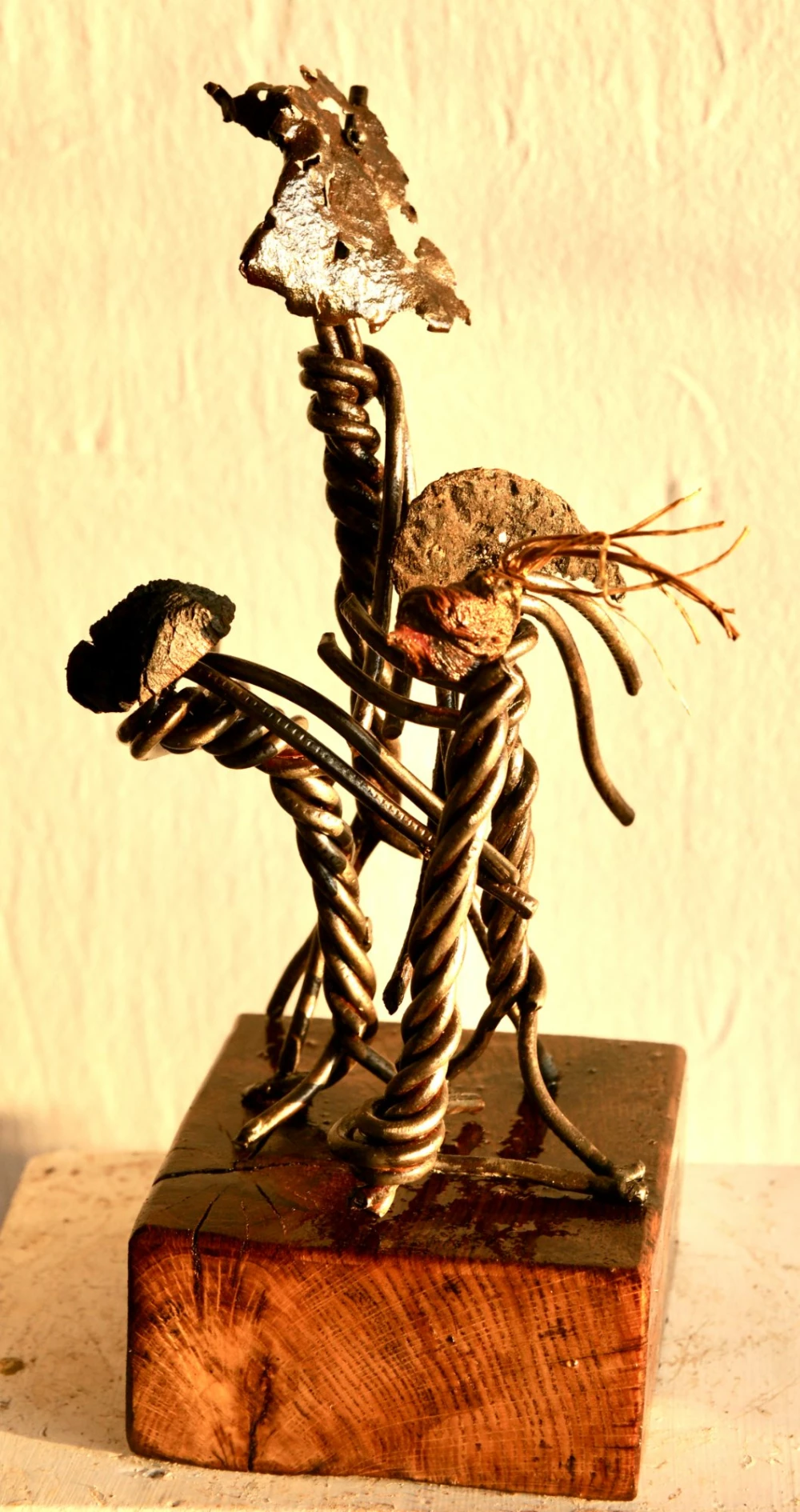
Demonstration
Twisted metal, wood, plant matter
Metal bars twisted like bodies in movement, organic elements pushing through them, here is the crowd, the collective surge, the moment when individuals become a mass. Le Caer's demonstration is not political, it is physical, visceral, as inevitable as a tide.
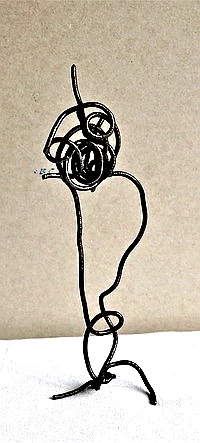
Marx Dormoy
Metal
A street name, a metro name, a man's name become a place. The metal wire draws a whirling head on a barely sketched body, this is thought overflowing the body, ideas taking up more room than flesh.
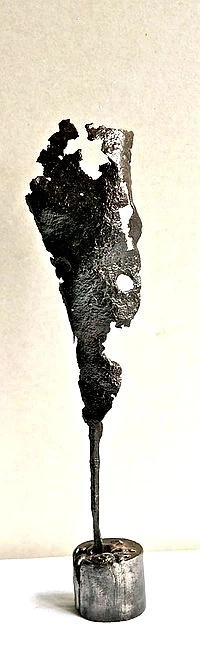
Mask I
Metal
The mask is not a lie, it is a different truth. This fragment of pierced metal, mounted on its rod like a head at the end of too thin a neck, looks out from nowhere and from everywhere. The empty socket is not a lack, it is the opening through which the world comes in and goes out.
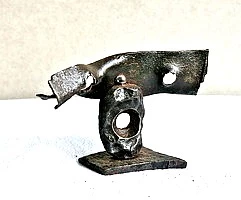
Mask II
Metal
The other mask, the one that advances instead of looking. Horizontal, aggressive, its two openings serving as eyes pierced in raw metal, Mask II is not contemplation but projection. It charges. It passes through. The hole is not there to see with, it is there to pass through.
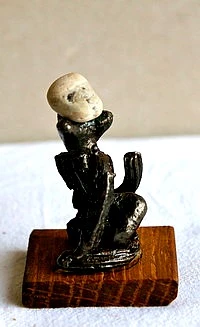
Birth
Stone, wood, metal
The head of stone set on the kneeling body of metal, as though the living were emerging from the mineral, as though consciousness were being born out of the raw. This small figure, curled on its wooden base, is a summary of creation, from the lesser towards the greater, from the cold towards the sentient. Birth is always a folding before the unfolding.
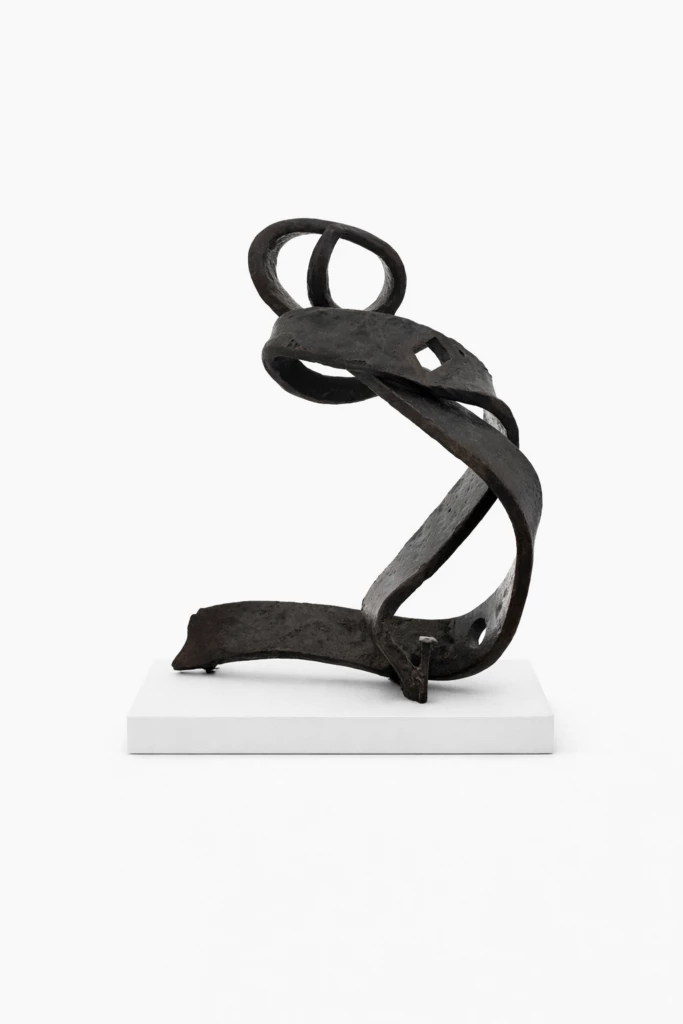
Passion
Forged metal
The rings of metal wind into one another until they can no longer be undone, and that is passion. Not gentleness, not tenderness, but that interlocking which ends up causing pain and which one would not undo for all the gold in the world. The forge understood everything, metal folded on itself holds better than any armour.
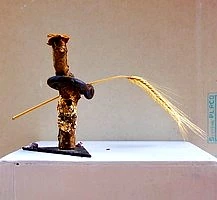
Peasant
Wood, metal, plant matter
An ear of wheat at the end of an outstretched arm, a gesture thousands of years old, the gesture of a man showing what he has made grow. Le Caer's peasant is made of the same substance as the work itself, hardened wood, rusted metal, dried plant matter. He is not posing, he is offering. And in that offering, the whole dignity of a life bound to the land.
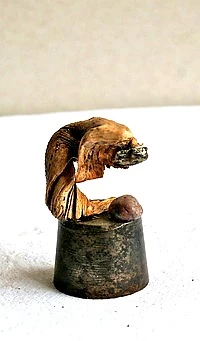
Stone on the Ground
Wood, stone, metal
The body bends until it touches the ground, and in that folding something is set free. Stone on the ground is not a fall, it is a choice to go down, to touch the earth, to give up verticality as the only possible stance. The figure of wood and metal leans over, and in that leaning it gains a knowledge that standing upright does not allow.
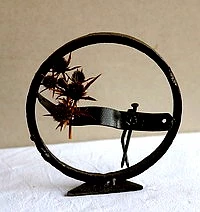
Encounter
Metal, plant matter
The metal ring holds the plant matter like a world in miniature. Thorns and dry stems against assembled and welded steel, nature and industry face to face, shut inside the same circle. This encounter is not peaceful, the two elements size each other up, brush against each other, refuse to merge. But they coexist. That is already a great deal.
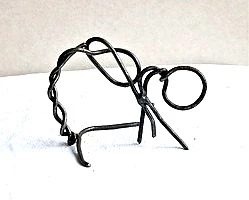
Reverence
Twisted metal
The metal beast lowers its head, or is it a greeting, a bow, a way of accepting what is greater than oneself? Le Caer's reverence has no master, it is made before life itself, before that perpetual movement which the twisted metal threads imitate without ever quite catching it.
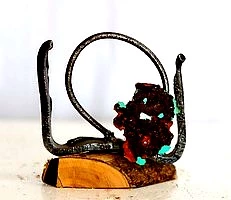
Anchorage
Metal, wood
The metal ring braces itself on its two feet, anchored in the wood like an anchor in a sandy bottom. At the centre, the mineral concretion, coloured, alive, unpredictable, held by the rigour of the metal. Anchorage is not a prison, it is what allows something fragile to stand without disappearing.
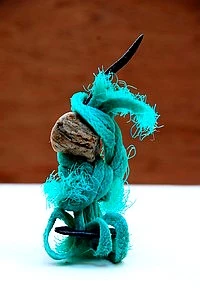
The Coiling
Cord, metal, stone
The turquoise of the cord wraps, twists, absorbs, and the stone half disappears into that textile embrace. The points of black metal pierce through like desires that refuse to be contained. Coiling is not a knot, it is a taut dialogue between what grips and what resists, between the softness of fibre and the hardness of metal.
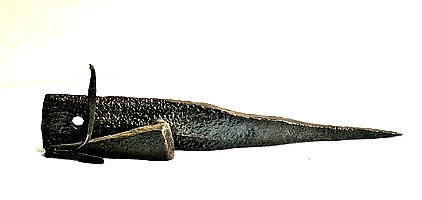
The Blade
Forged metal
It is not made to cut, it is made to exist. Horizontal, pointed, weighted with a small outgrowth that throws it off balance and gives it life, Le Caer's blade is pure tension, metal reduced to its geometric essential. A single gesture of the forge, and that is all. And it is enough.
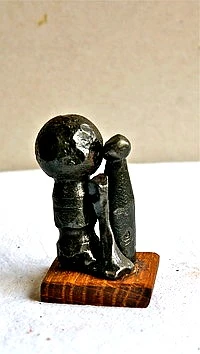
The Golem
Metal, wood
The head too large for the body, the arms held out towards something it does not yet understand. The Golem is the figure of the man-made being in search of its own humanity. This small piece of metal on its wooden base is not threatening, it is perplexed. And in that perplexity it resembles us more than we would care to admit.
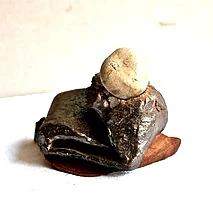
Rest
Wood, metal, stone
The white stone set on folded metal, the whole resting on wood, a stacking of materials that have all known effort and have finally agreed to stop. Rest is not surrender, it is the intelligence of knowing when to stop struggling. The stone does not fall. It chooses to stay there.
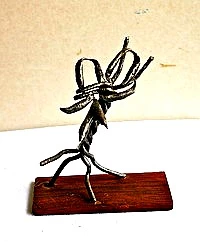
The Dancer
Forged metal, wood
Arms raised, one foot forward, the twist of the body caught in a single movement of the forge. Le Caer's dancer does not dance in slow motion. She dances at the exact speed at which metal agrees to bend without breaking. It is there, at that precise limit, that grace becomes possible.
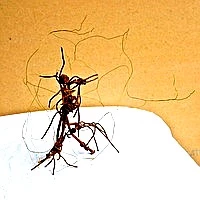
Turpitudes
Metal, copper wire
The insect of metal and copper advances as it comes apart, the threads go off in every direction, nothing really holds, everything wavers. Turpitudes are exactly that, those small abandonments of integrity, those successive accommodations with one's own principles, which end up tracing a silhouette one no longer recognises. The metal has understood, no more solidity, only threads fraying away.
Suspended Stones
A series in its own right within Pierre Le Caer's work, pebbles, river stones and raw rocks caught in structures of forged metal, copper wire or cord, and suspended in space. Stone, the material of the motionless par excellence, is here in perpetual movement. It rests on nothing, and yet it holds.
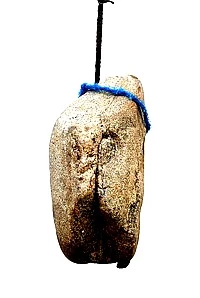
Stone That Could Not Care Less
Stone, cord, thread
The stone hanging from the black cord wears a belt of blue thread, like a jewel or a wound. The title says two things at once, the lightness of someone who could not care less, and the weight of someone who must nonetheless carry something. The pebble swings. It does not fall. It waits.
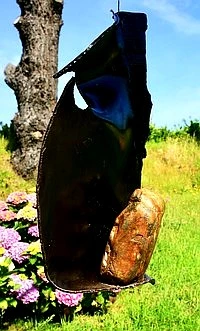
The Imprint
Metal, stone
The great wing of black metal holds the stone the way a hand holds a memory. Suspended in the open air, facing the garden and the sky, this sculpture is no longer quite a sculpture, it has become part of the landscape. River stone against varnished metal, each keeps the trace of what the other taught it.
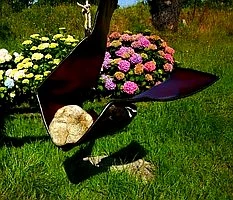
The Wing and the Stone
Metal, stone
The metal wing spread just above the ground, and the stone set on it like a stowaway. This sculpture is not taking off, it is preparing something. Between the hydrangeas and the green grass, it waits for the favourable season. Stone and metal have made a pact whose term we do not yet know.
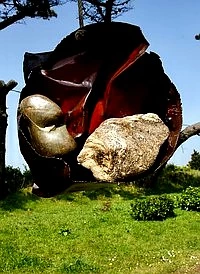
The Orb
Metal, stones
The circle of rusted metal opens a space inside itself, and in that space two stones coexist without touching. The orb is a world in miniature, a curved border marking out a territory where the ordinary laws no longer apply. What is inside the circle belongs to another order of reality.
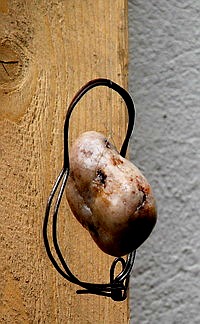
The Cradle
Stone, metal
The metal wire forms a handle, a loop, something resembling what hands do when they hold something precious. The stone rests in this metal cradle fixed to raw wood. It is held without being imprisoned. That is the whole difference between protection and constraint.
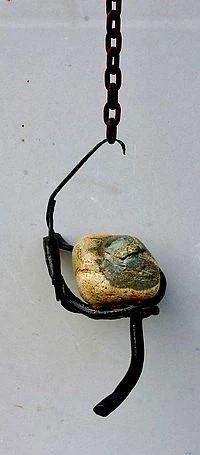
The Hold
Metal, stone, chain
The rusted chain comes down from the sky and at the end of that chain a forged metal claw holds the stone as a jaw holds its prey. But the stone is not trying to escape. It accepts the grip, it settles into it, it makes it its home. The hold is not violence, it is a tacit agreement between two materials that have learned to trust one another.
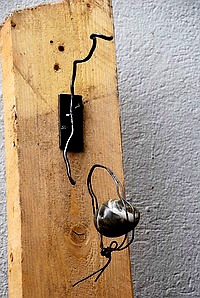
The Fastening
Metal, stone
The smooth metal ball and the raw stone, both hooked onto the wooden board by the same thread. Polished metal says what the forge can make perfect. The stone says what time can make perfect. This piece sets them side by side so that we understand that perfection has more than one face.
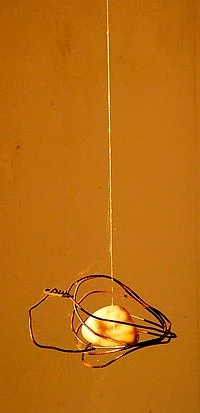
The Glass Cage
Metal, stone
The metal threads interlace to form a sphere around the stone. This cage imprisons nothing, it creates a space, a world inside the world. The stone floats in its geode of metal, hanging from a hemp thread that seems insufficient to hold up so much matter and so much silence.
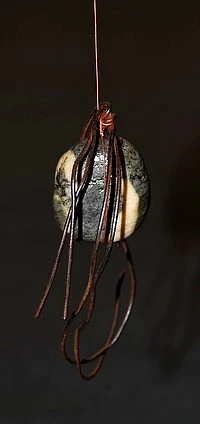
The Jellyfish
Stone, copper wire
The filaments of reddish copper descend from the stone like the tentacles of an abyssal creature. In that photographic darkness, the pebble streaked with white becomes a living organism, a jellyfish of stone and copper drifting in an invisible current. Le Caer found in the mineral the animal no one had yet seen.
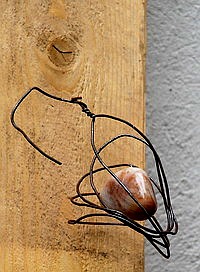
The Nest
Stone, metal
The pink and white stone rests in its basket of metal, fixed to the board like a nest to a branch. It has been there a long time, or at least that is what we assume, the materials have taken on the colour of time spent together. The nest does not hold an egg. It holds a stone. And perhaps that is the same thing.
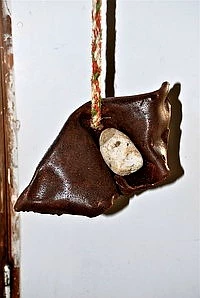
The Matrix
Metal, stone
The brown metal folded on itself like a mineral matrix holds the white stone in its hollow. What the matrix protects, it ends up transforming. This sculpture, hanging from its hemp cord, is halfway between the mineral and the living, something is taking shape inside, something that has no name yet.
Large Format
Large scale sculptures, made for interior or exterior spaces. Each piece stands more than 80 cm high.
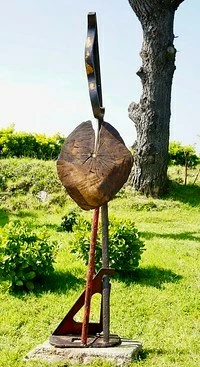
Goutte d'Or
Metal, wood
275 × 75 × 30 cm
A memory of the Goutte d'Or district in the 18th arrondissement of Paris and of the shoring of its buildings by the Charpentiers de Paris. A monumental sculpture that celebrates the work of men and the memory of a neighbourhood in full transformation.
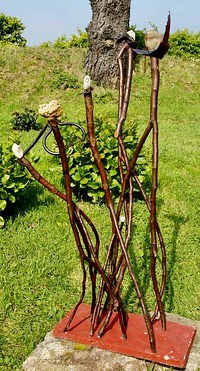
The Indignant
Wood, stone, metal
160 × 70 × 60 cm
The people in the street. This monumental sculpture captures the collective energy of an era, the strength of those who stand up and say no.
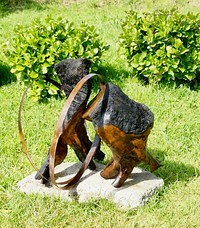
The Rutting Season
Metal, burned wood
80 × 70 × 120 cm
The play of wild boars. Instinct in its pure state. The burned wood carries the traces of fire as the beast carries the marks of the fight.
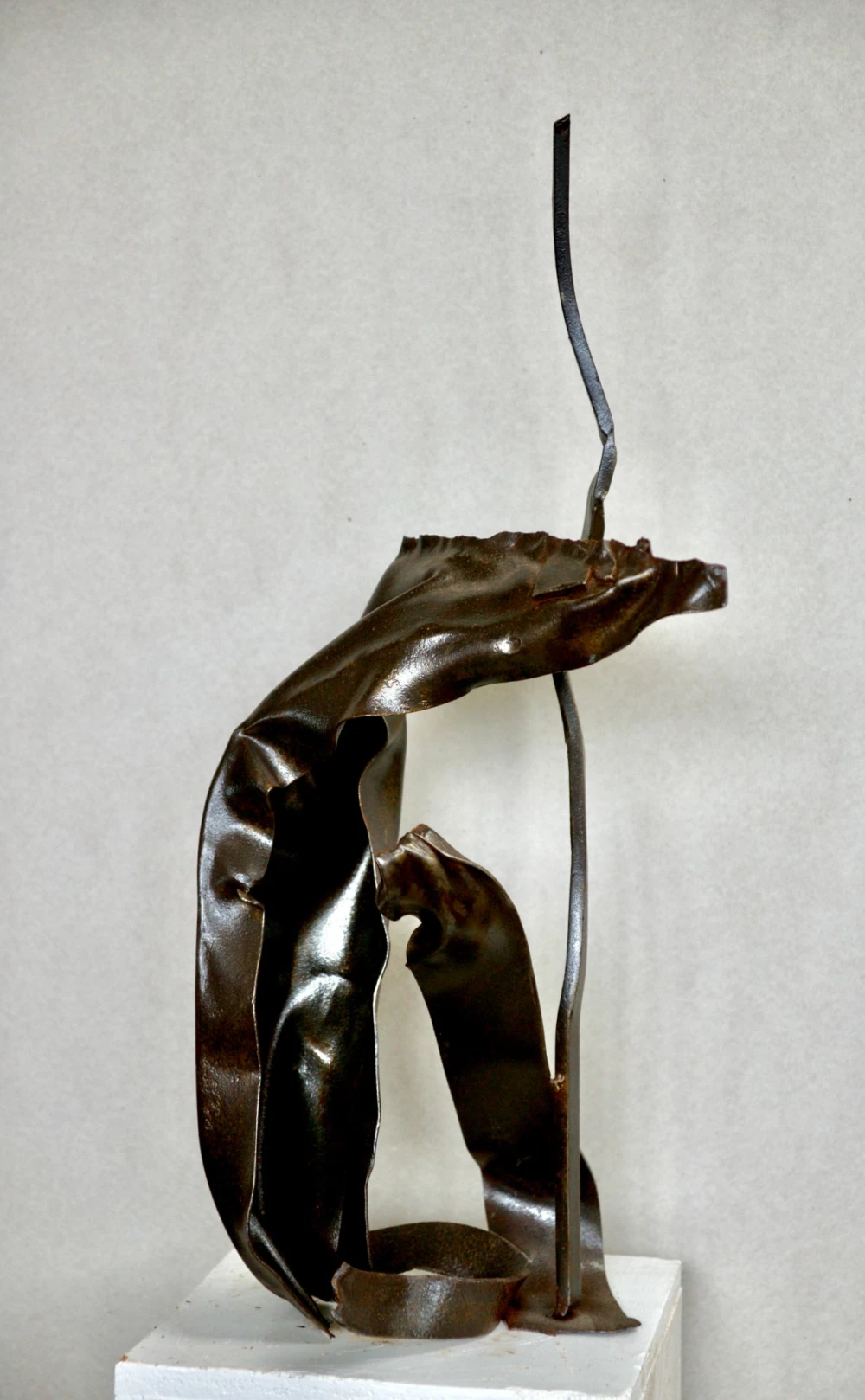
Dog and Cat
Metal
81 × 30 × 20 cm
A fundamental duality expressed in metal. Two opposing natures coexisting within a single form. The sculpture does not choose between them, it contains them both.
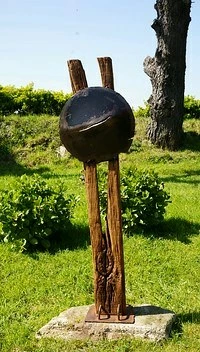
Slate and Memory
Slate, wood, stone, metal
80 × 34 × 28 cm
Some works need no title in order to speak. Slate, wood, stone and metal come together in a composition where each material finds its place, as in life.