« Art is the shortest path from one man to another », wrote André Malraux. Gabriel Lemaire Sicre quotes the line in his book, then adds at once that he did not take the shortest path himself. He is right. Between the child who grew up among his forebears’ paintings and the man who repaints tawing machines in a factory in the Tarn, there are some twenty years in computing, a move of six hundred kilometres, and a decision taken late.
Here is that story, told in his own words wherever they are the truest.
A family of entrepreneurs, and of painters
He was born into a family of entrepreneurs. His father and mother ran a company of about fifty people near Paris. The value of work was, in his own phrase, venerated there.
But there were also the paintings. Two of his great grandparents were painters, among them Albert Cadix (1853-1925), whose view of a Franche-Comté village stayed in the family house. Gabriel Lemaire Sicre speaks of it without indulgence: very well made, but a train behind the contemporaries who did enter the history of art. One uncle kept a gallery in Paris, another was an inventor and won the Concours Lépine.
So the walls at home were covered with paintings, his forebears’ and those bought from the gallerist uncle. Living with pictures on the wall was in no way exceptional, it was the normal state of things. That sentence explains a great deal: art was never, for him, an event. It was a familiar setting, and therefore a territory he could walk into.
Twenty years in computing
He began as a computer engineer. It was not a fallback but a passion, for a profession that promised, in the early 1980s, to change the world. He built database management projects, listening directly to his users, with the pleasure of bringing concrete answers to real needs.
He practised for some twenty years, then left. His reason, as he puts it, is worth reading twice: freeing human beings from tedious tasks was a noble quest, the infantilising of users and the endless race for technological progress were not. After some fifteen years he felt he had nothing new left to offer in that field.
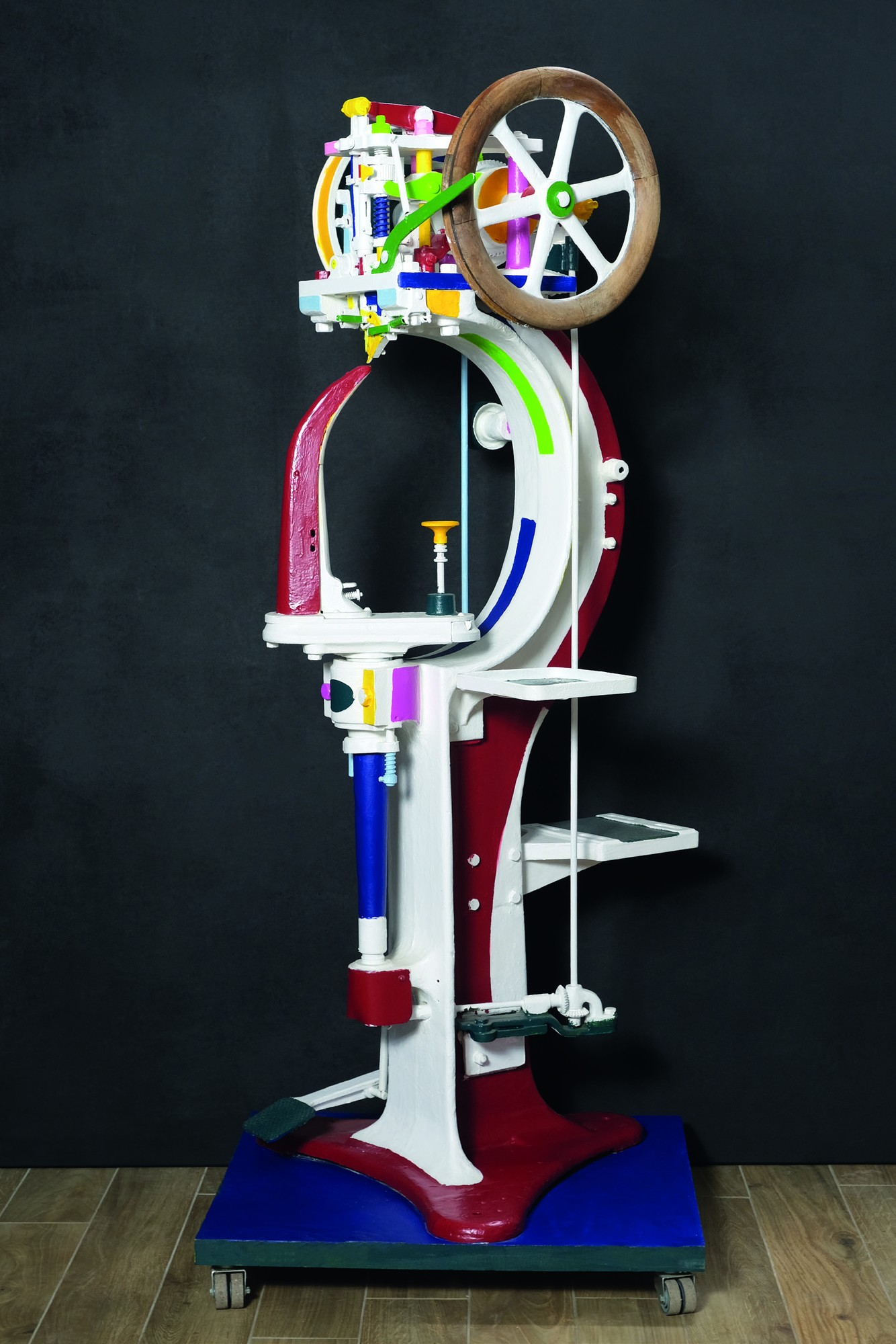
This past is not a parenthesis to be forgotten before speaking of the artist. It is a working tool. Computing teaches you to break a whole into functions, to name each organ, to follow the flows. That is exactly the gaze a dismantled industrial machine demands: here is the frame, here is the transmission, here is the working organ. He acquired that gaze in front of management systems, and he turns it today on presses and smoothing machines.
Self taught, completely
He finished his studies at nineteen, and says himself that it was too early to have received any deep education. He trained by buying quantities of art books. He took no drawing lessons, seeing no need for them given what he had to make.
All his life, he says, he has managed with whatever was at hand, with a practical intelligence. He adds a remark that says much about his method: he always found original objects that others did not find. For a photographer, he notes, having no luck is a professional failing.
The father, the mother
His father was self taught like him. Besides running his company he sat as a judge at the commercial court of Versailles. A colleague once remarked that he had an odd way of writing. The answer stayed in the family: this is my style, this is me, show me yours. The colleague, his son notes, was flattened.
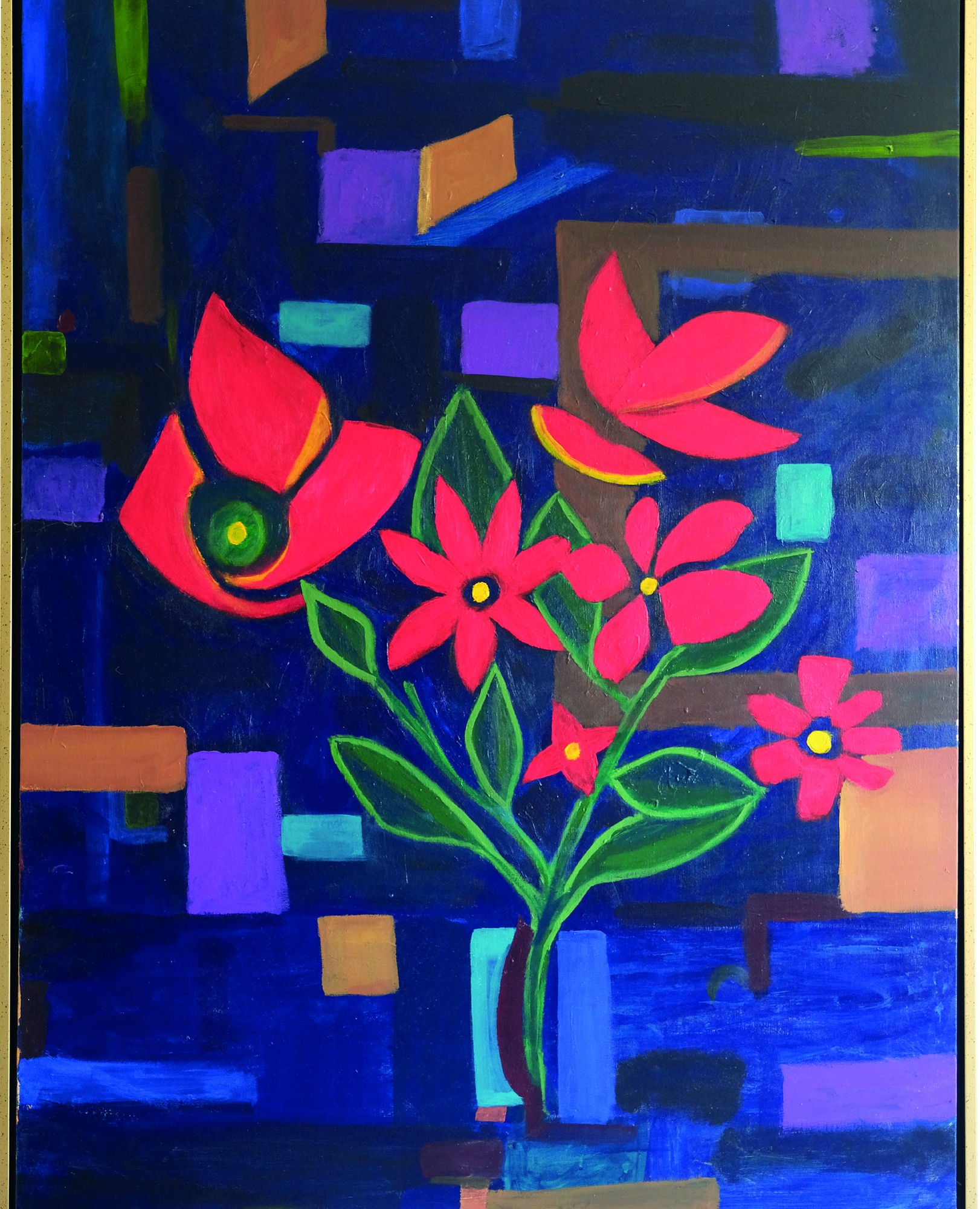
Gabriel Lemaire Sicre speaks of that father with an admiration that never sought to compete. Feeling incapable of doing what his father did, he chose his own path. Recognition came late, and it came through a painting: his father wanted to hang above his own bed the one he himself named La Fête.
His father died in 2011, before Le Paradis des Machines was built. It is from his mother, he says, that he gets his artistic gifts. She has always been a strength beside him and one of his first admirers, and she is convinced his father would have been very proud.
August 2013, the departure
In August 2013 he decided to leave the Paris suburbs. Searching online for a large building in the south of France, he arrived at Graulhet, in the Tarn, in front of a factory built in 1955 and waiting to be restored.
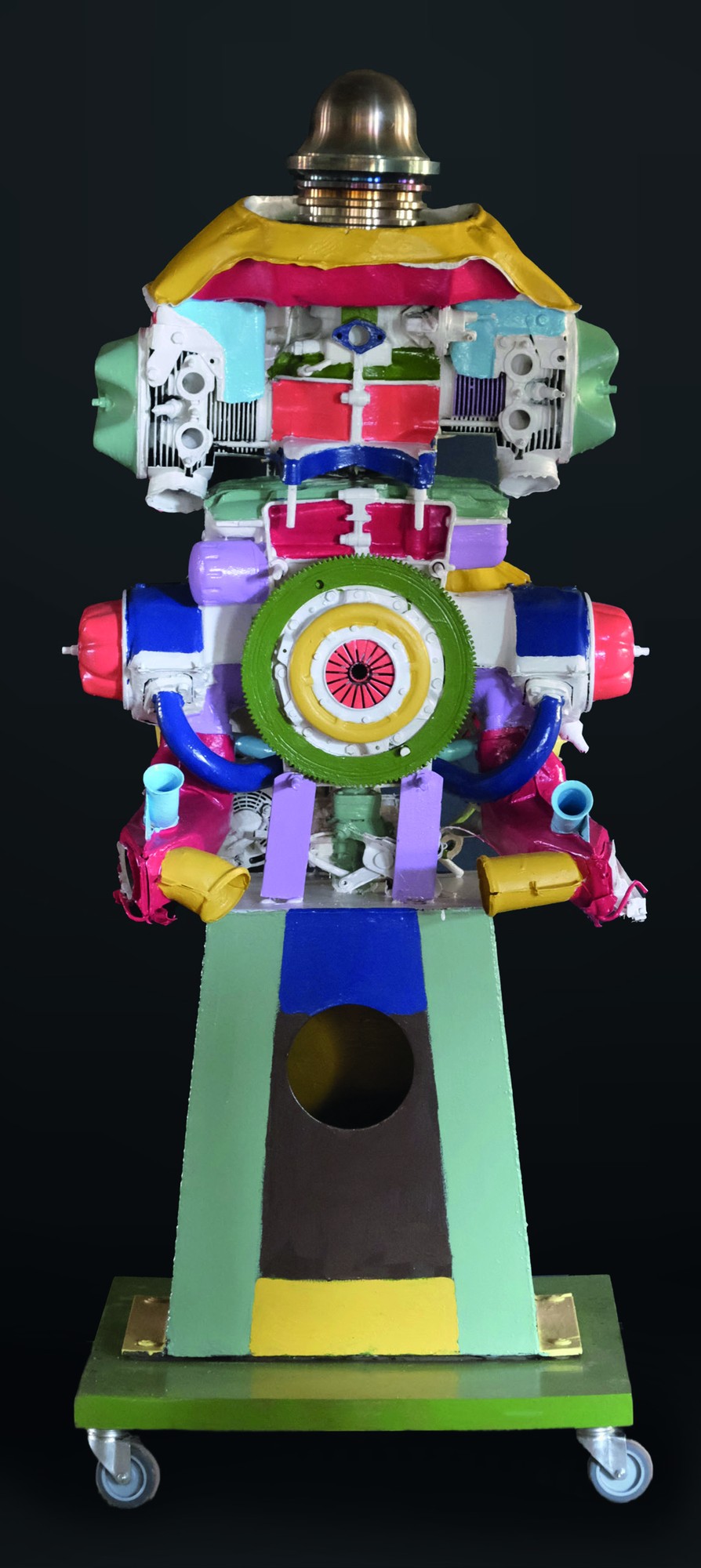
The building was completely empty. Not one machine inside: between the end of industrial activity and his arrival, the place had served as a second hand depot for thirty years. Everything now standing there he searched for, bought, transported, cleaned and painted.
In 2018 he discovered that the logo of the leather garment manufacture that had occupied the site before him resembled the pictorial writing he had developed years earlier, elsewhere. He drew a simple conclusion: he was in the right place. Serendipity, magic, or both.
What this story explains
Knowing it, you understand better what you see at Graulhet. The taste for systems comes from computing. The rigour of the building site and the respect for work come from the family. The calm relationship with a painting comes from the walls of childhood. And the idea that an abandoned heritage can be adopted in order to pass on something else comes from a man who defines himself, in his book, as an heir.
He gives the shortest formula himself: his work is alchemy, the art of turning base metal into gold.
For what follows, read how he came to painting, then what he is looking for with the machines. His works are gathered in his catalogue.