The question almost always comes after the purchase. It should come before. A sculpture is not a painting you unhook to change walls: it has weight, it occupies a volume, it is seen from several sides, and where you put it decides what you see of it.
Here are the questions to ask, in order, with concrete answers.
Weight, first
This is the point people forget and the only one that does not forgive. A piece in metal and stone sixty centimetres tall commonly weighs between fifteen and forty kilos. Monumental works go past a hundred.
Three simple markers. The floor of an older flat carries a point load of forty kilos without difficulty, provided you place it near a load bearing wall rather than in the middle of a room. A shop bought wall console is rarely rated above twenty kilos. And a shelf fixed into plasterboard, whatever the anchor, is not a place for a sculpture.
When in doubt, the floor is always the right answer. A heavy piece set straight on the floor, on a low plinth, holds without risk and looks better.
Choosing the height, and therefore the gaze
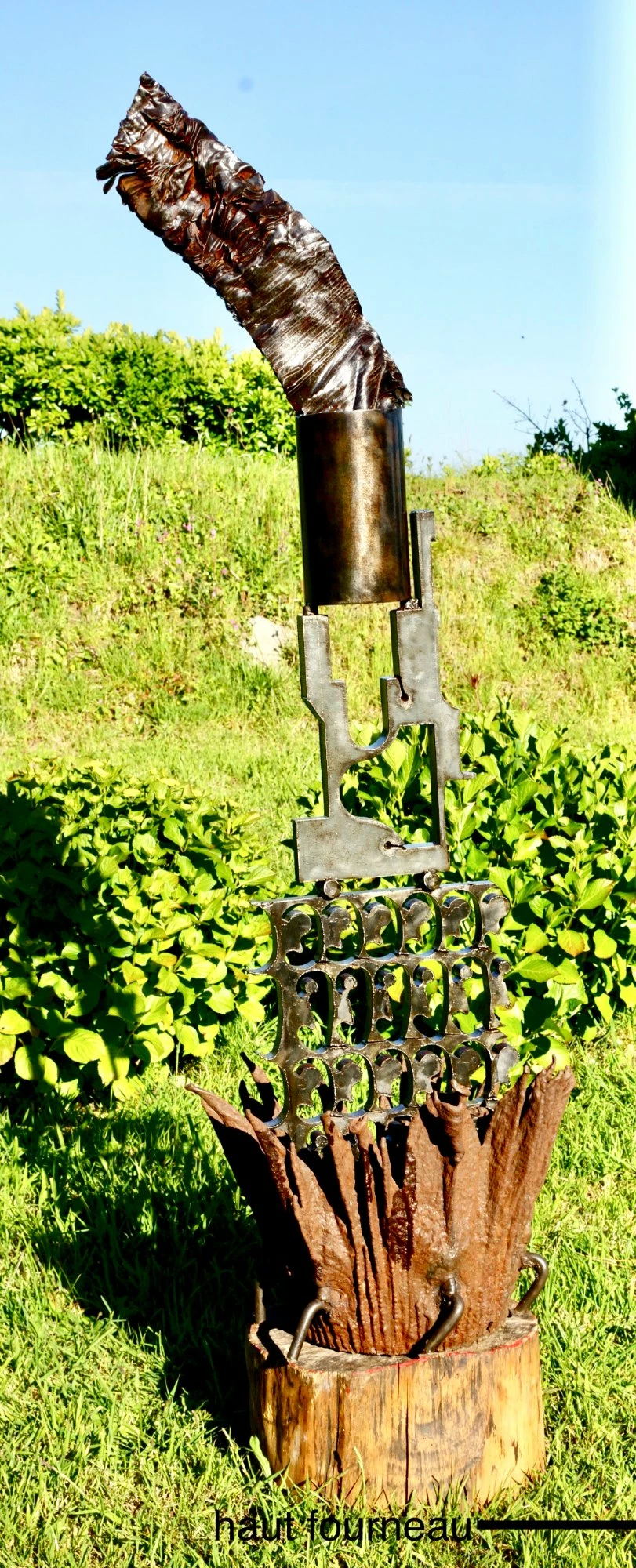
A sculpture on the floor is seen from above, which flattens the volumes. The same piece at chest height is seen straight on, and that is almost always what the artist had in mind.
The rule used in galleries: the centre of the work about one hundred and forty centimetres from the floor, the average eye height of a standing adult. For a piece looked at from a seated position, in a living room, come down to one hundred and ten.
A plinth is not a decorative accessory, it is what gives the work its autonomy. It separates it from the floor and from the furniture, and tells the eye that this is something other than an object. A simple dark plinth, narrower than the work, disappears in its favour. A pale wide plinth draws attention to itself.
Leaving space around it
This is the commonest mistake, and the easiest to correct. A sculpture wedged between a lamp and a photo frame becomes an ornament.
Allow at least forty centimetres of empty space on each side, and room to walk around it if the piece deserves it. Many metal assemblages change completely with the angle: what looks like a bird from the front becomes a human silhouette in profile. A work flattened against a wall loses half of what it says.
Light
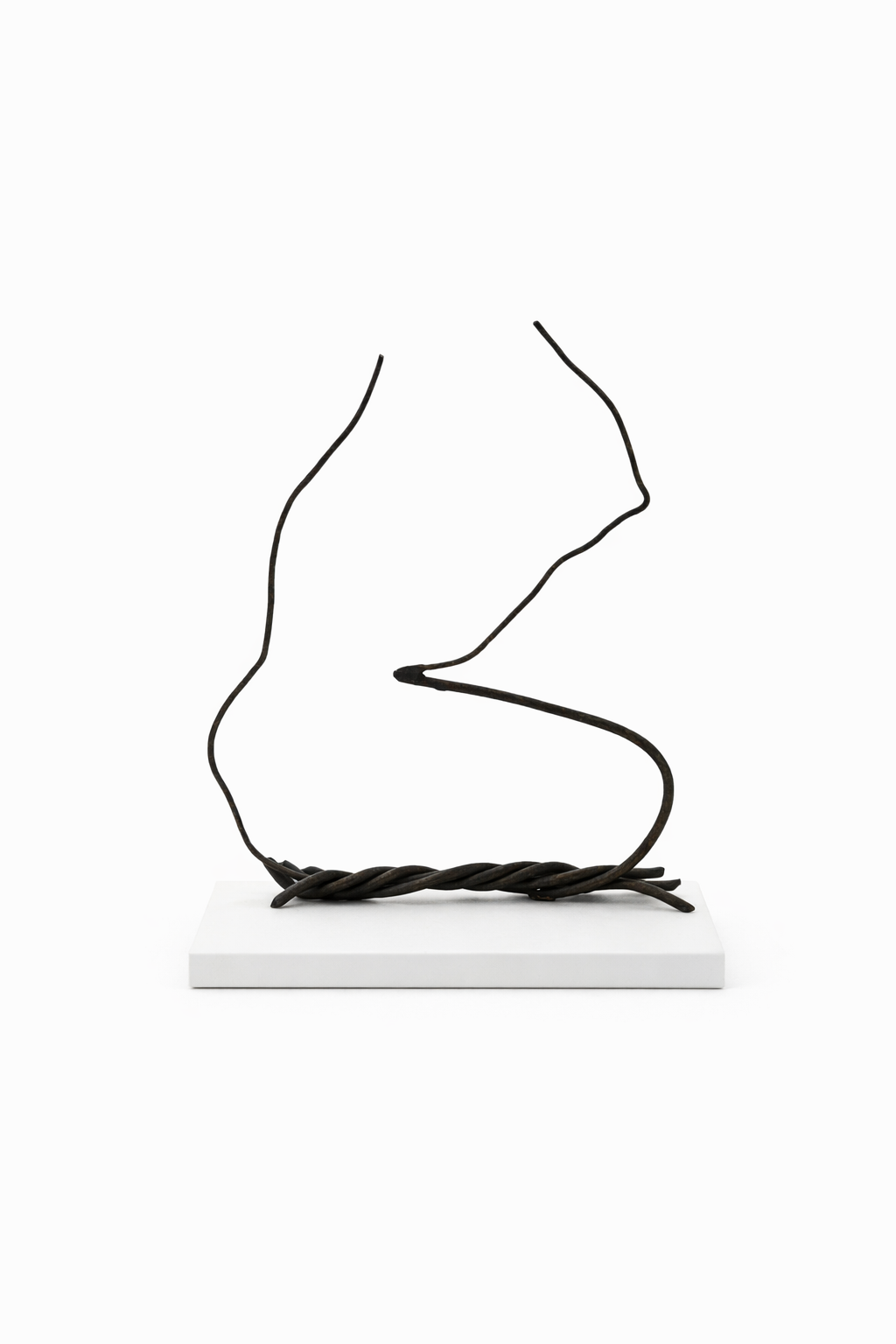
A metal sculpture lives on raking light. A vertical ceiling light flattens everything and removes the shadows that give relief.
What works: an adjustable source at about forty-five degrees, one or two metres from the work. A warm light, around three thousand kelvin, on patinated metal or stone. A more neutral light on pieces painted in bright colours, otherwise the hues shift.
What does not work: direct full sun all day on a piece containing wood, which eventually splits, or on colours that fade.
And outdoors?
An outdoor sculpture is not an indoor sculpture that you take outside. Three conditions have to be met.
The material has to take it. Untreated steel develops a rust patina that may well be intended, but it evolves and stains what it stands on. Stone and granite fear nothing. Driftwood, for all its marine past, degrades once it is fixed to the ground in damp.
The fixing has to resist wind. A tall light piece goes over in the first storm. A plate anchor, or a buried concrete base, is essential beyond a metre and a half.
Frost has to be anticipated. Water that sits in a hollow freezes, expands and splits the joints. An outdoor work has to be able to drain.
If you are unsure about a particular piece, ask us: we know what each work can take, and we prefer to say so before the sale.
Children, animals, doorways
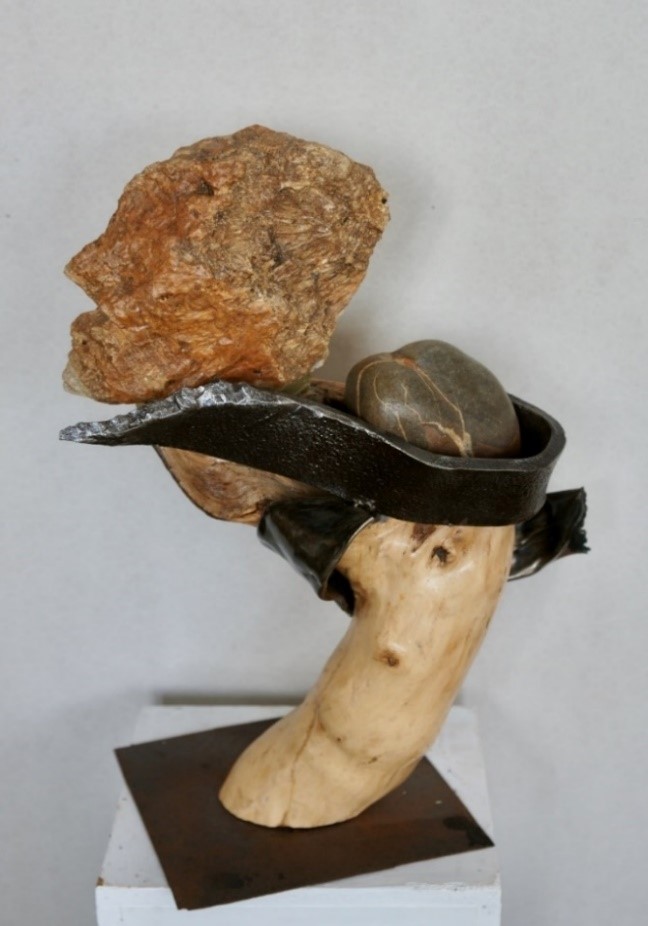
A sculpture is only dangerous if it is unstable. A heavy piece on a wide base does not move. A thin tall piece on a narrow plinth tips over.
Two gestures are enough. A pad of removable fixing putty between the work and its plinth, invisible and reversible, stops it sliding. And avoid corridors, doors that slam, and the edge of a table where someone puts down a bag.
A word about insurance
The moment a work is in your home, it is your household policy that covers it, or does not. Most policies cap valuables at a fairly low overall figure. Above that a specific declaration is needed. We devote a whole article to insuring a work at home, because the subject deserves better than one paragraph.
Before buying, measure
One last piece of advice, the one that prevents regret. Before confirming an acquisition, take the dimensions from the work’s page and mark out the volume at home with stacked boxes. Five minutes, and you will know whether the piece has its place.
Every page in our catalogue gives height, width, depth and material. If something is missing, ask, and we will measure again.