Understanding the materials of a sculpture means understanding part of its story. In the work of Pierre Le Caër, every material was found before it was worked: the metal comes from shipyards, the wood from the foreshore, the stone from the coastal paths of Brittany. A short guide for collectors.
Metal: sheet steel, forge and oxidation
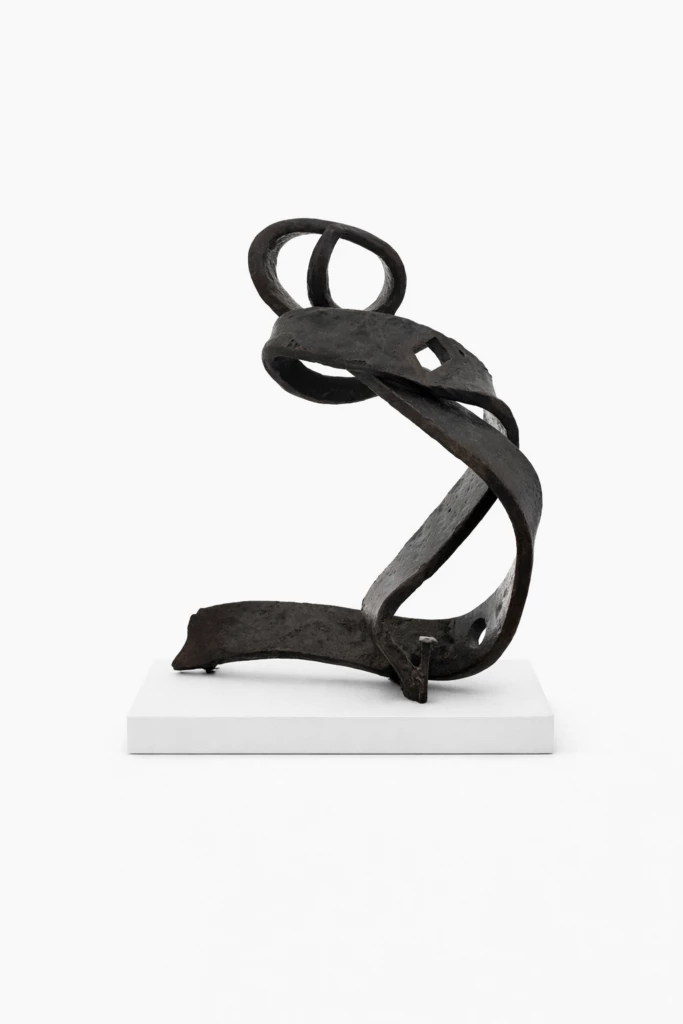
Sheet steel cut with a torch, assembled and welded steel, twisted wire, copper: metal is the backbone of Le Caër’s work. Often salvaged, a hull plate or a machine part, it already carries an industrial or maritime memory that the sculptor reveals rather than erases. Oxidation, controlled and then stabilised, gives each piece its singular patina, as in Passion, a spiral of oxidised and polished steel.
Driftwood: sculpture begun by the sea
Gathered on the shores of Finistère, bleached by salt and sun, driftwood reaches the studio already carved by the elements. It becomes the base, the keel or the body of the work, as in Frigate, whose keel is a piece of driftwood picked up at the tip of Brittany.
Breton stone: granite, pebbles and raw rock
Granite, slate, river pebbles: Breton stone brings mass, anchorage, permanence. In Le Caër’s suspended works it plays a paradoxical role: a material of stillness, it becomes movement and balance, held by metal or rope, resting on nothing and yet holding perfectly.
Unique assemblages, impossible to reproduce
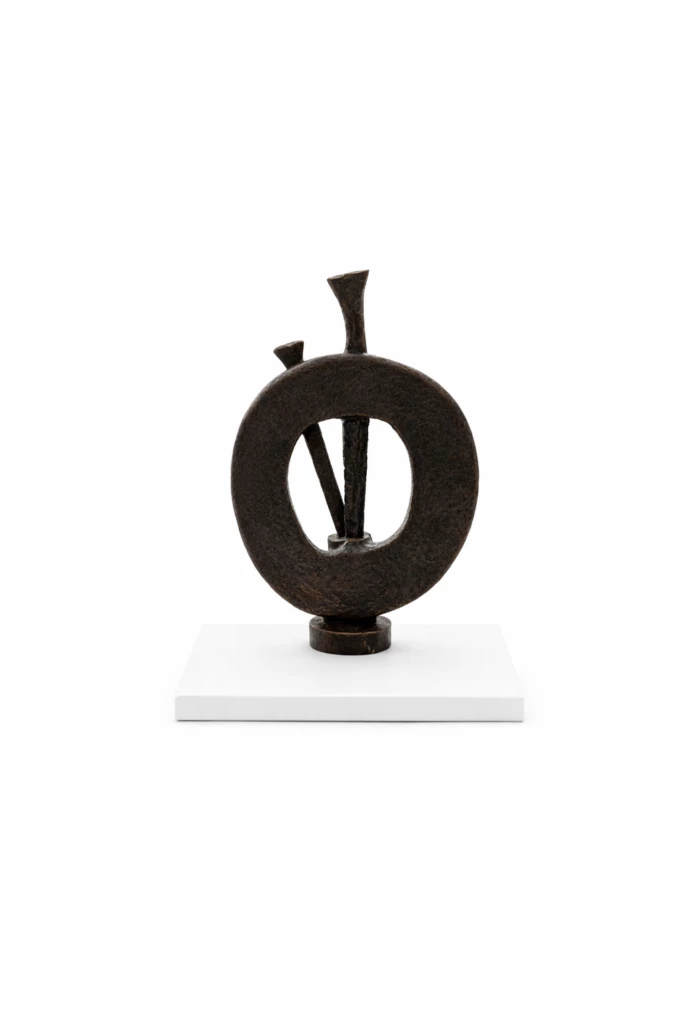
Because every element is found rather than manufactured, no work can exist in two copies. That is the very definition of a
Recognising an assemblage, and a point of vocabulary
A clarification first, because art market vocabulary is often loose. Pierre Le Caër does not forge. Nothing in his own texts mentions forging. He assembles and welds metal that has already been discarded. To forge is to give form to new material through heat and impact; to assemble salvage is to compose with forms you did not choose. The second is what he does, and it is more interesting.
On a piece, it shows. Look for the joins: an assembly weld leaves a visible bead, sometimes deliberately left raw. Look too for traces of earlier use, a drilled hole that serves no purpose in the work, the edge of a sheet cut for another function. Those traces are the signature of found material.
What time does to each material
A collector also buys a future. Here is what happens over ten or twenty years.
Metal. Stabilised oxidation changes very little indoors, in dry air. Outdoors it goes on living and the patina deepens. That is not deterioration, it is the normal behaviour of the material, and it is what the artist chose.
Wood. It moves with the humidity of the room. Very dry heating can open an old split. Nothing serious, but avoid direct contact with a radiator.
Stone. It does not move. That is precisely its role in these assemblages.
The joins. The point to watch is neither the metal nor the stone, it is what holds them. A load bearing rope or copper wire deserves a look every two or three years.
Three questions to ask before acquiring
Is this piece intended for indoors or outdoors? The answer changes all the care it needs.
Has the metal been stabilised, and by what process? Stabilised oxidation and oxidation left free do not call for the same precautions.
Is there a load bearing element in a flexible material, rope, cord or wire? If so, ask what to watch and how often.
Caring for a mixed-media sculpture
These works need little maintenance: gentle dusting, avoiding standing damp for indoor pieces, and for outdoor sculptures, accepting that the patina goes on living. That is their nature. With every acquisition through our shop, the agency sends you the recommendations specific to the chosen work.