Some dates cut a life in two. For Pierre Le Caër it is 13 August 2017. That day the Dojo de la Chapelle closed after twenty eight years of activity, and with it the studio and the exhibition room that occupied the same courtyard in the eighteenth arrondissement. He was seventy.
What was there
The Dojo de la Chapelle, 21 rue de la Chapelle, opened in 1989. He taught there seven days a week. In 2003 he took over neighbouring premises and created the association le Croisement des Arts, chaired in turn by Michel Brugnon and then Gérard Morel. The exhibition room that resulted stayed open for a dozen years.
In other words, at the back of a Paris courtyard there was a judo club, a sculpture studio and an exhibition space, all run by the same person. That is rarer than it sounds.
Five years of negotiation
The property development that replaced the dojo was approved by the city of Paris in 2013. Five years of discussion with the social housing landlord in charge of the project followed.
He spoke to the local paper without holding back:
« After five years of bitter negotiation and a war of attrition waged by the social landlord in charge of the development that will replace the Dojo, I am going to retire, but the club is doomed and I regret the turn events have taken, because a rehousing solution would have been possible; but political will was lacking among those behind the project and at the town hall. »
And on what it meant for him:
« Our small human community finds itself on the street; for me a page of my life is turning, after devoting myself to the club seven days a week and reinvesting my profits in the Dojo since 1989. »
What an artist loses with a studio
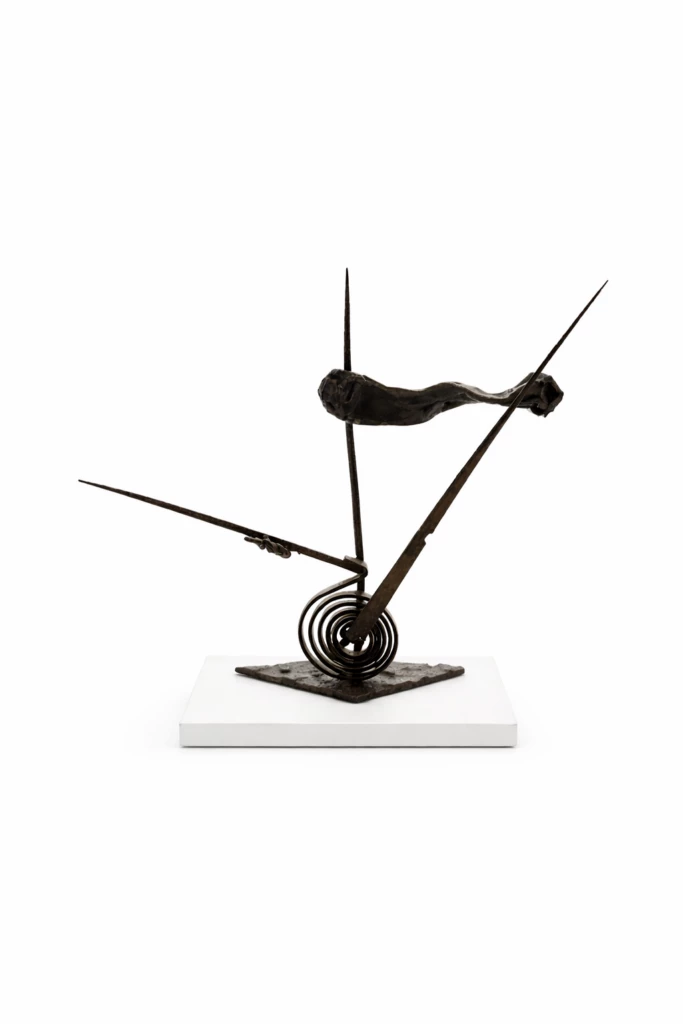
A studio is not premises. It is a stock of material accumulated over twenty years, tools set at the right height, neighbours who tolerate the noise, and an address where people know they can drop by.
For a
The move
He left for Brittany, to Ploudalmézeau in northern Finistère. A large farm barn of seven hundred covered square metres, serving as both studio and home, facing the Iroise Sea. He speaks of it with quiet clarity: « A magnificent region, admittedly a little austere. »
Seven hundred square metres instead of the back of a Paris courtyard. This is not a retreat, it is a change of scale.
What the displacement produced
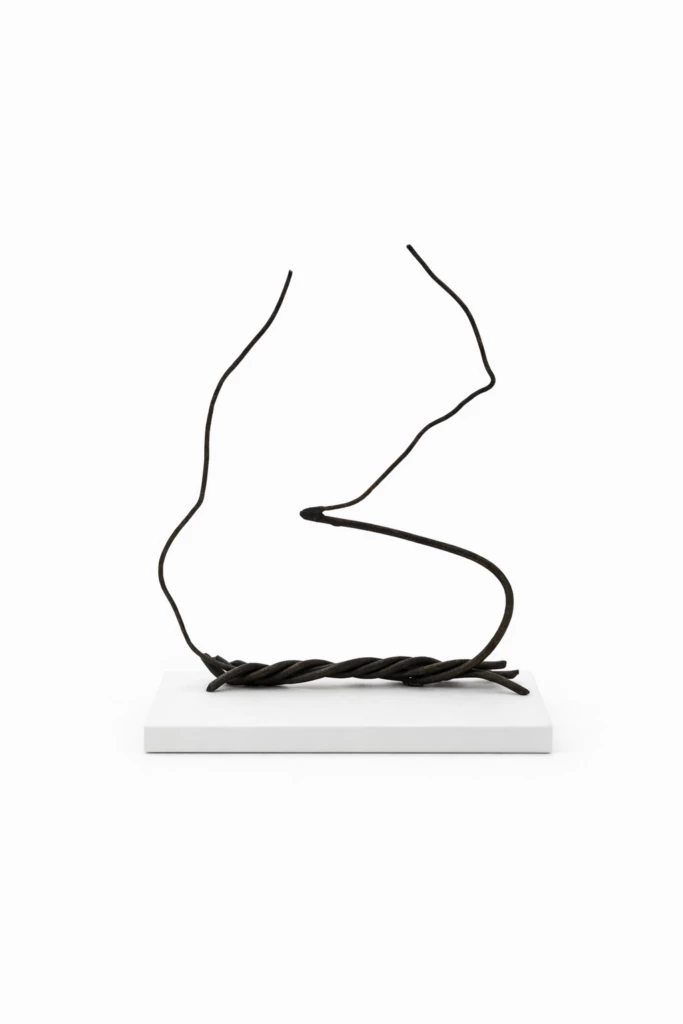
What followed proves him right, and it is perhaps the most interesting part. The work does not stop, it changes. Stone takes a place it did not have, wood and vegetation enter the assemblages, the sea and the coast become subjects. The shift in materials is dated by this eviction.
A whole series was then born of the 2020 lockdown. At over seventy, in a Breton barn, production continues.
A wider question
This story is not only his. It raises the question of artists’ studios in a city rebuilding on top of itself. A studio takes up floor area, makes noise, produces dust and earns little per square metre. It therefore loses the land arbitration almost every time.
The local paper that covered the closure spoke of a waste and a great loss for the arrondissement. Nine years later, the phrase still holds.
Seeing the works
The works of both periods, Parisian and Breton, appear in the complete catalogue, 137 pieces in six groups. His relationship with judo throws light on what the dojo meant, and the Ploudalmézeau studio can be visited by appointment, through contact.