Some paths resemble no other. That of Pierre Le Caër, the Breton
From judo to sculpture: the revelation of 1995
Born in Brest in 1947, Pierre Le Caër first devoted his life to judo, a discipline he practised and taught at the highest level. It was in Paris, in the spring of 1995, that artistic expression revealed itself to him. He never left it again. From that first life he kept a physical relationship with material: precision of gesture, a sense of balance, the patience of repetition.
A studio facing the Iroise Sea
Since then, Pierre Le Caër has worked in his 700 square metre studio in Ploudalmézeau, at the western tip of Finistère, facing the Iroise Sea. It is there that his unique assemblages in metal, wood and Breton stone come into being. « In the same way, the original piece appears on my road. So I seize it, and the work comes into existence », he says of his approach.
The art of assemblage: metal, driftwood, gathered stone
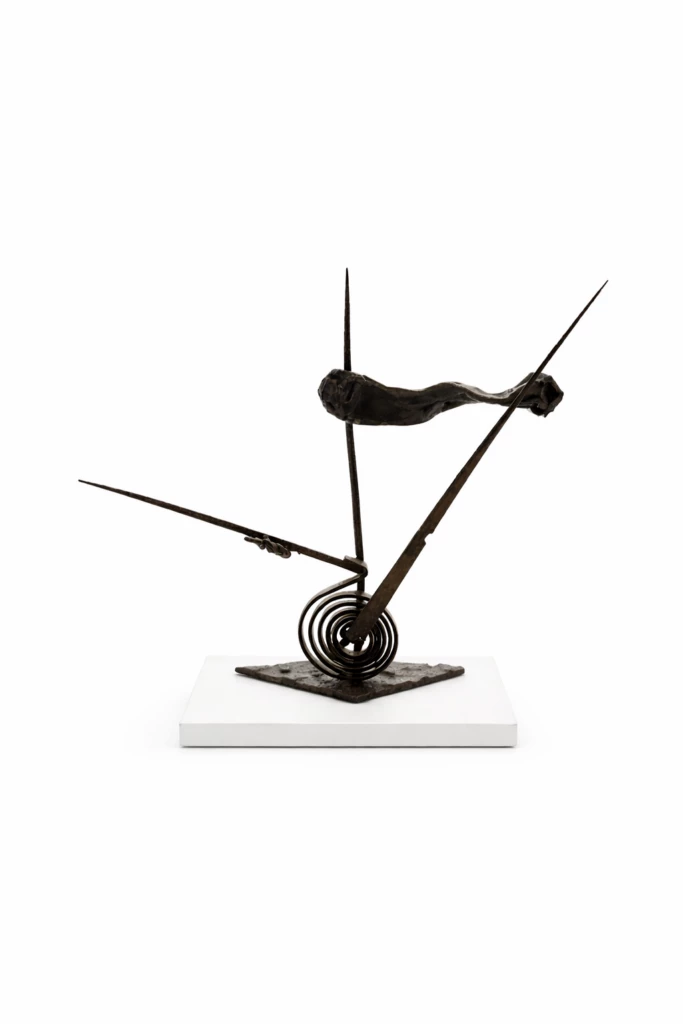
Every work begins with an encounter: a stone picked up on a Breton path, a piece of metal salvaged from a Brest shipyard, a length of driftwood bleached by salt. Assembled with craftsman’s precision and deep intuition, these elements form sculptures charged with a primitive force and a rare sensitivity, unique pieces that speak of nature, of the human, and of Brittany.
From intimate pieces to monumental formats
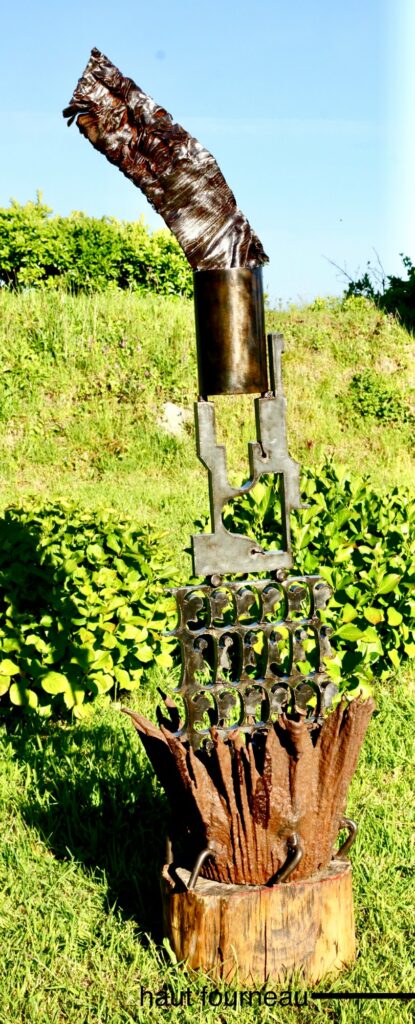
Pierre Le Caër’s work covers every format: intimate pieces such as Serenity or Dog and Cat, monumental sculptures over two metres tall such as Blast Furnace, and emblematic maritime works such as Frigate, cut from the steel plate of a Brest shipyard.
The judoka, with dates
The first life is not scenery, it is documented. Born in Brest on 7 March 1947, Pierre Le Caër began judo in 1961 at the Dojo Brestois, with Claude Urvoy. French cadet champion at middleweight and third in the European cadet championship in 1965, he took bronze at the European junior championships in Lisbon on 2 April 1967, under eighty kilos.
Then came three years in Japan from 1968, and four years in the United States between Reno and San Francisco. He opened his first dojo in Rennes in 1981, stayed eight years, then created the Dojo de la Chapelle in Paris in 1989, in the eighteenth arrondissement.
From 1995 to 2017 the studio and the dojo stood at the back of the same courtyard. He crossed a few metres from one to the other. The relationship between the two practices is the subject of a separate article, because it explains how he makes things hold.
Tatemono, the word he uses
He brought back from Japan a word found in no critical text about him: tatemono. From tate, to stand up, and mono, the object. A tatemono is an object that stands up.
That word is the key to his work, and it rules out three things. It rules out representation, since a tatemono does not represent, it holds. It rules out the plinth as support, since with him the plinth does not hold the work but fixes what already held. And it rules out decorative composition: a piece that holds by a miracle is not pretty, it is correct.
He puts it this way: « For my part I like balance, I like the work to be sufficient for its own stability, and if I add a plinth it is to fix it definitively. »
2017, the departure and what it produced
On 13 August 2017, after twenty eight years, the Dojo de la Chapelle closed, and with it the studio and the exhibition room in the same courtyard. He was seventy, and he left for Brittany.
The work did not stop, it changed. In the barn at Ploudalmézeau, stone takes a place it did not have, wood and vegetation enter the assemblages, the sea becomes a subject. He sums up that influence in one sentence: « My work is subject to the influence of the region: sea and coast. Strength, permanence and beauty. »
A whole series was then born of the 2020 lockdown. At over seventy, production continues every day.
Acquiring a work by Pierre Le Caër
ARTDELION represents Pierre Le Caër and offers a selection of his works for acquisition, acting as the artist’s agent. Each sculpture is a