There is one word in Pierre Le Caër’s vocabulary that appears in no piece of art criticism about him. He is the one who uses it, and it comes from Japan, where he spent three years from 1968. The word is tatemono.
Two syllables, one definition
The artist gives the translation himself: tate, to stand up, and mono, the object. A tatemono is therefore an object that stands up. Nothing more, and that is exactly what makes the word valuable.
A variant appears in a critical text from 2001, where tate becomes to hold in balance. The two translations do not say quite the same thing, and that hesitation may be the best way into his work. To stand up is a state. To hold in balance is a continuous action, something that could stop.
His sculptures sit exactly between the two.
Why a Japanese word
Pierre Le Caër did not come to sculpture through art school. He came through judo, a discipline he practised and taught at the highest level before he held his first piece. Japan is not a distant aesthetic reference for him, it is a three year stay, a language heard every day, a bodily practice learned on the spot.
So when he looks for a word to name what he makes, he does not look for it in the history of Western sculpture. He takes it from where he learned to stand up.
What the word rules out
A precise word excludes as much as it designates. Tatemono rules out three things.
It rules out representation. A tatemono does not represent, it holds. Many of his pieces carry figurative titles, but the title comes afterwards, often last.
It rules out the plinth as support. With him, the plinth is not what allows the work to hold, it is what fixes it once it already holds. He says so plainly: « For my part I like balance, I like the work to be sufficient for its own stability, and if I add a plinth it is to fix it definitively. »
Finally it rules out decorative composition. A piece that holds by a miracle is not pretty, it is correct. « When a work is balanced, it already has a great part of harmony. »
Doubt as method
The most revealing passage in his own texts is the one where he describes what happens between two elements and a third.

« But two is beautiful, is it enough? Will a new addition strengthen it, weaken it? The doubt is there, the balance can be broken. »
This is not an artist’s affectation. It is a technical description of what an assemblage does: each addition is a physical risk, not only an aesthetic one. One piece more and the thing no longer holds.
A found object is not a work
On this he is categorical, and it separates his practice from much of what is done with salvaged material.
« However beautiful it may be, alone and isolated, it will remain a creation of nature or of chance, but not that of the artist. »
In other words: a remarkable stone picked up on a path remains a stone. It becomes a work only at the moment when it is put in tension with something else, and when that tension holds. The artist’s act is not finding, it is making things hold together.
How the word changes what you see
Try it on any piece in his catalogue. Do not look for what it represents. Ask instead what stops the whole thing falling over, and at which precise point that happens.
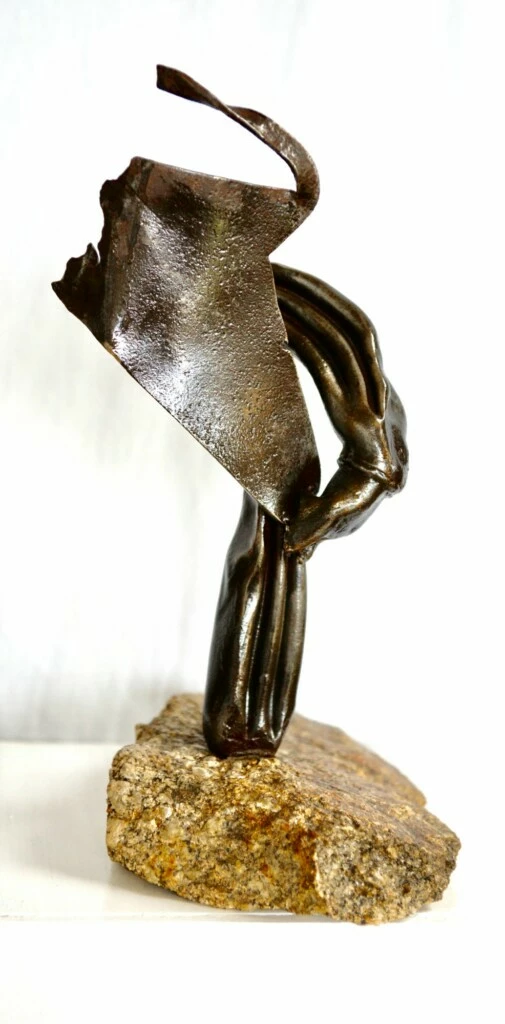
Almost always there is a single point. An axis, a weld, a bearing. Remove it and everything collapses. That is where the work is, and that is what the word tatemono exists for.
Going further
Pierre Le Caër’s complete catalogue holds 137 pieces. The works currently available are in the shop, and ARTDELION, the agency that represents him, answers questions through contact.