An agency is judged on its artists. ARTDELION represents two, which is few and deliberate. Two very different approaches, three hundred documented works, and one thing in common that is not incidental: both men assemble found material.
Pierre Le Caër, Breton material
Pierre Le Caër was born in Brest in 1947. Before sculpture there was elite judo, Japan where he spent three years from 1968, San Francisco, Reno, then a dojo he opened in Paris in 1989 in the eighteenth arrondissement. Artistic expression arrived late and all at once, in the spring of 1995: a thin strip of oak, two old nails, and a composition exists.
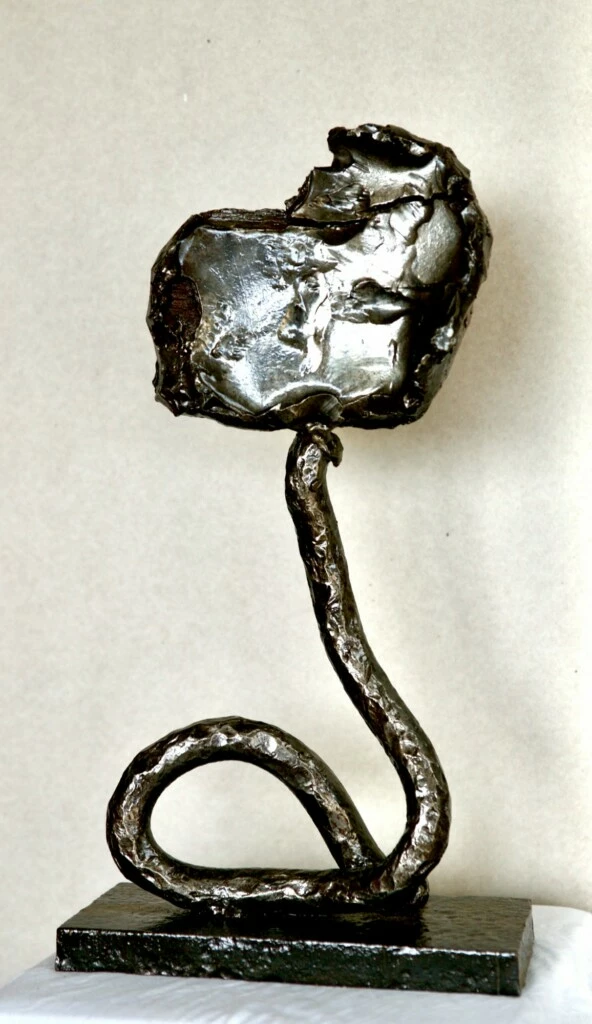
Since then he has assembled every day. Forged metal, Breton stone, bark, driftwood, shells picked up while walking. His works have been shown at the Crédit Mutuel de Bretagne, at the French Judo Federation, at Brest city hall and at Galerie Bastien in Brussels. He works today in a 700 square metre studio in Ploudalmézeau, facing the Iroise Sea.
His complete catalogue holds 137 pieces in six groups, from early works of the 1990s to the suspended stones, a series in which pebbles held by copper wire or rope float without touching anything.
Gabriel Lemaire Sicre, the machines of Graulhet
Gabriel Lemaire Sicre spent some twenty years in computing before giving his life to colour. He painted first, thrown onto large plywood panels. In August 2013 he left the Paris region, looked for a large building in the south and arrived in Graulhet, in the Tarn, in a completely empty factory built in 1955.
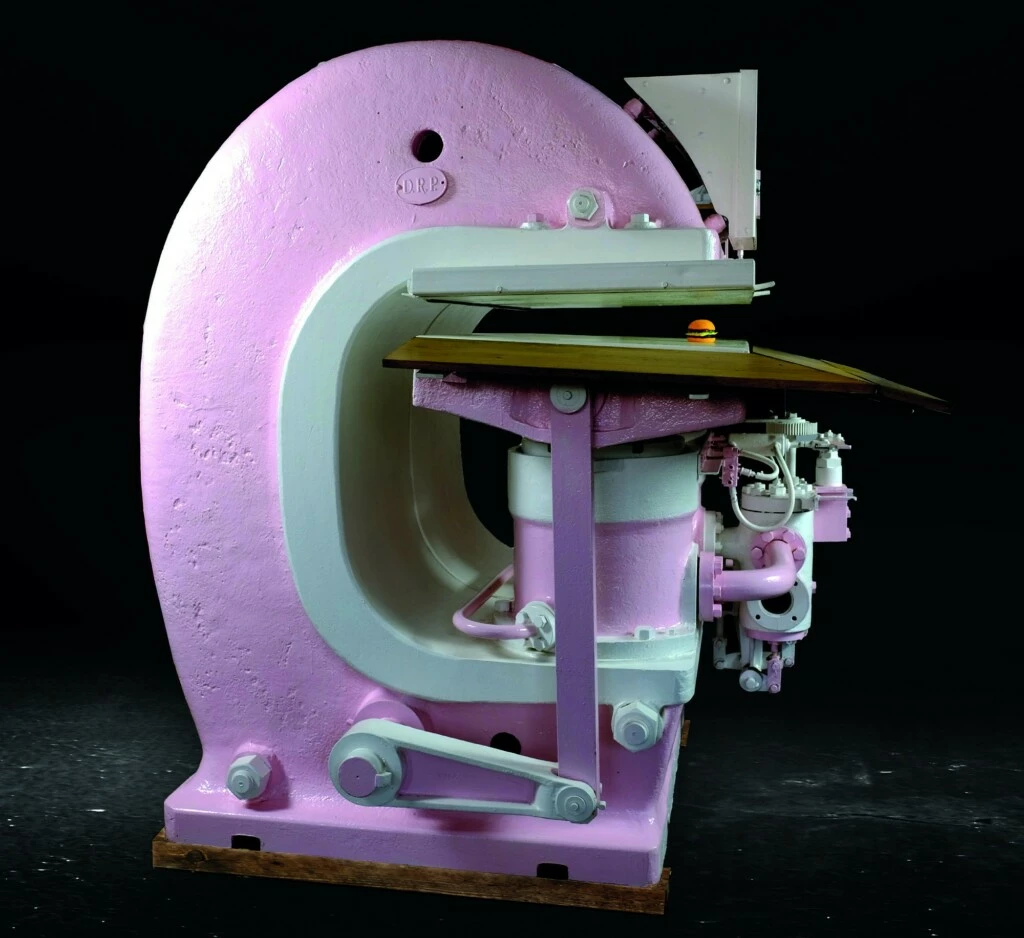
The place explains the work. Graulhet was one of the world capitals of leather, specialising in tawing. The decline of that single industry left abandoned machines behind it, in derelict sites and in engineering workshops. The first piece was a twenty tonne press, found in a car park, which the artist describes as the most imposing Pac-Man he had ever seen. It had escaped the scrap dealer because the weight of the metal did not cover the cost of hauling it to the foundry.
Since then he strips, degreases with a small kitchen knife, primes and paints. « To reach the moment of grace, you have to go through the moment of grease. » The colours come straight from the tin, unmixed, chosen so that the work can be restored if it fades. Some pieces weigh several tonnes and the colour takes their mass away.
His complete catalogue holds 163 works in thirteen chapters, from a pantheon of machines turned into gods to the early paintings. None is for sale: Le Paradis des Machines is a collection, and the place can be visited.
What the two have in common
Neither of them buys his material. The metal, the stone, the wood, the machine, everything comes from what somebody else abandoned. With Pierre Le Caër it is the chance of a walk, with Gabriel Lemaire Sicre it is the end of an industry. In both cases the work begins with a look directed at an object nobody wanted any more.
It is also why none of their pieces is reproducible. There is no edition, no series, no print run. One work, one copy.
Seeing and acquiring
Both catalogues are reachable from the catalogues page. The works currently available for acquisition are gathered in the shop. For a question about a specific piece, a studio visit or a request for information, contact is direct.
Artists who wish to join ARTDELION go through the application page.