The works in Le Paradis des Machines carry names that mean nothing to anyone today: fleshing machine, tanning drum, staking machine, glazing machine, buffing machine. They are nonetheless precise words, each naming one stage in the passage from hide to leather. Here is what each machine did, in the order of the chain.
What tawing is
First point to establish, because the confusion is universal. Tanning proper treats large hides, those of cattle. Tawing, mégisserie in French, treats small skins, sheep and goat, for footwear, glove making and clothing.
The French word comes from mégis, an old term for a bath of water, alum, salt and ash. Graulhet was one of the world capitals of this activity, specialising in basane, skin tanned with vegetable extracts.
The wet phase, known as beamhouse work
The fleshing machine. It comes after unhairing. The skin is still loaded with epidermis and fat. The machine has several rollers and a blade: the rollers draw the skin towards the blade, which scrapes it. It removes the epidermis, the remaining hair and the excess fat, and exposes the dermis. Two workers operate it, one placing the skin, the other stretching it.
The tanning drum. This is the beating heart of the workshop. A barrel turning on its axis, filled with water and tanning agents. Tanning happens here, then dyeing and fatliquoring. The French word foulon comes from the Latin fullonem, the one who presses cloth, and is attested in French since the twelfth century.
The dry phase, currying and finishing
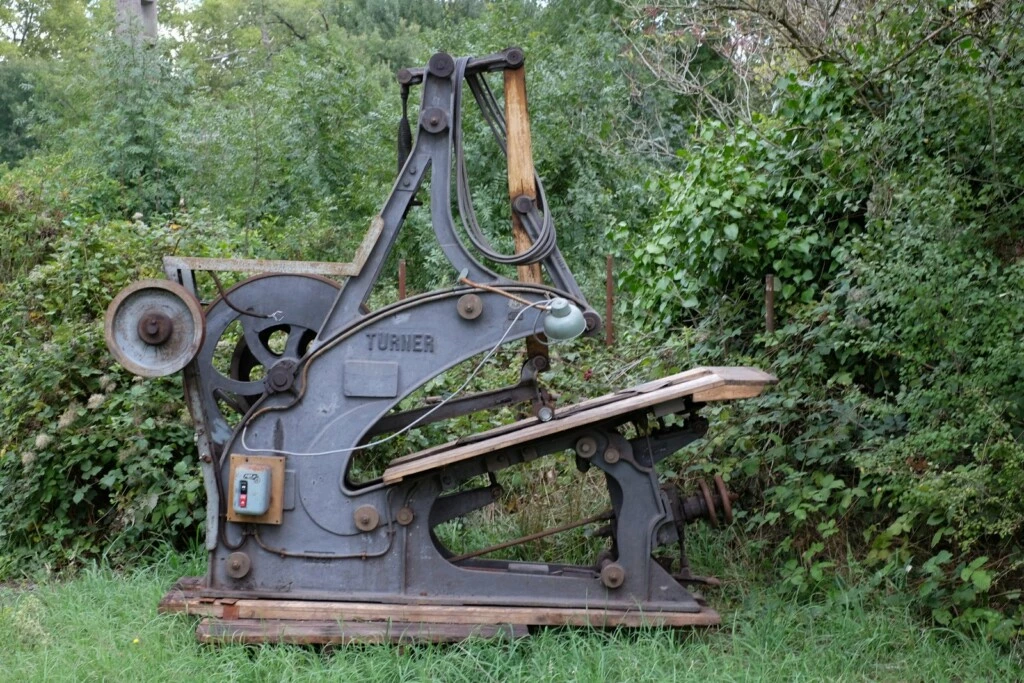
The press. After tanning the skin is soaked. It has to be wrung out, and that is what presses are for. Heated, they also serve for graining and embossing.
The staking machine. The tool of softening. In its original form a solid wooden bench with a half moon iron blade set into it, with a rounded edge, over which the worker pulls the skin. The word palisson is attested as a leather worker’s tool since 1723. The mechanised version is the palissonneuse.
The glazing machine. A finishing machine, which flattens and brings a shine to the grain, the outer face of the leather. The French verb lisser is attested in this sense since the fifteenth century, for the calendering of cloth.
The buffing machine. The sanding machine. Buffing gives leather its velvet surface, and produces velour, nubuck or suede. Buffed leather reacts to light in a way glazed leather does not.
The words that are in no dictionary
Two entries in the collection raise a fascinating problem.
The punching machine is well defined in dictionaries, but as a metalworking tool: a solid punch and a hollow die, for perforating. In leather the principle is identical, but the use belongs more to leather goods, for eyelets and perforations, than to tawing.
The refouloir is the most interesting case. Dictionaries give three definitions, and none concerns leather: in artillery, a wooden cylinder on a pole for pushing the charge to the base of the barrel; in technology, an iron tool with a toothed end for tamping mortar; in locksmithing, a forged iron spring.
The common sense is therefore simply that which pushes back. Which very probably means that refouloir is a workshop word, particular to the Graulhet tawing houses, that was never recorded. In other words, a word the disappearance of the industry carried away with it, and whose only surviving witness today is a painted machine.
We will not invent its function. We prefer to leave the question standing.
Why this vocabulary matters
A machine whose function you do not know is only a shape. A machine you know scraped the fat off a sheepskin so that it could become a glove is something else.
The complete catalogue holds 163 works in thirteen chapters. The two most demonstrative transformations show the same machine before and after, and the history of Graulhet explains why these machines ended up in the brambles.