Une machine de mégisserie qui pèse deux tonnes ne se met pas sur un socle par magie. Entre le moment où Gabriel Lemaire Sicre la repère dans une friche et celui où elle est peinte, il y a un travail dont personne ne parle jamais, et qui prend des mois.
1. Trouver
Le point de départ n’est pas un atelier, c’est un terrain. Une friche, un dépôt d’atelier de construction mécanique, un parking. Les machines qui ont survécu ont survécu par accident : le poids du métal ne compensait pas le prix du transport vers la fonderie. Elles ont donc échappé au ferrailleur pour une raison purement comptable.
C’est une chose à garder en tête devant une pièce du catalogue. Chacune de ces machines a été à quelques euros de disparaître.
2. Décider, sans savoir
À ce stade, la machine est couverte de graisse, de rouille et de végétation. Elle est parfois couchée, parfois encastrée. Décider de l’emporter, c’est décider sur une silhouette devinée, sans savoir ce qu’il y a dessous, ni si la pièce sera démontable.
3. Transporter
C’est l’étape la plus physique et la plus coûteuse. Un camion, une grue, des sangles. Une machine se charge rarement debout, et il faut souvent la redresser sur place avant de pouvoir la lever. Rien de tout cela n’est réversible : une pièce mal manipulée se tord, et une machine tordue ne se redresse pas.
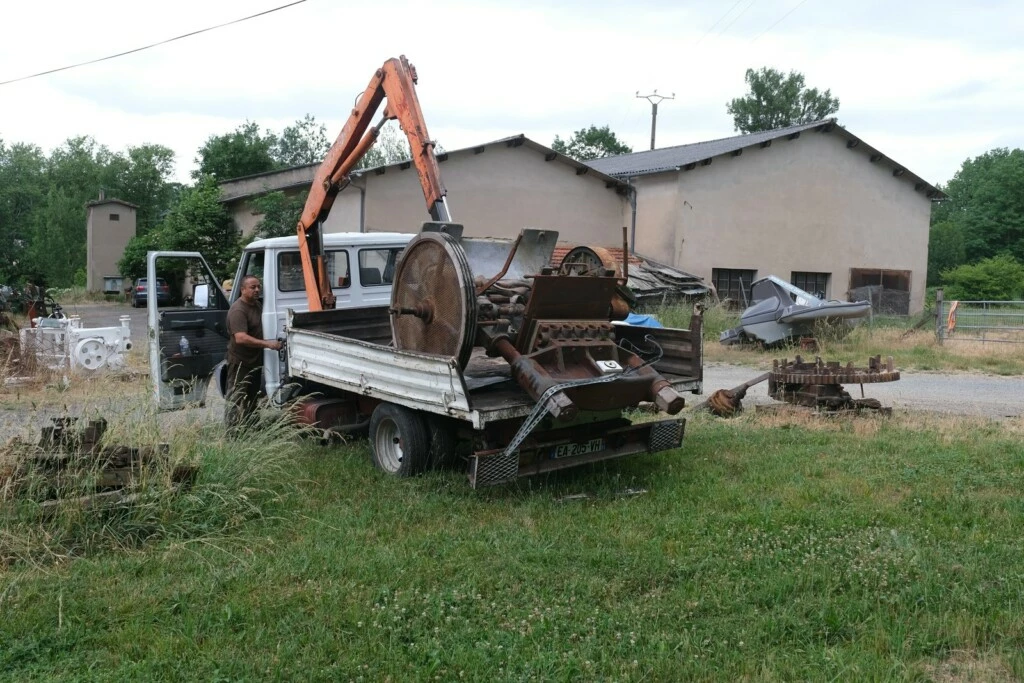
4. Démonter
Une fois arrivée, la machine est démontée. Cette étape est celle qui distingue radicalement ce travail d’un simple déplacement d’objet. Démonter, c’est comprendre : découvrir comment la peau passait entre les rouleaux, où était la lame, comment la transmission arrivait de l’arbre à poulies.
Ce savoir est perdu partout ailleurs. Les ouvriers qui utilisaient ces machines n’écrivaient pas de mode d’emploi, et les notices constructeur ont disparu avec les usines.
5. Dégraisser
C’est l’étape la plus longue, et la moins spectaculaire. Cent ans de graisse minérale, de poussière de peau et de tanin, à retirer pièce par pièce. Le travail se fait au petit couteau de cuisine, littéralement.
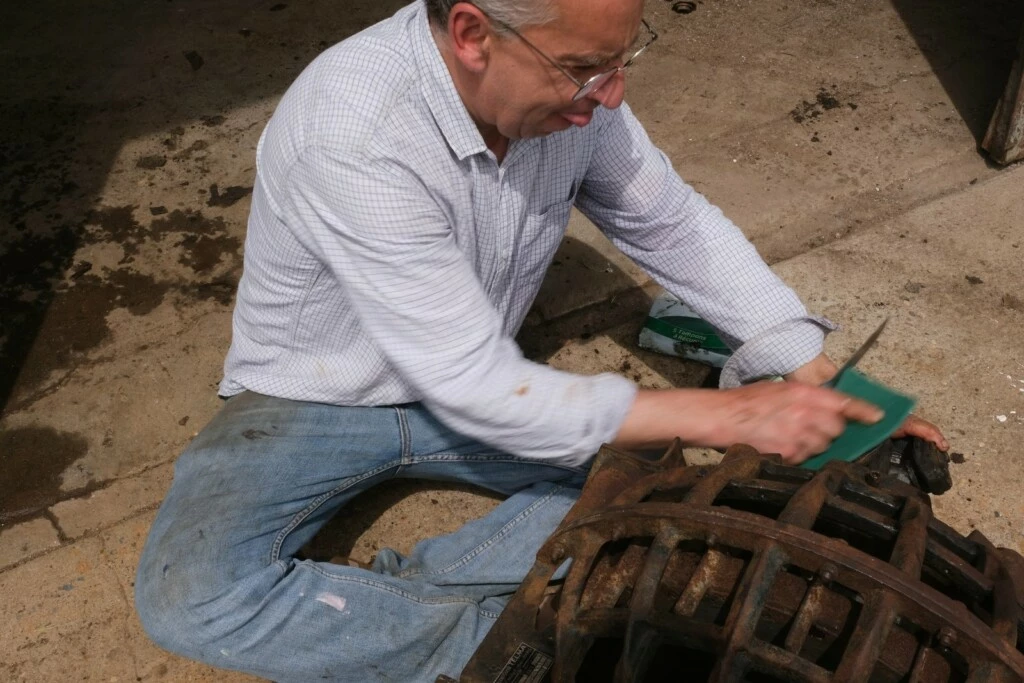
L’artiste en a fait une formule qui résume tout son travail : pour arriver à l’instant de grâce, il faut passer par l’instant de graisse.
6. Apprêter, puis peindre
Vient enfin la couleur. Un apprêt, puis des couleurs sorties du pot, sans mélange. Ce choix technique n’est pas esthétique, il est patrimonial : une couleur non mélangée peut être retrouvée à l’identique. Si la pièce se fane dans vingt ans, elle sera restaurable. Un mélange, lui, ne se refait jamais deux fois pareil.
Et il y a l’effet, qui est le vrai sujet : certaines de ces pièces pèsent plusieurs tonnes, et la couleur leur retire leur masse. Une machine qui écrasait un atelier devient légère.
Ce que cela change pour un visiteur
Savoir tout cela modifie ce qu’on regarde. Une machine peinte n’est pas un objet trouvé posé sur un socle. C’est une machine qui a été trouvée, hissée, démontée, comprise, nettoyée pendant des semaines, remontée, apprêtée et peinte.
Le catalogue complet réunit 163 œuvres en treize chapitres. Aucune n’est proposée à la vente : Le Paradis des Machines est une collection, et le lieu se visite. Pour comprendre ce que faisait chacune de ces machines, un glossaire de la mégisserie est publié à part. Pour organiser une visite, le contact est direct.