Before the machines there is colour. That is the real order of things, and it is worth restoring: Gabriel Lemaire Sicre was a painter before he built Le Paradis des Machines. Most of his paintings were made before he arrived at Graulhet in 2013. The machines then took up almost all his time.
His meeting with painting he sums up in one sentence: the will to go beyond a world of computing whose limits he was living, towards something richer, through an impulse towards colour.
Plywood, and projection
It all began with paint thrown onto large sheets of plywood. He uses a precise word for the result: magical. Those panels revealed genuine paintings.
Two decisions are already taken in that gesture, and they will never move again.
The first is the support. Plywood is not canvas. It is an industrial panel, rigid, mass produced for something else. Laying colour on it means already working on an object industry has made. Nine years later he will lay colour on presses and smoothing machines. The principle is the same, the support has simply gained weight.
The second is the colour itself. It is thrown rather than laid down, and it comes straight from the tin. That rule still holds for his machines: the colours are all original and unmixed, which means a work can be restored if a shade fades or a scratch happens. A painter’s constraint has become a conservation guarantee.
A mosaic mind
Alongside that work he built a body of mosaics. Here again his own formula beats any commentary: what he paints and what he writes is himself, a mosaic personality, a non linear mind, with sharp colours and clearly cut outlines.
Anyone looking at his paintings sees exactly that. Frank zones separated by clean edges, which do not fade into one another. No haze, no obliging gradient. Each colour holds its territory and defends it.
In 2009 he painted a square world map in which, he says, his structure and his dynamism are articulated, surrounded by his flesh, symbolised by red. It is a self portrait that shows no face.
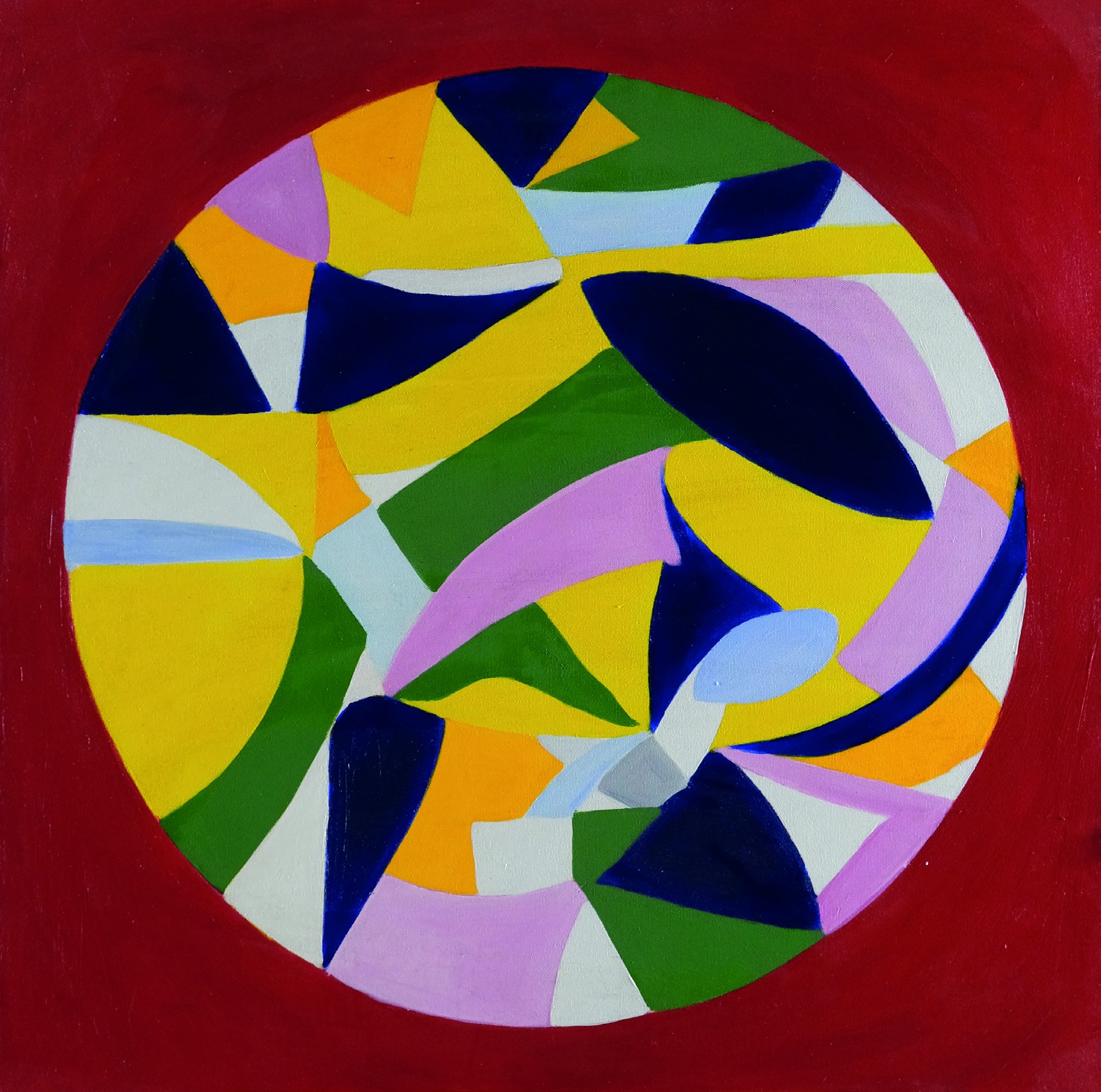
Bach, balance, and a king lying down
Music is not a side interest. He plays the piano, essentially Bach, whom he holds to be a source of endless teaching. And he draws from it a definition of his own work: music is a search for the balance of sounds, and that quest for balance and rightness is one of his driving forces.
He pushes the comparison into a concrete experiment. A painting of 2016 shows a king when you look at it vertically, and a musical score when you tip it on its side. His conclusion: there is no difference. In both cases you see forces balancing harmoniously to bring another reality into being.
He adds, and this is essential to understanding his work, that the painting is not the result of a theory built in advance. He read and understood it that way much later. Nothing, with him, begins with a concept.
Women, flowers, children
The subjects of his paintings return with a quiet regularity: women, flowers, children at play, maternities. And he describes how they turn into one another. Flowers, he says, are like women: he sometimes begins a painting to make a bouquet and, turning it upside down, it produces a woman.
That sentence describes an entire method. The form is not decided and then executed, it is found along the way, often by changing which way up the picture goes. Exactly as a gearbox laid on its side becomes a madonna.
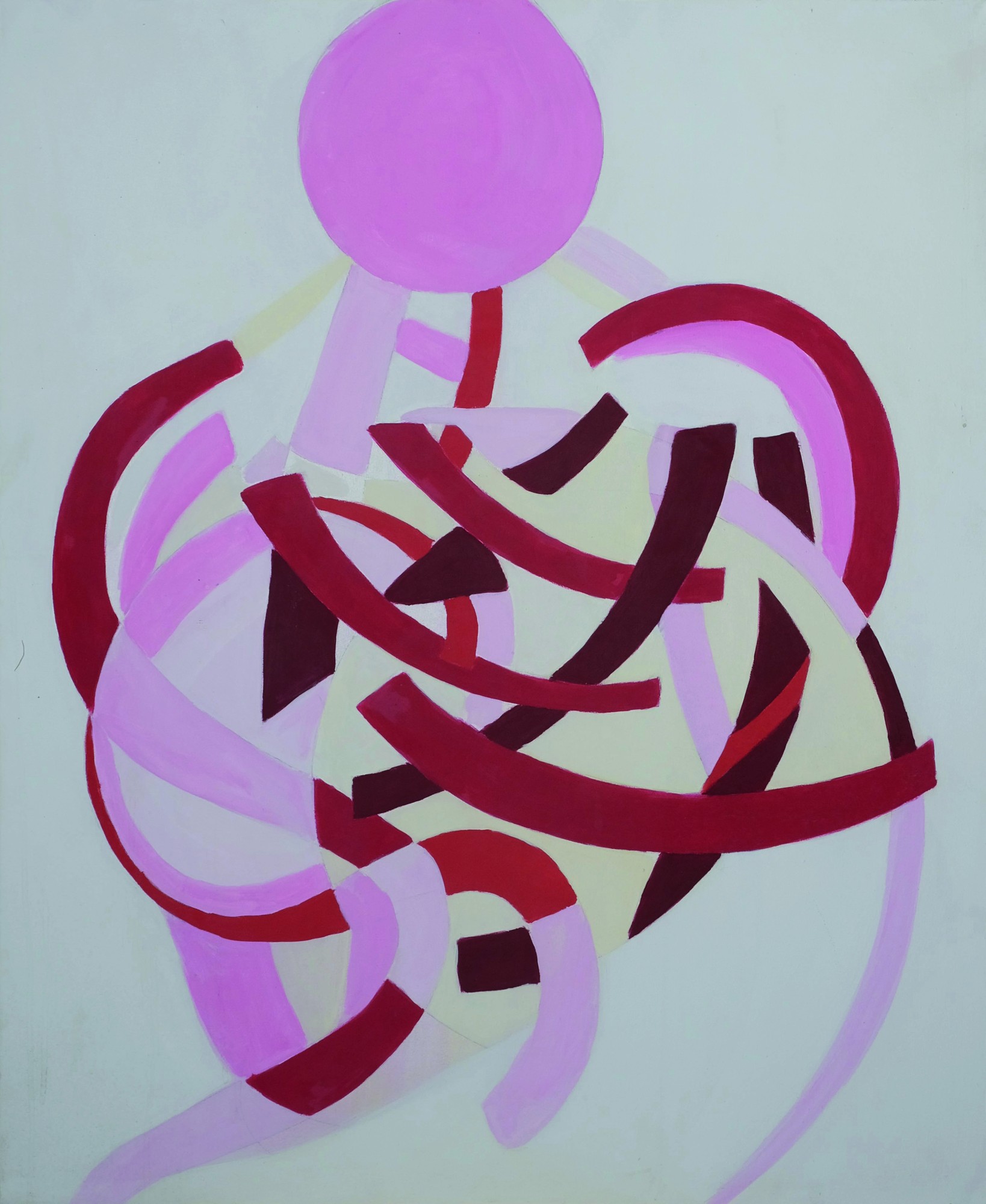
These paintings are published in his catalogue along with the rest of his work, and they deserve to be looked at in that order. They are not early works to be excused before reaching the machines, they are the laboratory in which everything that follows was worked out: the cut outline, the pure colour, the balance of forces, the subject found rather than programmed.
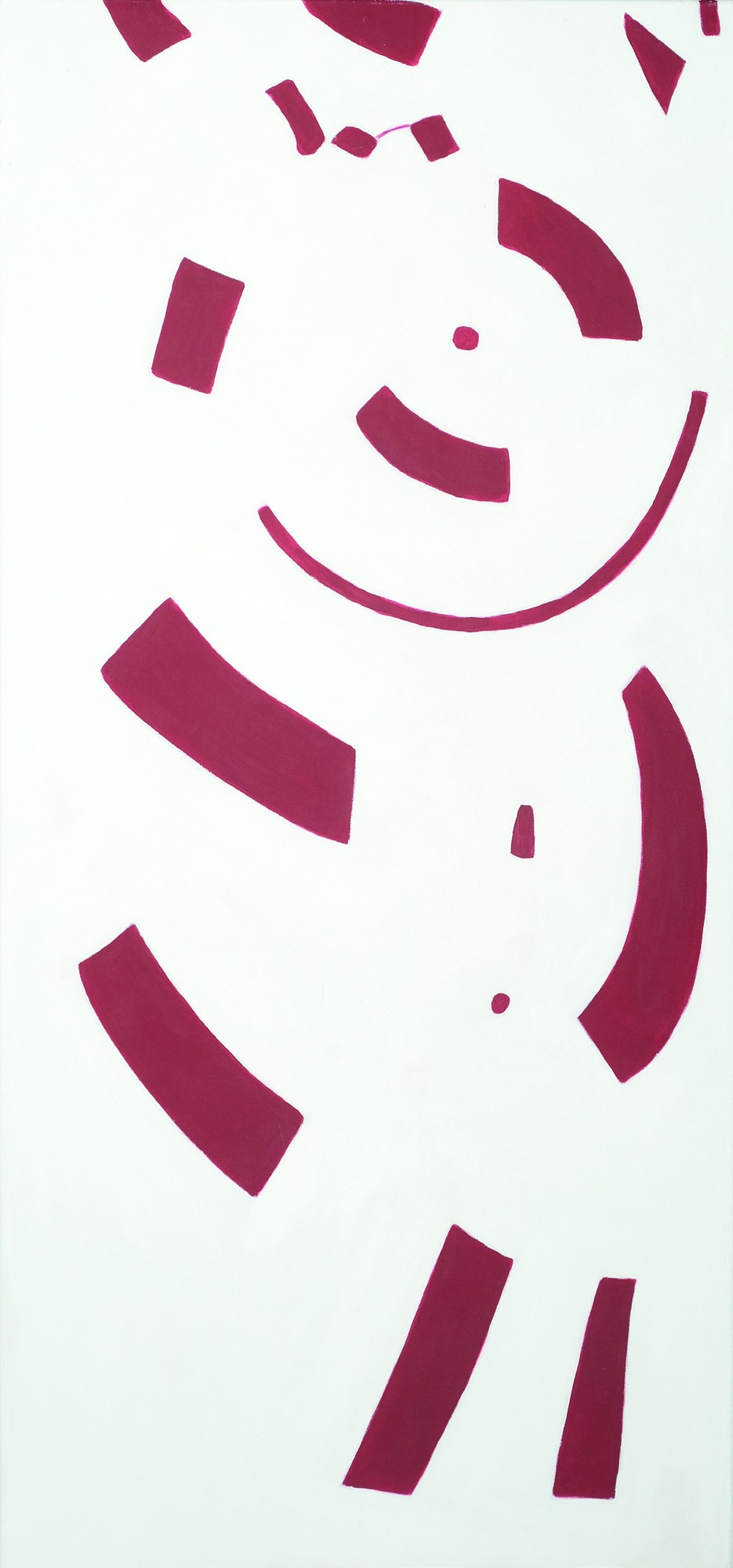
What painting gave the machines
When he stands before his first machine, on a car park in Graulhet, he is not discovering colour. He already has a pictorial language, a palette, a relationship with the industrial support and a method of searching by trial.
All that remains is to change scale and material. That will take ten years of work, and it is the story his research around the machines tells. For his background and his family, read his biography.