There is a difference between seeing photographs of painted machines and standing in front of a two tonne piece whose colour has erased its weight. Le Paradis des Machines is a place, in Graulhet, in the Tarn, and it can be visited.
What it is
A collection of industrial machines from the leather trade, dismantled, degreased, primed and painted, gathered in a former industrial building in the town.
The whole is run by an association declared in March 2025, whose purpose is to promote and develop the plastic arts, sculpture, digital and decorative arts within a museum. The place has been open to the public since November 2025, and it appears in the heritage inventory of the Tarn tourist board.
What you see
The catalogue gives the measure of it: one hundred and sixty three works, in thirteen chapters. These are not thirteen rooms, they are thirteen families of reading.
A pantheon of machines turned into gods. The gods. The humans. The living world. Le Paradis des Machines and its author. And at the end, the early paintings, those from before the machines, painted on large plywood panels.
The route is therefore not chronological, it is thematic. One machine can be a god and another an animal, when both did the same job in the same factory.
The entrance
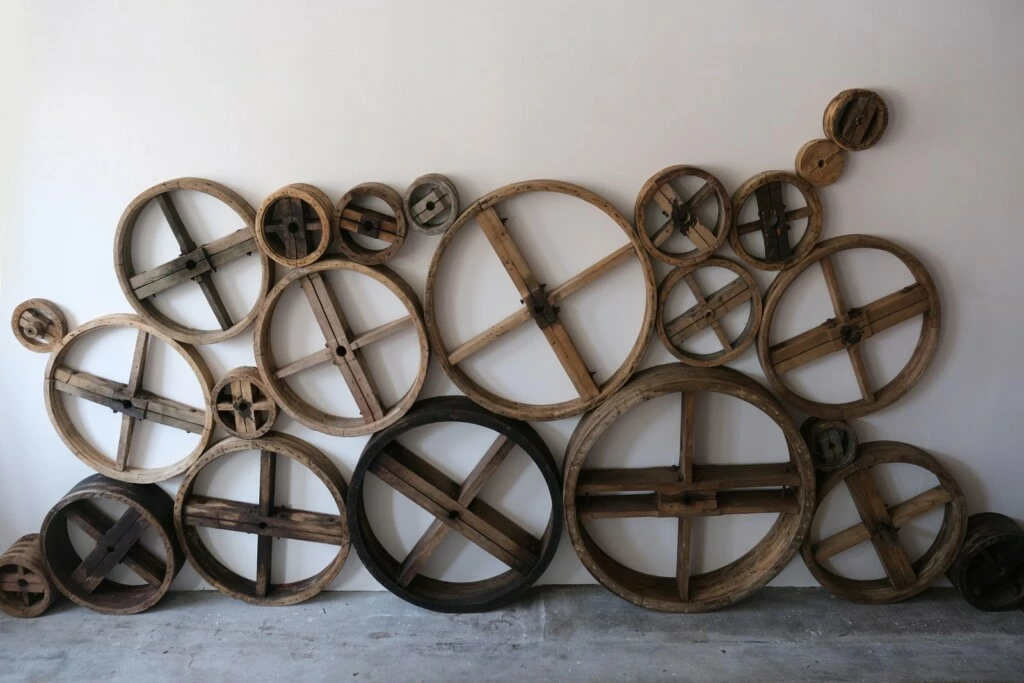
The first object you meet is not a complete machine but a wall of wooden pulleys, set against one another in decreasing sizes. It is a good warning: what is shown here is not a collection of mechanical curiosities, it is a work of composition.
These pulleys came from the line shaft and belt systems that powered workshops before machines were individually electrified. They have had no function for a century.
Why nothing is for sale
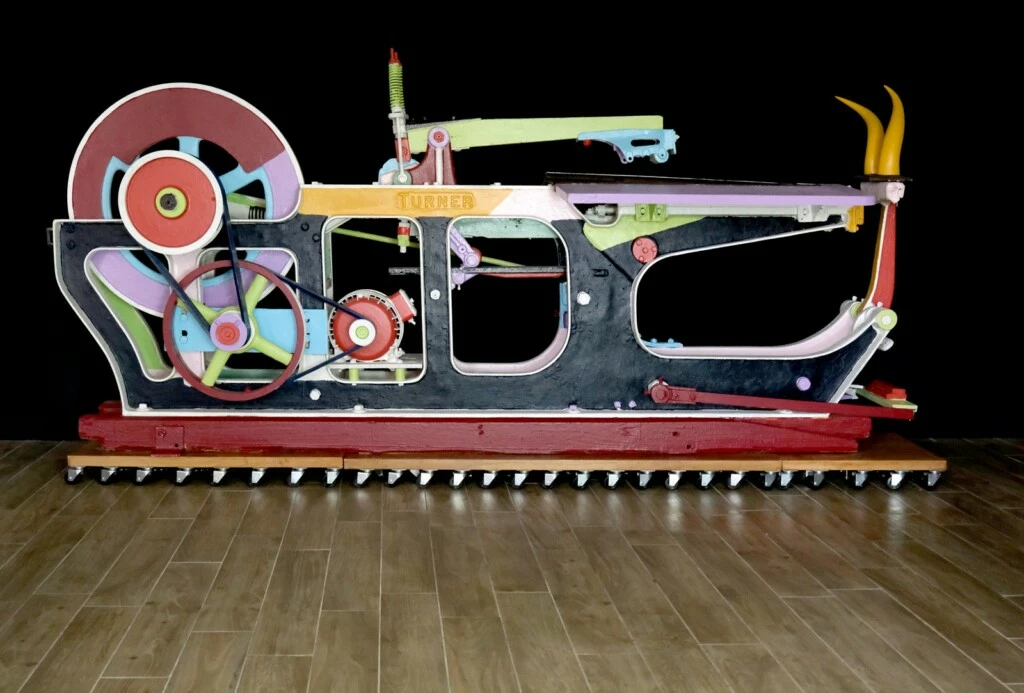
This is the question the agency receives most often, and the answer is simple. Le Paradis des Machines is a collection, not stock.
Three reasons, and they hold. Coherence first: a collection from which the strongest pieces are removed stops being a collection. Weight next: several pieces are counted in tonnes, and moving them is a building site, not a delivery. Meaning last: these machines were already dispersed once, when the factories closed. Gathering them and then selling them off one by one would reproduce exactly what the work sets out to repair.
That is why the complete catalogue is published in full, with the dimensions and materials of every piece, but without prices. Each listing says so.
What a visit adds
Three things a photograph does not give.
Scale. A tanning drum is a barrel you walk into. A twenty tonne press cannot be understood on a screen.
The sound of absence. These machines were loud, they were numerous, they ran together. Seeing them still and silent in an industrial building produces an effect that cannot be photographed.
And the smell of the building, which is the smell of every old leather workshop.
Arranging a visit
The place receives individual visitors and groups. The adult admission is twelve euros, and group capacity goes up to seventy five people. Current practical information is held by the Tarn tourist board, and the agency can make the connection for a guided visit or a particular request.
A few streets away, the town has a Maison des Métiers du Cuir, installed in a former factory on the banks of the Dadou, which presents the stages of turning a skin into leather and keeps the tools and machines in their original function. The two places complement each other: one conserves, the other transfigures. Seeing both on the same day is the best way to understand what the second one does.
Preparing a visit
The glossary of machines lets you arrive knowing what each tool did. The history of Graulhet in figures explains why these machines were available. And the transformation process tells what happens between the derelict site and the plinth. For a visit request, contact is direct.