Exhibiting an industrial machine on a plinth is not a new idea. It has a precise history, with dates, and placing Gabriel Lemaire Sicre’s work within that history is more useful than looking for an artist he resembles.
1934, Machine Art at MoMA
The most accurate reference is also the oldest. From 5 March to 29 April 1934, the Museum of Modern Art in New York presented an exhibition titled Machine Art. The curator, Philip Johnson, masked the building’s decorative mouldings to obtain a bare presentation, and showed utilitarian manufactured objects across three floors: springs, kitchenware, scientific instruments.
They were set on plinths. Visitors found ordinary industrial objects raised to the level of sculpture. The exhibition even included a beauty contest, judged among others by the aviator Amelia Earhart and the philosopher John Dewey.
The gesture is exactly the one at Graulhet: the plinth, the isolation, the aesthetic gaze turned on a tool of production. With ninety years between them and one decisive difference. Johnson exhibited new, anonymous, mass produced machines. Lemaire Sicre exhibits dead and located machines, whose factory and trade can be named.
The Bechers, or anonymous sculptures
From 1959 to 2007, Bernd and Hilla Becher photographed disappearing industrial architecture: cooling towers, gasometers, silos, coking plants. First in the Ruhr, then in Britain, France, Belgium and North America.
The title of their major publication says everything: Anonyme Skulpturen, anonymous sculptures. They saw these structures as sculptures, and classified them by function in comparative grids they called typologies. Golden Lion at the Venice Biennale in 1991, Erasmus Prize in 2002.
The kinship is structural. A collection of machines classified by trade, a glazing machine, a fleshing machine, a tanning drum, is a typology in the Bechers’ sense.
The difference is in the gesture. The Bechers record without touching. They document a disappearance. Lemaire Sicre dismantles, degreases and paints. He intervenes against the disappearance. One is an observation, the other a refusal.
The limits of the ready-made
The comparison with Duchamp will occur spontaneously to many visitors, and it is better to address it than to suffer it.
The ready-made rests on a displacement of context with no work of the hand. The object is not modified, only its status changes.
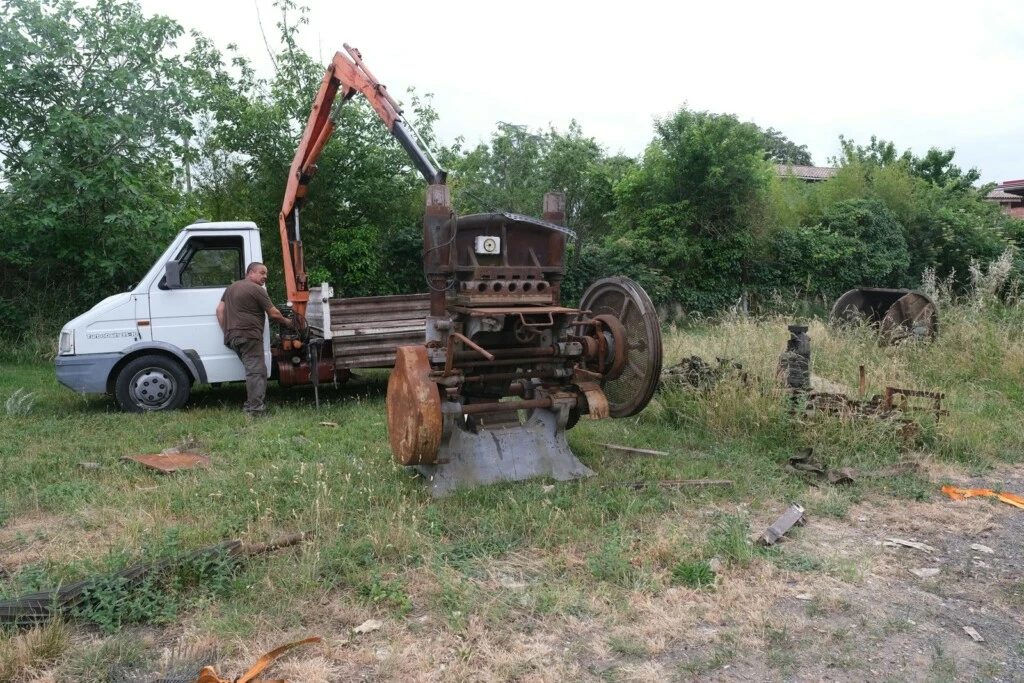
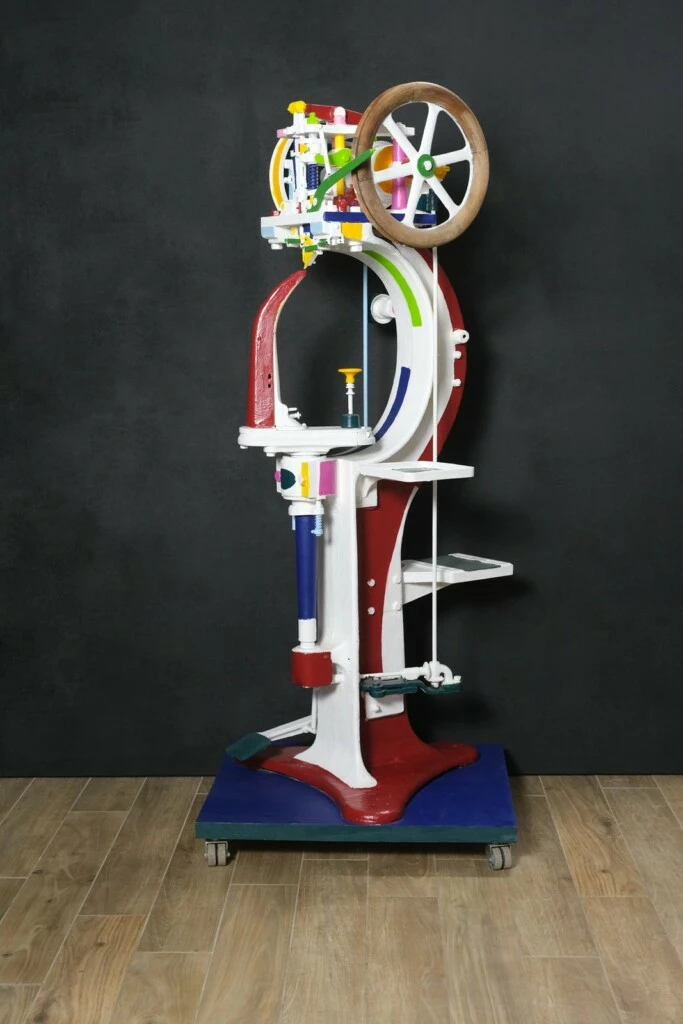
Here that is not the case. There is dismantling, weeks of degreasing with a knife, priming, painting part by part. The gesture is far closer to polychrome sculpture, or to a diverted restoration, than to the ready-made. The found object is the starting point, not the work.
Colour, and a caution
The colours come straight from the tin, unmixed. That is a technical choice before it is a plastic one, since an unmixed colour can be matched again and therefore restored. But the effect is certainly plastic: the flat industrial colour separates the parts and makes the mechanics legible.
Here a caution is required. One could relate this use of colour to several twentieth century painters. We will not do so unless the artist has himself named his references. Inventing a lineage is the commonest fault in texts of this kind, and the easiest for an informed reader to dismantle.
What can be said, on the other hand, is that his own working files contain precise names, and that is the subject of a separate article.
What this work is not
It is not industrial archaeology, which documents and conserves without transforming. It is not technical museography, which puts machines back into working order. It is not interior decoration using industrial objects, which treats the machine as a motif.
It is what remains once those three paths are refused: keep the object whole, do not make it work, and give it a second reading through colour.
Seeing the collection
The complete catalogue holds 163 works in thirteen chapters, from a pantheon of machines turned into gods to the early paintings. None is for sale. The glossary of machines gives the original function of each.