Pierre Le Caër’s path is often described as a change of career: judo first, then sculpture. That is inaccurate. For twenty two years, from 1995 to 2017, he did both on the same day, in the same courtyard, and that was not a matter of convenience.
The judoka, with dates
Born in Brest on 7 March 1947, he began judo in 1961 at the Dojo Brestois, with Claude Urvoy. Results came quickly: French cadet champion at middleweight and third in the European cadet championship in 1965, then a bronze medal at the European junior championships in Lisbon on 2 April 1967, under eighty kilos.
Then came departure. Three years in Japan from 1968, four years in the United States between Reno and San Francisco. He opened his first dojo in Rennes in 1981, stayed eight years, then settled in Paris in 1989 and created the Dojo de la Chapelle, in the eighteenth arrondissement.
One place, two activities
From 1995, the studio and the dojo were at the back of the same courtyard. He crossed a few metres from one to the other. His first audience was not collectors but his own students, and he admits it with rare honesty: « An easy success, because it has to be said, I showed them in the evening, at the judo club bar, to the eyes of my own students. »
An artist more concerned with his legend would have kept that detail quiet. He tells it, and it says a great deal about how he sees the work.
What judo teaches and sculpture requires
Three things carry over from one practice to the other, and they are concrete.
Imbalance as a principle. In judo you do not throw by force, you use the moment when your opponent is off their base. An assembled sculpture works in exactly the same way: it is not mass that holds, it is a precise point where forces are transferred.
Repetition. A judo movement is learned through thousands of repetitions, until it no longer requires thought. Of that first life he keeps « precision of gesture, a sense of balance, the patience of repetition ».
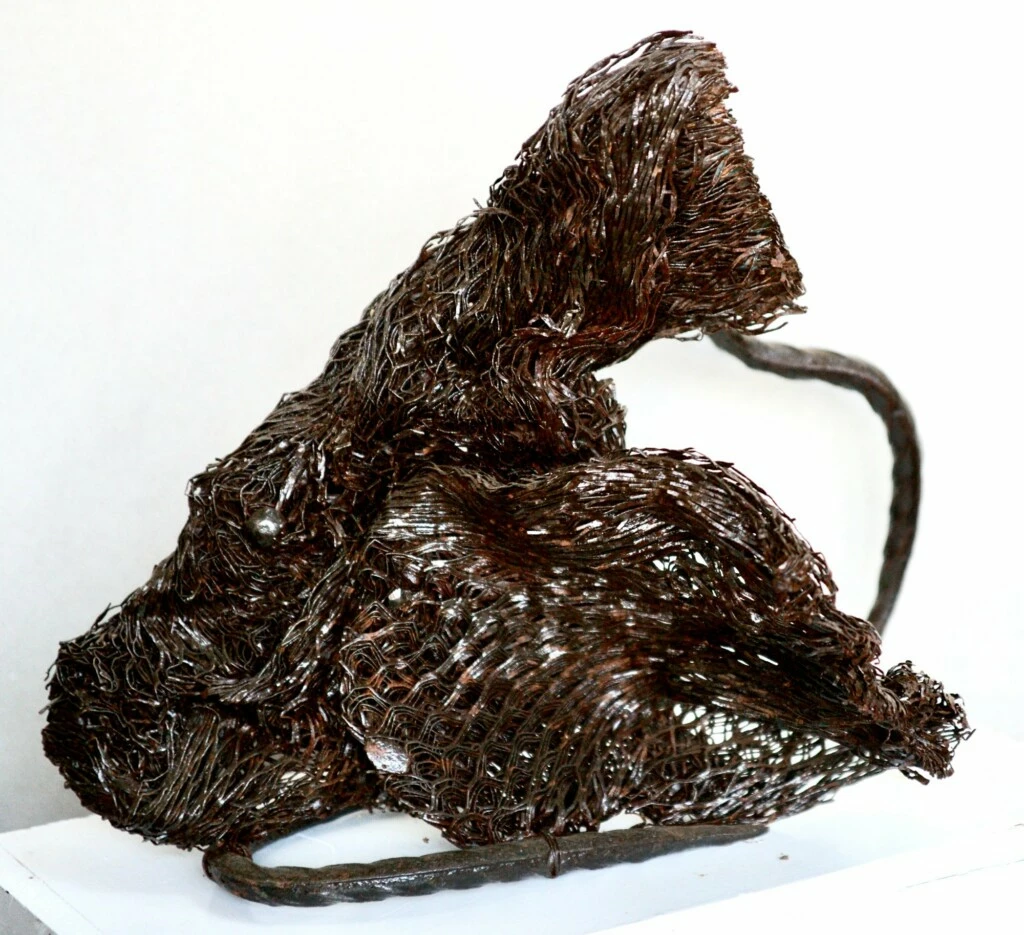
The refusal of display. According to the local paper that covered the closing of his club, he kept the spirit of a judo far from the all competition approach. The same restraint is found in his pieces: nothing is spectacular, everything is held.
Balance is not a metaphor
When he speaks of balance he does not mean harmony in a vague sense. He means statics.
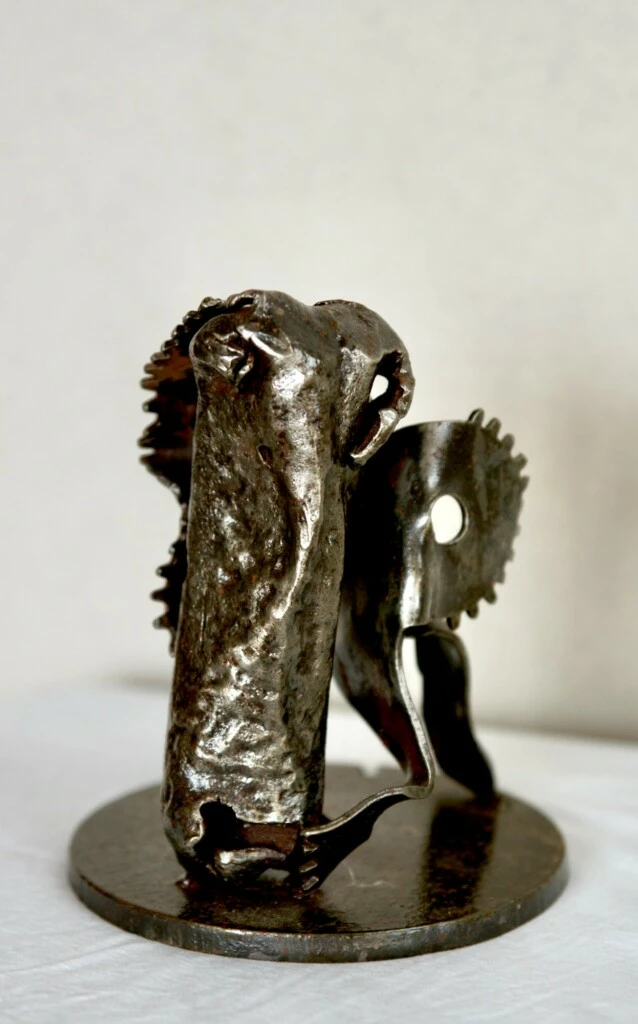
« For my part I like balance, I like the work to be sufficient for its own stability, and if I add a plinth it is to fix it definitively. »
A work that needs a plinth in order not to fall has failed. The plinth comes afterwards, to immobilise what already held. Few
The loop
In 2017, after twenty eight years, the Dojo de la Chapelle closed and he returned to Brittany. He now teaches two classes a week at the Dojo Brestois, the club where he began in 1961, alongside Claude Urvoy, ninth dan, whom he still describes as being on the mat.
Fifty six years later, in the same place, with the same teacher. For someone who has spent his life looking for the point where things hold, there is a certain consistency in that.
Seeing the works
The complete catalogue holds 137 pieces. The word he uses to name them, tatemono, also comes from Japan. The available pieces are in the shop, and the agency answers through contact.