A catalogue spanning thirty years is rarely read in a straight line. Pierre Le Caër’s is an exception, because his materials change at the same time as his address. Two periods, two geographies, two ways of assembling.
The Parisian period, metal dominates
The works he groups under the name early creations were made in the eighteenth arrondissement, at the back of the courtyard where his dojo and his studio stood. He describes them himself without ornament: « the work of metal predominates. The purity offered expresses a rather martial anchoring ».
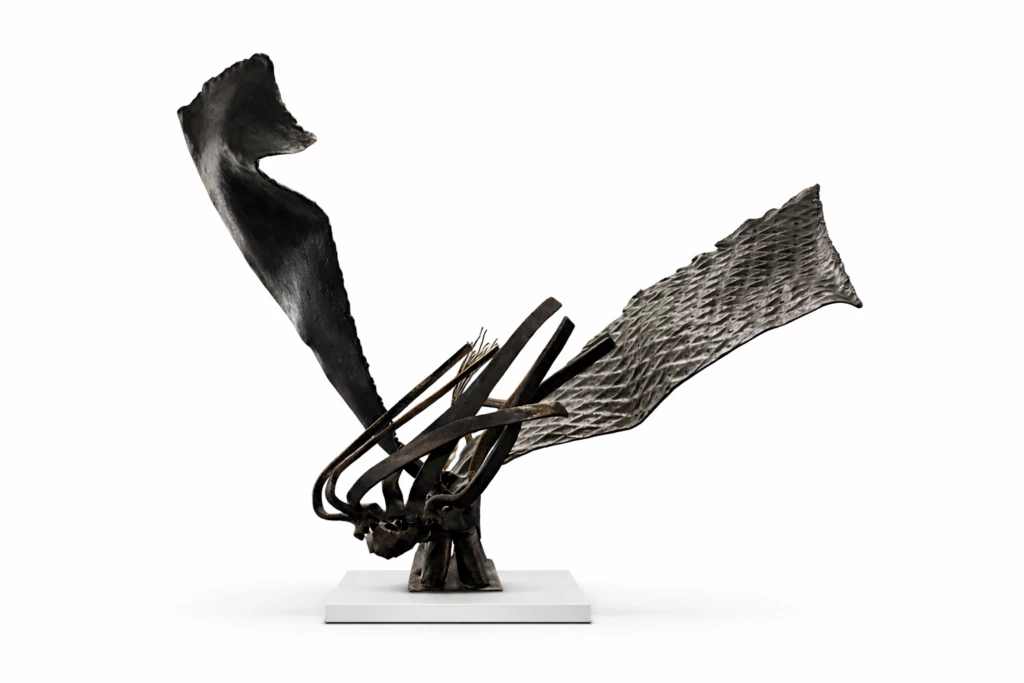
The vocabulary of that period is industrial and urban. Cut sheet steel, rod, plate, twisted wire, and sometimes an identifiable element such as the circular saw blade that enters the piece called Arrogance. The raw material is salvaged scrap, described in his biography as pieces of metal rusted, twisted, damaged, thrown away.
One sub genre even stands out: the metal plates, where he works within a flat sheet. Croupe, Peine and Angoisse belong to it.
A point of vocabulary
One thing deserves to be said clearly, because the opposite is often written.
Pierre Le Caër does not forge. Nothing in his own texts mentions forging. He assembles and welds metal that has already been discarded, and he says so: « I am making some progress in my assembly techniques ». The difference is not incidental. To forge is to give form to new material through heat and impact. To assemble salvage is to compose with forms you did not choose.
In the same way, his captions say wood, twisted wood, bark, cork. His first piece is a sliver of oak. A more decorative vocabulary would sell better, and be less accurate.
The Breton period, stone enters
After 2017 and the return to Ploudalmézeau, stone takes a place it did not have. He gives the reason in one phrase: adding stone brings a « Celtic complement ».
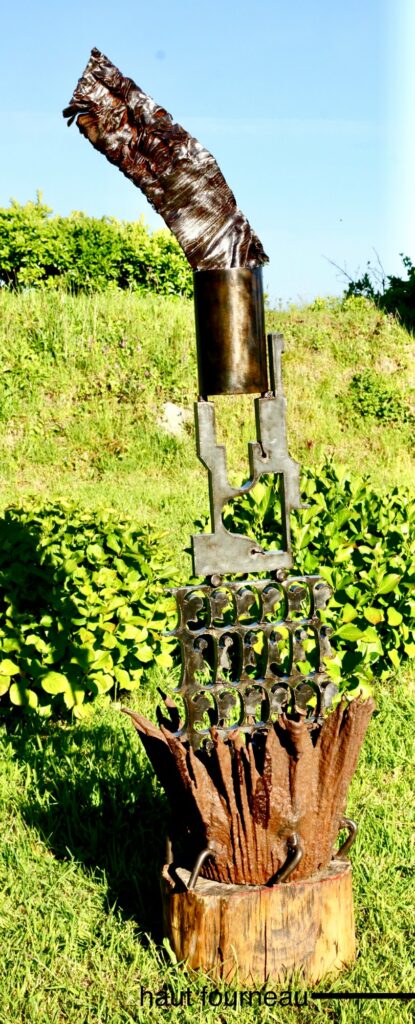
The landscape enters the studio. The small formats are conceived, he writes, near the beaches of the Iroise Sea and its granite rocks. Shells, vegetation, rope and cordage appear. Titles such as Jardin celtique, Landunvez, L’oiseau sur la vague and Côte des légendes place the pieces on a map.
He sums up the influence in one sentence: « My work is subject to the influence of the region: sea and coast. Strength, permanence and beauty. »
What each material brings
Metal brings structure and memory. It is what holds, and it already carries an industrial or maritime history that the artist reveals rather than erases.
Stone brings mass and anchorage. But it plays a paradoxical role with him, which he exploits in the suspended stones: a material of stillness, it becomes movement, held in the air by metal or rope, resting on nothing.
Wood brings the gesture of nature. It arrives already worked by time, salt or use. Twisted wood, bark, cork, oak.
Found elements bring accident. A shell, a saw blade, an old nail: these are the points where the work escapes its author.
Minimal care
A detail rarely documented for a
How to place a piece
In front of a work from the catalogue, two clues are often enough to date it.
If metal dominates and the piece has something dry and tense about it, it probably comes from the Parisian period. If stone, wood or vegetation take over, and above all if the whole thing breathes more, it is probably Breton.
Seeing the works
The complete catalogue holds 137 pieces in six groups. The word tatemono explains what these assemblages are after, and the closing of his Parisian studio in 2017 explains the shift from one period to the other.