You can describe what Gabriel Lemaire Sicre does for pages. Two pairs of photographs say it better. The same machine, at two moments of its life, a few years apart.
The glazing machine
In the first image, a block of cast iron in the brambles. The machine is still standing, where it was abandoned, and the maker’s name is visible on the frame. Green has begun to grow over the mechanics. It is a glazing machine, a finishing machine, the one that flattened the grain of the leather and made it shine.
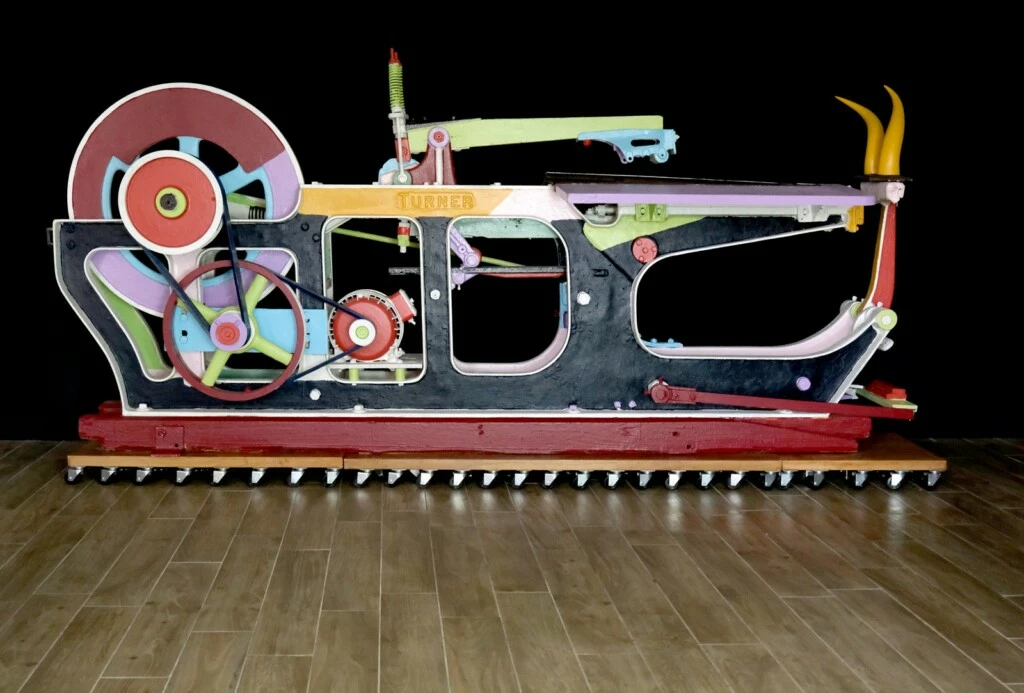
In the second, the same architecture, exactly the same proportions, and nothing else the same. The frame has become white, the moving parts are blue, red, yellow, sea green. The piece is called Drakkar, and the name becomes obvious as soon as you read it: the long low line, the row of teeth like oars, the prow.
What is striking is not the transformation, it is what has not changed. No element has been added or removed. It is the same machine. Only colour has moved the reading.
The staking machine
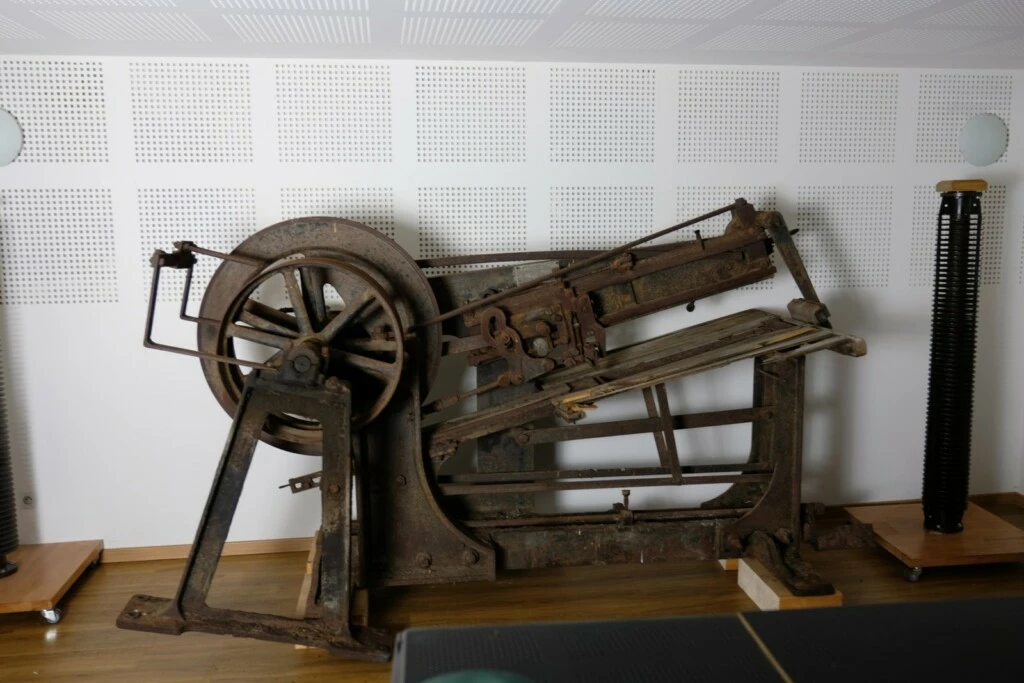
The second pair is even more telling, because the first photograph was taken inside the factory, in the very place where the machine worked. Tiled floor, white wall, the machine standing there like a working tool somebody is going to switch on tomorrow.
The staking machine, the palisson, was the tool of softening. In its original form it was a solid wooden bench with a half moon iron blade set into it, with a rounded edge, over which the worker pulled the hide to relax it. The word is attested as a leather worker’s tool since 1723.
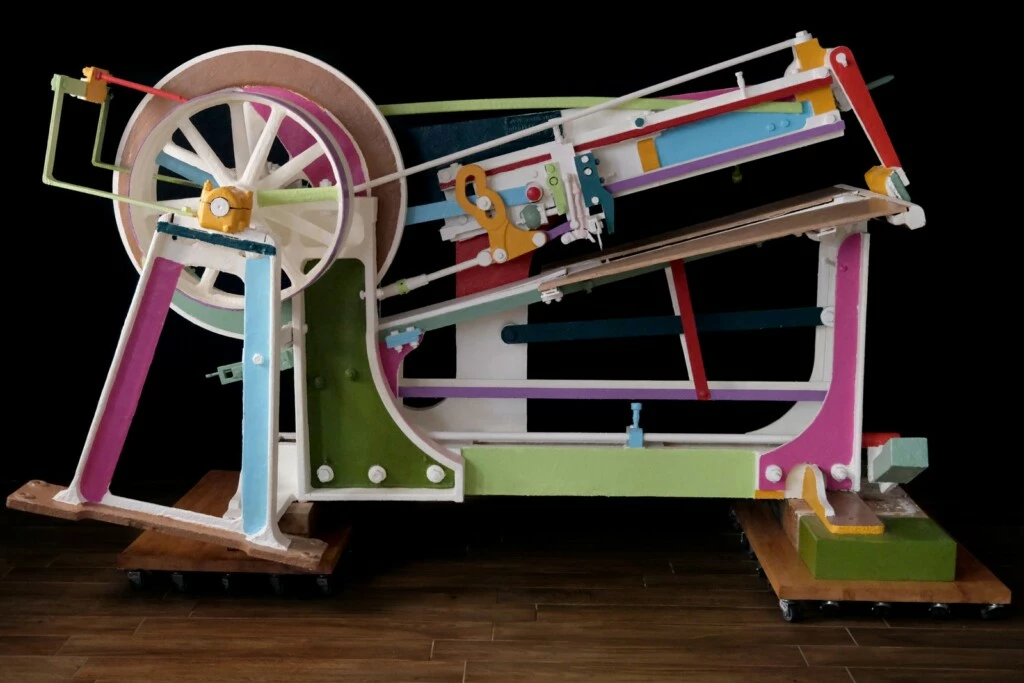
Painted, the machine becomes Coléoptère, the beetle. The two large wheels become elytra, the structure becomes a thorax. Here again nothing has been added. The insect was already in the machine, it only had to be seen.
Why colour is enough
There is an optical reason for this. An industrial machine is monochrome by necessity: grey iron, steel, black grease. The eye therefore cannot separate one function from another, it sees a mass.
By putting a different colour on each part, the artist makes visible what the engineer had drawn: here is the frame, here is the transmission, here is the working organ, here is the adjustment. Colour does not decorate the machine, it explains it. And in explaining it, it turns it into a figure.
What the comparison proves
Three things description alone does not prove.
That the work is not sculpture in the sense of modelling: the final form is the engineer’s, not the artist’s.
That the artistic act is an act of reading. Seeing a longship in a glazing machine and a beetle in a staking machine is recognising a figure where there was a function.
And that the raw material really was disappearing. The photograph in the brambles is not a set up: that is the state these machines end in when nobody takes them away.
Seeing more
The complete catalogue holds 163 works in thirteen chapters. The whole process, from derelict site to plinth, is set out separately, and the glossary of leather-trade machines explains what each one did.