A visitor entering the Graulhet factory for the first time sees machines painted in vivid colours. That is accurate, and it is not enough. Behind those three hundred pieces there is a research Gabriel Lemaire Sicre has formulated himself, and it comes down to a few ideas. Here they are, in the order in which they imposed themselves on him.
Continuing the moderns
The starting point is an ambition he states without detour: he worked in the awareness of a necessity, that of continuing the work of the great modern artists. He names those whose heir he feels himself to be, Robert and Sonia Delaunay, Fernand Léger, and sets himself the task of completing their work with a series of statues.
He knew, he says, that he had the luck of an exceptional material for it, and that the opportunity comes only once in a lifetime.
The affiliation is not idle. Léger painted machines and workers, the Delaunays made pure colour a principle of construction. The chromatic circle, the frank outline, the legible mechanical form: that vocabulary is exactly the one Gabriel Lemaire Sicre applies, no longer to canvas but to the object itself.
An abstraction born of another abstraction
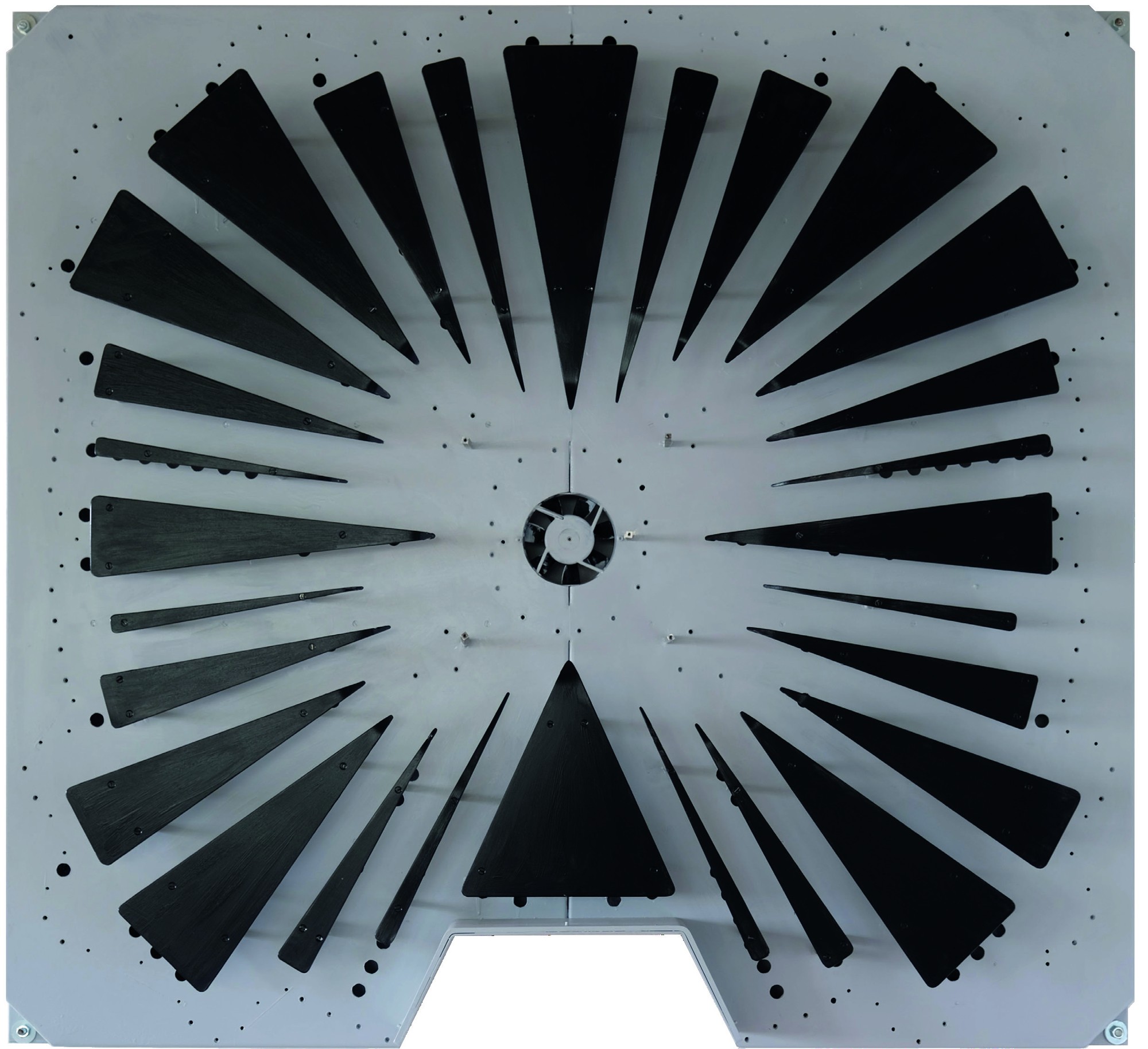
His definition of his own gesture is perhaps the most useful sentence in his book. He makes a form born in an engineer’s imagination coincide with his own work of abstraction from it. An abstraction born of another abstraction, he writes, a theorem arising from another theorem.
A tawing machine is not a natural object. It is already an idea: an engineer solved a problem of transmission, of pressure, of speed, and that solution took the shape of a frame, a flywheel, a cam. The artist does not start from nature, then, he starts from a thought already put into volume, and draws a second thought from it.
Keeping a child’s eye
A second necessity he claims for himself: keeping a child’s eye. Not the innocent eye, he specifies, but the candour that lets you discover, in something used every day, a hidden marvel.
He asks the question that sums up his work: who would think a Citroën 2CV engine beautiful? You have to see it to believe it, and once you have, imagination starts up. He also recalls that all this material was available for almost nothing compared with what it had cost new, like the bits of string children know how to play with.
Play is in fact the first level of reading he proposes for his work, with a line from Jung: man is only truly himself when he plays. He notes that retired workers, discovering his machines, said with a laugh that had they been painted like this in their day, they would have worked on them with far more joy.
Power, and transmission
Second level of reading, power. He distinguishes two kinds, material and spiritual, and their respective places, the castle and the temple. The industrial revolution built new castles, the factories.
His own is both at once. A castle by its dimensions and its history, a temple by its arrangement: industrial radiators and hide beaters stood upright like columns, high rooms that produce the emotion of a nave. He speaks of a pantheon where objects that have become cult objects reside, and quotes Malraux: the tomb of heroes is the heart of the living.
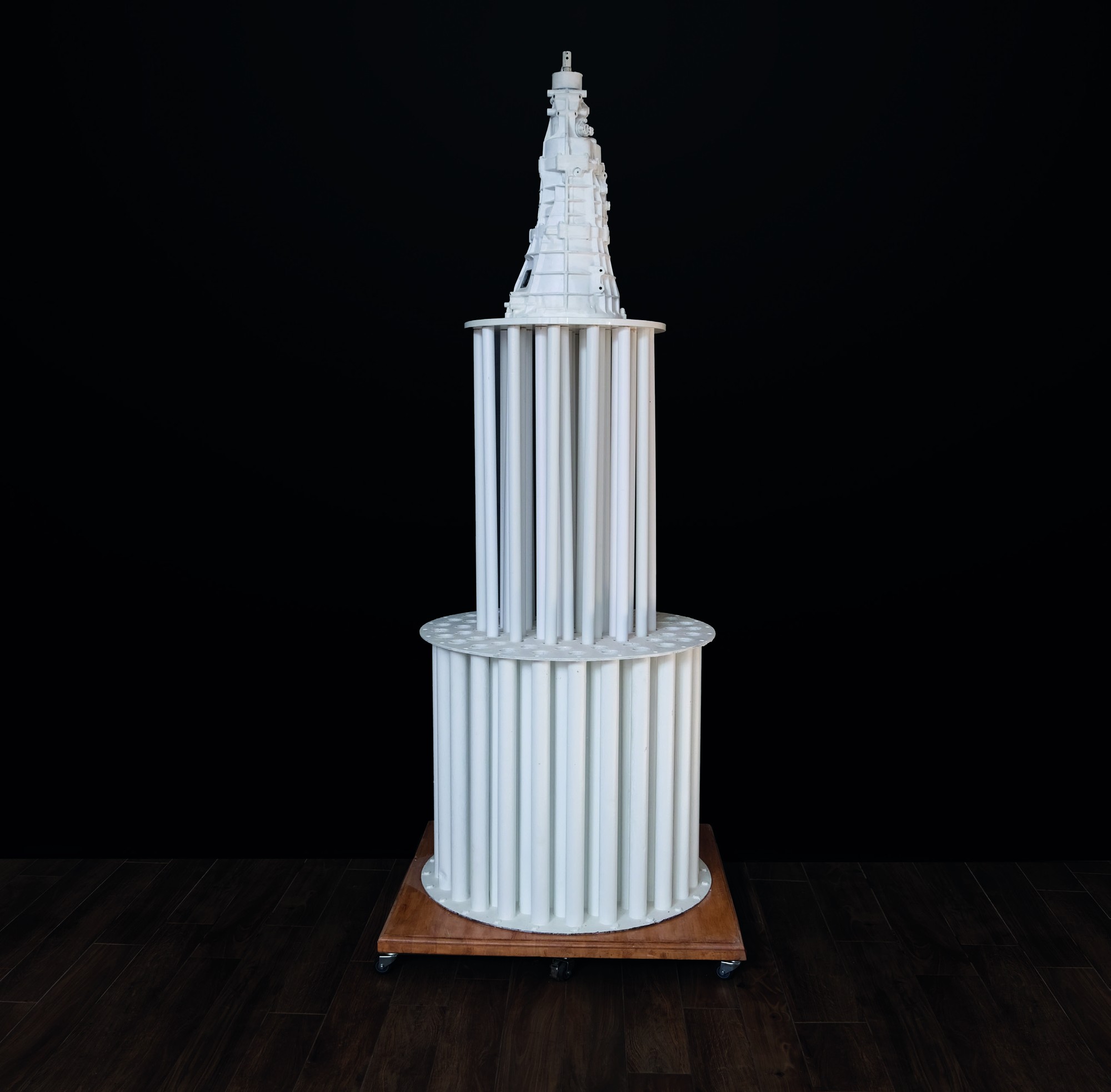
Hence the word he uses to define himself: an heir who adopted an abandoned industrial heritage in order to pass on a heritage made of other values.
Synchronicity, and a thesis in Nature
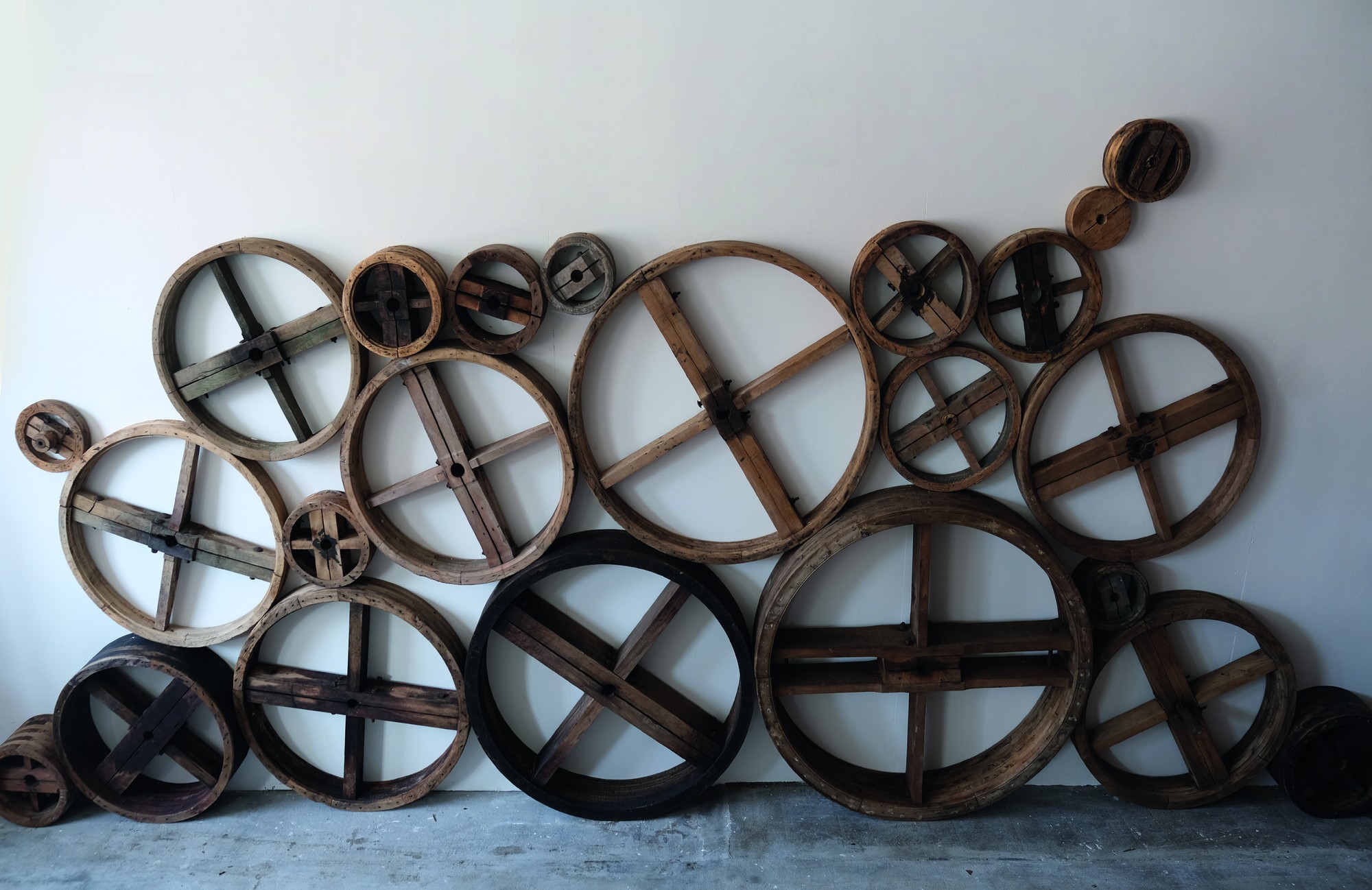
He likes telling this story, and it lights up his method. A monumental composition seven and a half metres wide, made of assembled pulleys, was seen by a retired engineer living five hundred metres from the factory. The man told him he had devoted his doctoral thesis, and a paper published in Nature in 1977, to the number of contact points between randomly placed discs.
His conclusion: composing with joined circles is within reach of a three year old, finding pulleys a metre and a half across is now a feat, and meeting the man who formalises the composition mathematically belongs to the order of the miraculous.
Sing your own country to reach the universal
There remains the question of place. He rejects art made anywhere, without identity, and sets against it a line from Beethoven: if you want to be international, sing your own country. His work is therefore dated and situated, made of the intelligence of a town where these machines served and of a country that was also the cradle of modern art.
He ends on a constraint he accepts. Le Paradis des Machines is a work under constraint, the constraint being to make art with machines. And he notes, amused, that the French anagram of « l’œuvre à contraintes » is « nous raconte la vérité », it tells us the truth.
For his background, read his biography, and for his beginnings, how he came to painting. His works are gathered in his catalogue.