The machines in Le Paradis des Machines all come from the same place and the same industry. To understand why they were
A thousand years of leather, and one speciality
Graulhet has worked skins for a very long time, along the river Dadou. The town specialised in basane, goat or sheep skin tanned with vegetable extracts, which until the nineteenth century was used for book covers and bindings.
The regional system was divided: Mazamet pulled the wool and produced the raw skin, and the tawers of Graulhet turned it into basane. Hence the title the town claims, world capital of basane.
The rise
A first trade union existed as early as 1880, four years before the law that authorised them. In 1909 and 1910 the town went through a strike of one hundred and forty seven days, with eighteen hundred strikers. These are not the figures of a village craft.
In 1930 there were ninety five tawing houses and three thousand five hundred workers. Both wars brought military orders. Between 1945 and 1974 the town employed more than four thousand workers in the sector.
In the 1950s another source counts one hundred and sixteen factories across all sectors and three thousand two hundred workers. The two series do not contradict each other, they measure neither the same scope nor the same year.
The peak, then the turn
The demographic peak is legible in the census. The commune had twelve thousand and seventy three inhabitants in 1968, fourteen thousand and ninety seven in 1975, its maximum.
Then the curve descends, steadily, for close to forty years. Thirteen thousand five hundred and forty three in 1982, twelve thousand six hundred and sixty three in 1999, eleven thousand eight hundred and ninety in 2012, the low point.
Two thousand two hundred inhabitants lost in thirty seven years. That is the demographic trace of a retreating monoculture, and it is measurable.
What caused the decline
The decline sets in from the 1980s, under competition from Chinese, Indian and Pakistani production. An industry resting on a single product and a single skill had no shock absorber.
The firms that held on did so through innovation. Stretch leather was developed in Graulhet in the 1990s.
Today, and on which definition
Here precision is needed, because three different figures circulate and all of them are accurate.
Twelve tawing houses and one hundred and eighty employees, counting tawing in the strict sense, since 2010.
Eighty companies and six hundred and fifty employees, counting the whole leather sector including leather goods and trading. With six companies holding the Entreprise du Patrimoine Vivant label.
About sixty companies and five hundred employees in a more recent and tighter estimate.
What none of these series says, and which is nonetheless true: Graulhet still produces twenty five per cent of French leather.
And the population has risen again. Twelve thousand six hundred and eighteen in 2017, thirteen thousand one hundred and twenty nine in 2023. Twelve hundred inhabitants regained since the low point.
What becomes of an empty factory
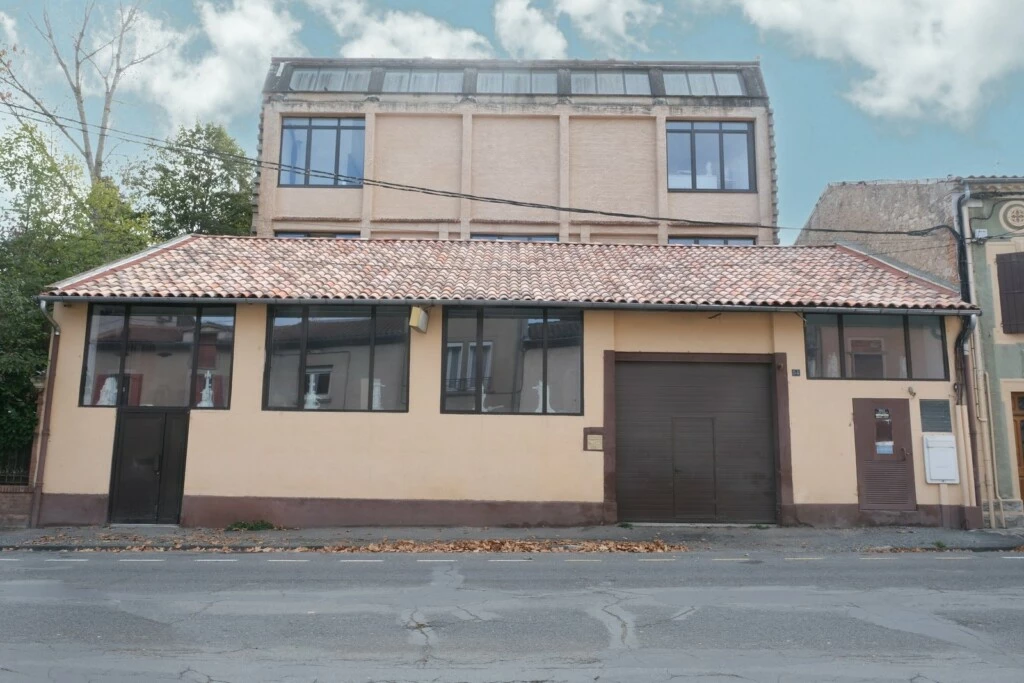
When an industry falls from a hundred and sixteen factories to a dozen, the buildings remain. A two thousand square metre tawing works, abandoned for some twenty years, was for instance taken over in 2023 by a local leather goods maker.
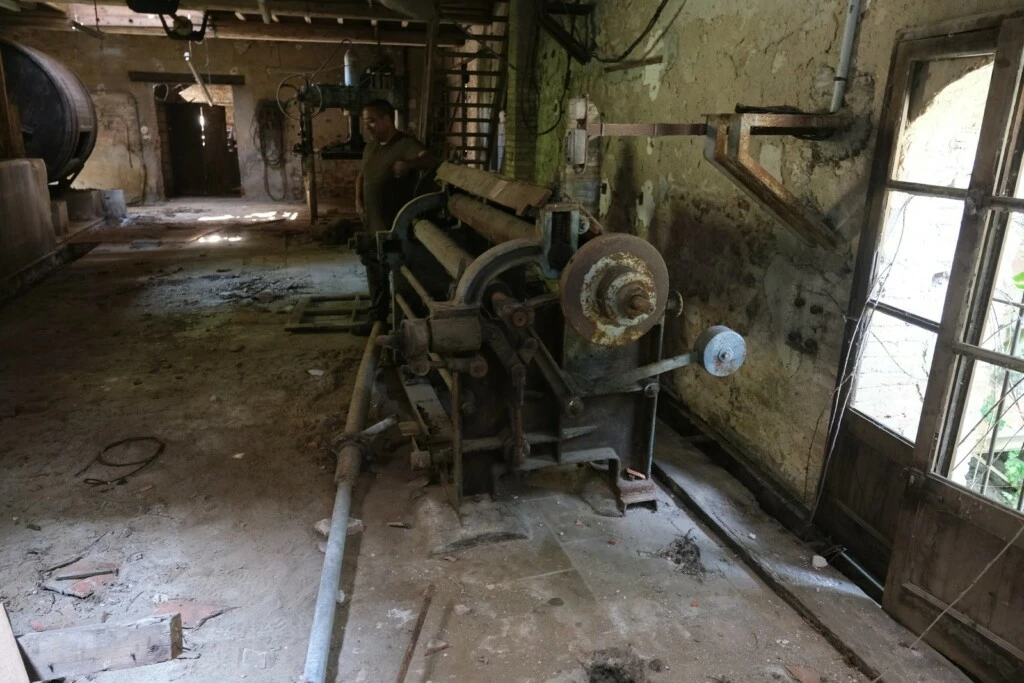
It is the same movement that explains the collection. The machines that were not melted down stayed where they were, in empty buildings and in the yards of engineering workshops. They were still there when somebody decided to take them away.
One sign remains legible on the town’s façades, for those who know how to look: the motifs marking the floor where the skins were dried.
Going further
The complete catalogue holds 163 works. The glossary of machines explains what each one did, and the transformation process tells what happens between the derelict site and the plinth.