It is easy to imagine the
September 2001, a trilogy
The first documented example is also the clearest. After the New York attacks of 11 September 2001, he made a trilogy. Three pieces, in direct response.
It is worth measuring what that implies for someone who works with no prior project. His usual gesture is to wait for the material to call. Here the event calls, and the material follows.
A chronology through the titles
Twenty years later, the same mechanism produces a list that reads like a newspaper.
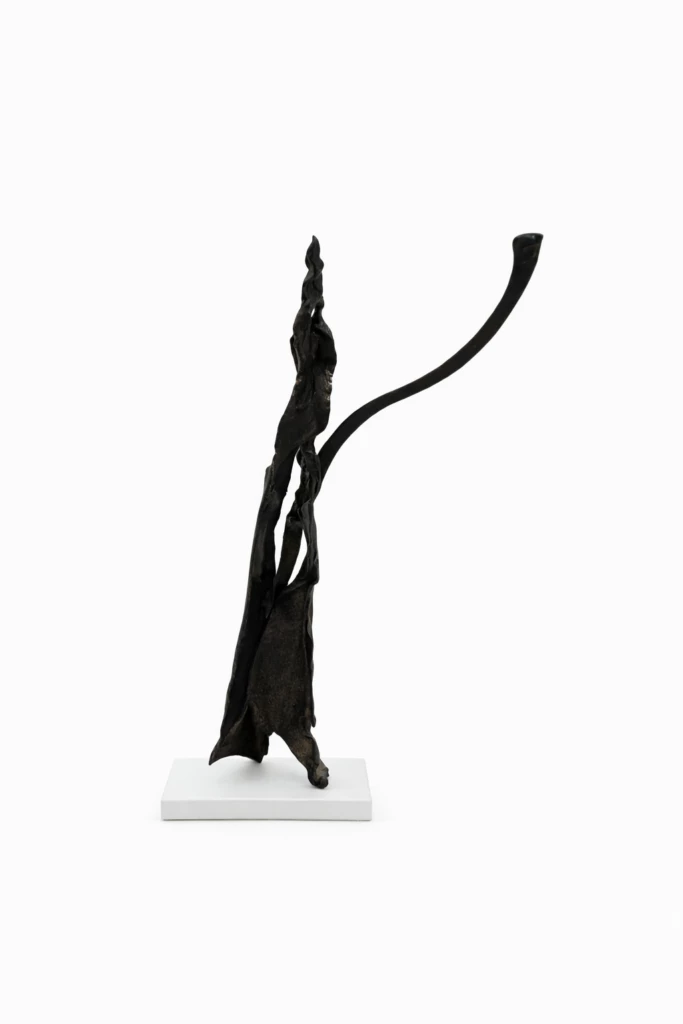
Les indignés, in wood and stone, for the 2011 movement. Prière pour la banlieue. Demonstration. Gilets jaunes, in his 2019 portfolio. A whole series born of lockdown, which he describes himself: Covid-19 « generated a fairly long series ». And in 2022, Poutine ou la virilité à coups de canon.
Add Négrier, Marx Dormoy, Death or the Whip, and the picture becomes clear. This is not a decorative
What the title does, and what it does not
An honest caution is needed here. The titles are attested and the works exist, but nothing allows us to claim that the form of a piece illustrates the event. A sculpture called Gilets jaunes is not necessarily figurative in any way.
With him the title comes afterwards. It names the state of mind of the moment when the piece was made, not its subject. It is a practice of dating as much as of naming, and it is more interesting than illustration: it inscribes a studio in a calendar.
Why scrap lends itself to this
There is a material reason for current events entering this work, and it lies in the material itself.
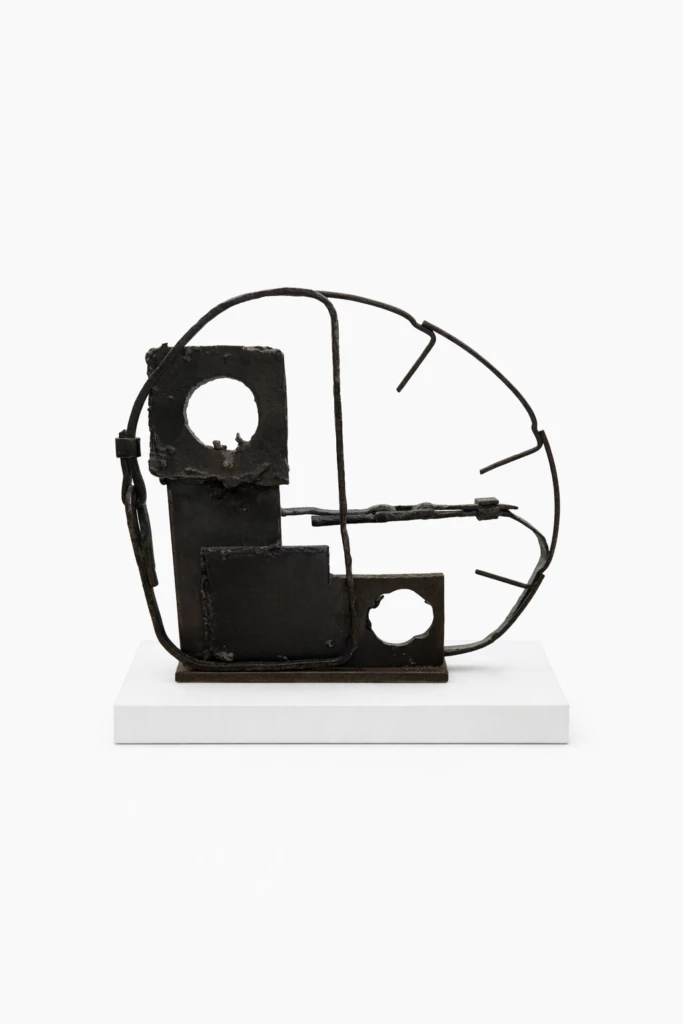
What he assembles has already served. A sheet, a rod, a plate, a circular saw blade all had an industrial life before reaching the studio. Salvage is dated by nature. Assembling discarded metal is already writing economic history without saying so.
In the same way, the stone he picks up has no legible age, and that may be why it plays the opposite role in his work: that of permanence.
Two registers side by side
The catalogue holds together two families of titles that appear to have nothing in common.
On one side, titles of current events and anger: the demonstrations, the wars, the epidemics.
On the other, titles of intimacy and landscape: Serenity, Tendresse de pierres, Harmonie, Rêve de pierre, Soleil couchant, Jardin celtique, L’oiseau sur la vague.
There are also the tributes, among them Les lambeaux de désirs de Léo Ferré, and Tribute to Tristan Corbière, the poet from Brest. A
How to read one of his titles
Three questions are enough in front of a piece from the catalogue.
Does the title name a form, an event or an emotion? All three families coexist and are not read the same way.
Is there a date attached? When there is, it places the piece within a series rather than within a career.
Does the title add or subtract? With him, a title drawn from current events does not close the reading, it opens it onto a context. That is the opposite of an explanatory title.
Seeing the works
The complete catalogue holds 137 pieces. The word he uses to name them is tatemono, and his way of starting, at forty eight, partly explains this freedom of subject. The available pieces are in the shop.