Gabriel Lemaire Sicre’s story always begins with the twenty tonne press found in a car park. It is the most striking account, and it is also the end of a search, not its beginning. Before the machines there are some twenty years in computing, painting on plywood, and a departure. His full background is told in his biography, and his beginnings as a painter in how he came to painting.
A first life, elsewhere
By his own account he spent some twenty years in computing before giving his life to colour. That detail matters more than it seems, and it explains part of what you see at Graulhet today.
Computing is a trade of systems: you break a whole into functions, you name each function, you follow the flows. That is exactly the gaze a dismantled industrial machine demands. Here is the frame, here is the transmission, here is the working organ. An artist coming from drawing would see volumes. He sees an architecture of functions, and he paints it as such.
Painting, thrown
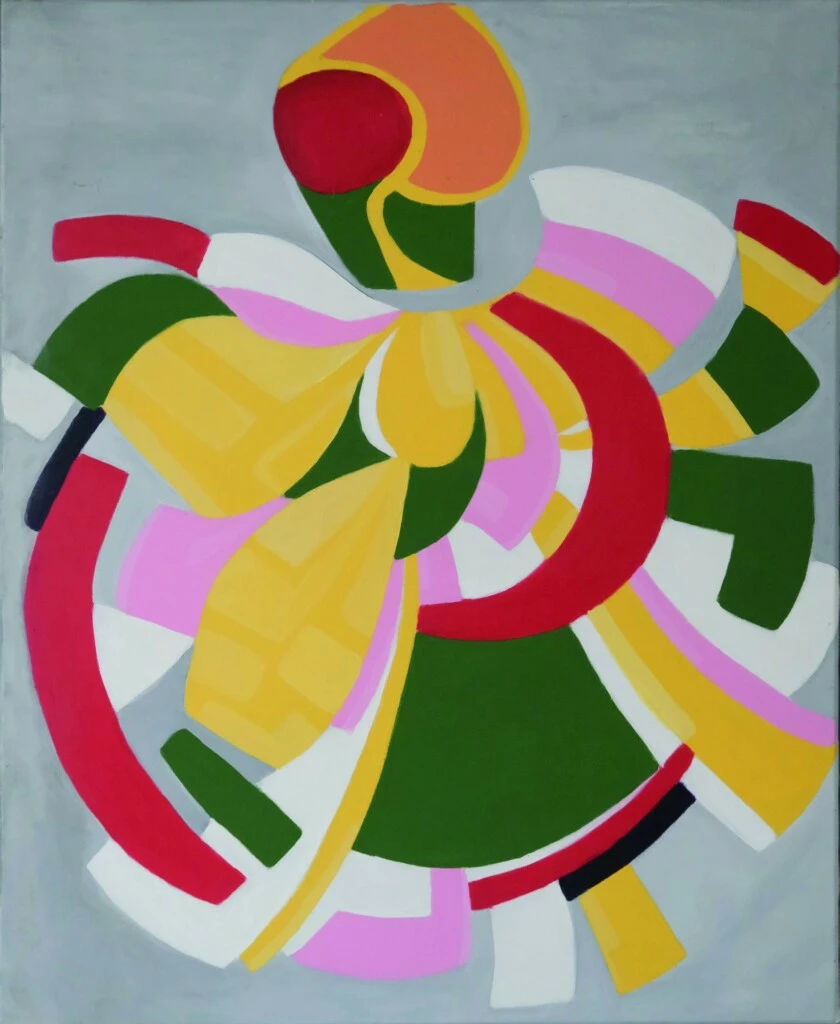
The first practice is not sculpture, it is painting. Colour thrown onto large sheets of plywood.
Two things are already present in that gesture, and they will not change again.
The first is the support. Plywood is not canvas. It is an industrial panel, rigid, mass produced, with no nobility. To paint on it is already to choose to put colour on something industry made for another purpose.
The second is pure colour. It comes from the tin, unmixed, and it is thrown rather than laid down. Paint is not a material you model, it is an event that arrives on a surface.
The last chapters of the catalogue gather these early paintings. They are published with the rest, in full, and they deserve to be looked at in that order: these are not juvenilia to be excused, they are the laboratory of everything that follows.
What painting could no longer give
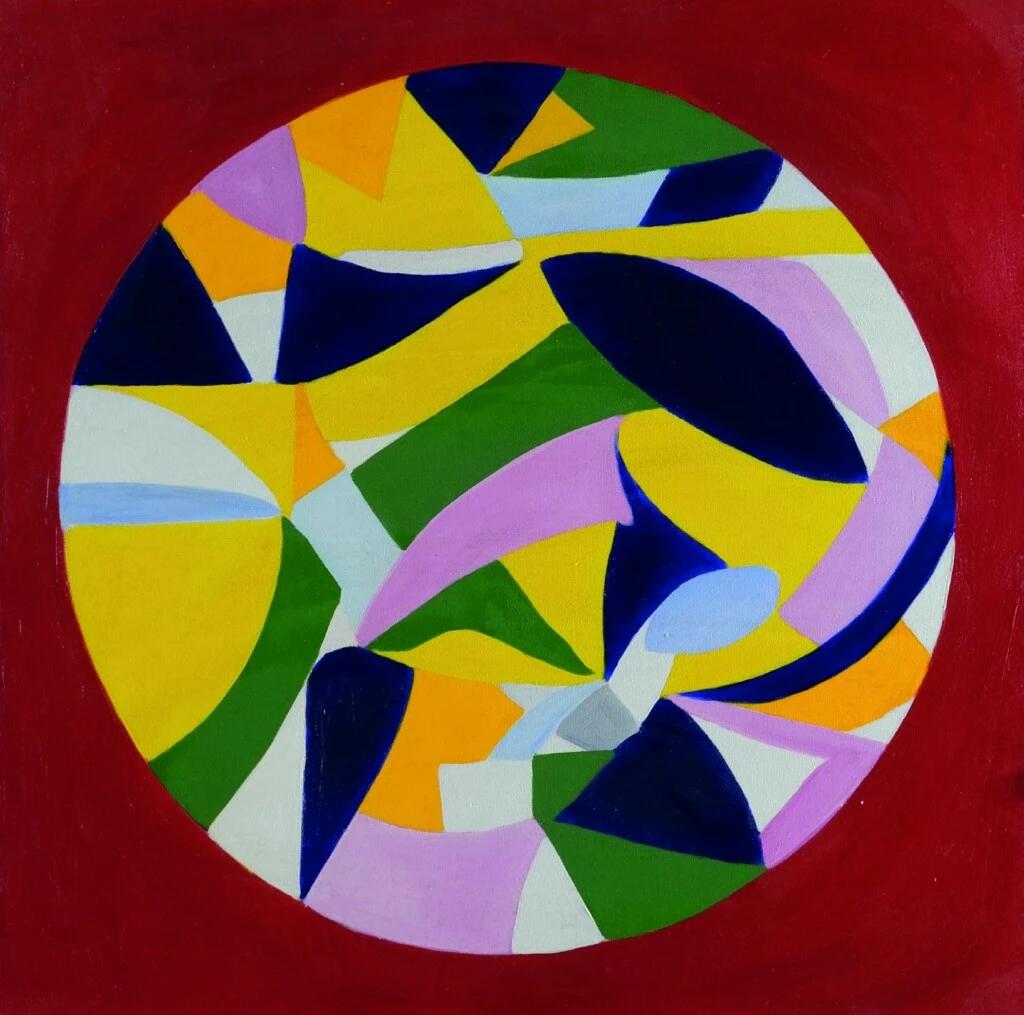
There comes a point where the format becomes a limit. A sheet of plywood, however large, remains a surface. It has no weight, no volume, no memory of its own. Colour arrives on something new.
That is where the search shifts. The question stops being which colour to put on, and becomes what to put it on. And the answer is not found in an art supplies shop.
August 2013, the departure
He leaves the Paris region. What he is looking for is specific, and it tells you everything about the project: a large building, in the south.
Not a studio. A building. The difference is one of kind. A studio is a place where you make transportable objects. A building is a place where you can bring in things that will not come out again.
The risk in that decision is worth measuring. He is not moving towards an identified opportunity, he is moving towards a constraint of floor area, with the idea of filling it with something he has not yet found.
Graulhet, and an empty factory
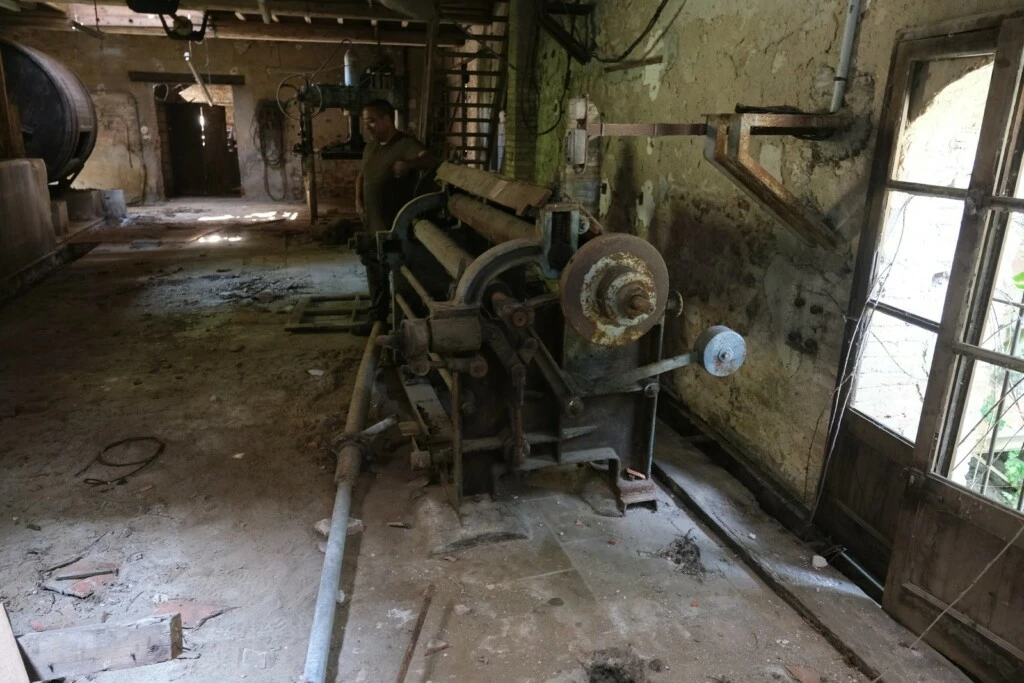
He arrives in Graulhet, in the Tarn, in a factory built in 1955 and completely empty.
What follows is well known, but it takes on another meaning once you have read what came before. He did not discover the machines by chance while visiting a derelict site. He already had, in his painting, the gesture, the colour and the relationship with an industrial support. What he lacked was an object on the scale of the building he had just found.
The leather-trade machines were there, in a town that had once employed more than four thousand workers in the sector and now counted only a few hundred. The history of Graulhet explains why they were available, and why nobody wanted them.
The first piece, and why it is an answer
The first is a twenty tonne press, found in a car park, which he describes as the most imposing Pac-Man he had ever seen. It had escaped the scrap dealer because the weight of the metal did not cover the cost of hauling it to the foundry.
Look at what that piece resolves. The support is no longer new, it has a hundred years of use. It is no longer flat, it is volume. It is no longer light, it weighs twenty tonnes, and colour is about to take that weight away. And it is no longer anonymous: it comes from a specific industry, a specific town, a vanished trade.
Painting on plywood had asked the question. The machine answers it.
What this chronology changes
It prevents this work from being read as a lucky find. This is not someone who had a good idea in front of a rusted machine. It is someone who already painted this way, who spent months looking for a place able to hold something else, and who recognised what he was looking for when he saw it in a car park.
What comes next
The full process, from derelict site to plinth, tells what happens next. The glossary of machines gives the original trade of each. And Le Paradis des Machines is today a place that can be visited, in Graulhet.
One point of method, finally. The biographical elements in this article come from the artist’s own account and not from published sources. We present them as such, and a recorded interview will allow them to be made precise.