Looking for an artist’s influences is a risky exercise: you often project your own. With Gabriel Lemaire Sicre the problem does not arise in the same way, because some references are written into the titles of the works. He names them.
A gearbox after Ingres
The title is explicit: after Ingres. The piece is a gearbox, painted entirely white, set on a wheeled platform.
What happens in that title is worth unfolding. Ingres is French drawing par excellence, the pure line, the academic nude, skin smoothed to the point of unreality. A gearbox is the absolute opposite: cast iron, gears, oil.
White is what joins them. Painted matt white, the mechanism stops being a mechanism and becomes a plaster cast, a marble, a figure from a drawing studio. The title is not a joke, it is an instruction for reading. And for an artist based in the Tarn, a few dozen kilometres from Montauban where Ingres was born, the reference is also local.
A sewing machine turned thinker
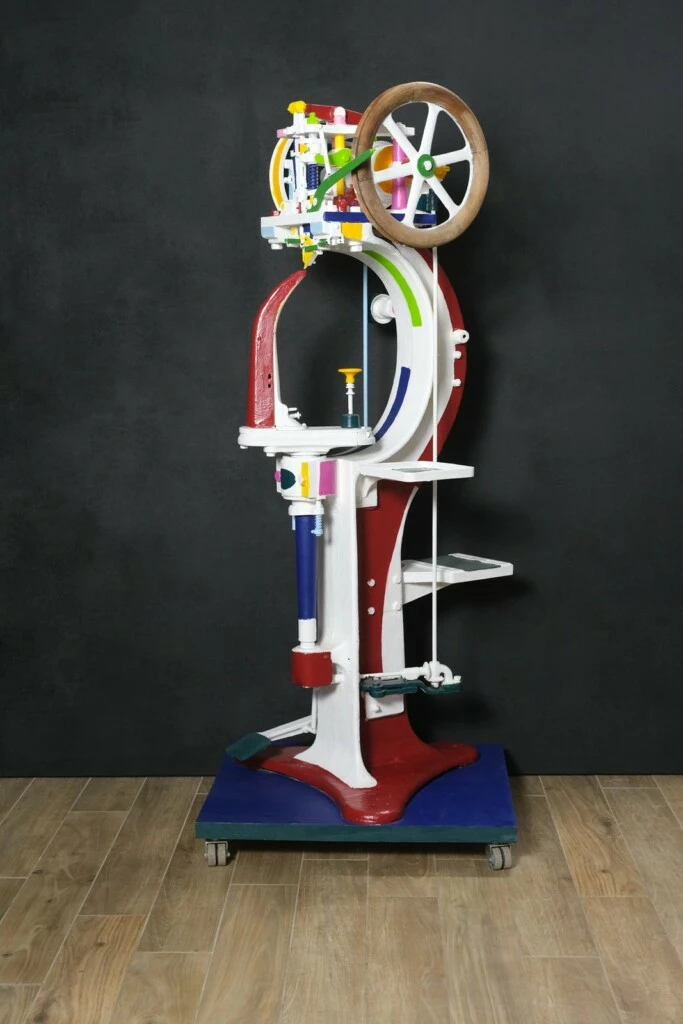
A second explicit reference. An industrial sewing machine, painted, whose title summons the thinker, echoing Rodin.
Here again the connection rests on something precise, posture. A cobbler’s sewing machine has a head bowed forward, a folded arm, a seated mass. You only have to look at it from the side. The sculpture was in the machine, just as the beetle was in the staking machine.
A cutting die in homage to Dalí
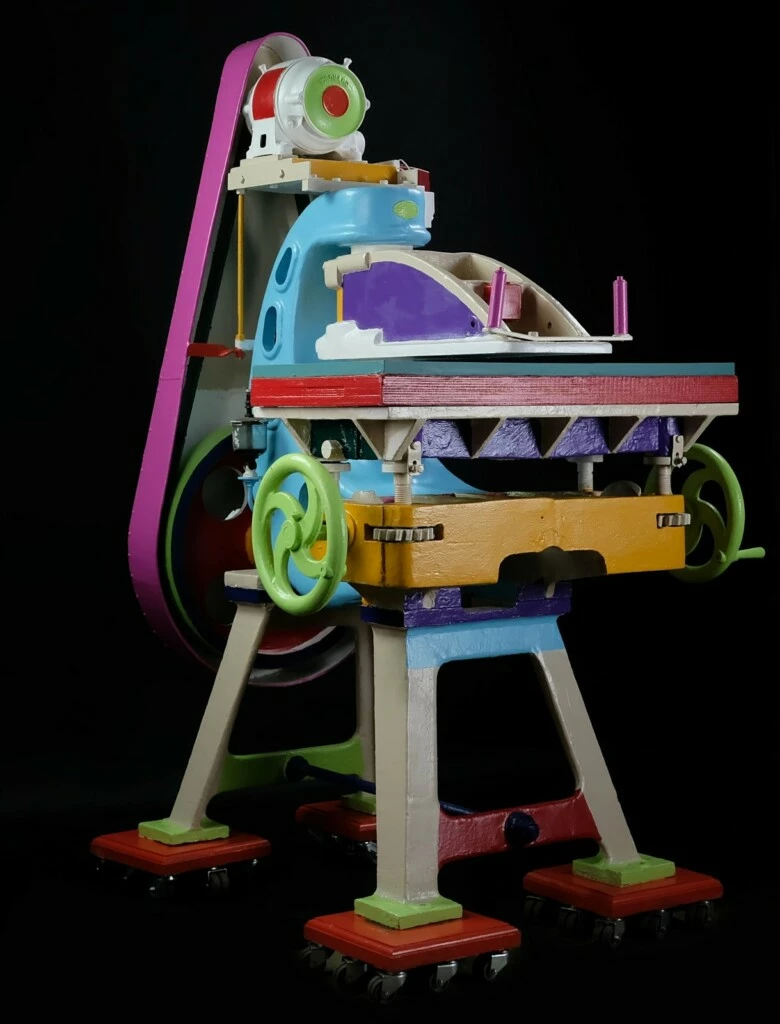
A third explicit title. A cutting die, the tool that cut shapes out of the skin, turned into a homage to Dalí.
The reference here is mental rather than formal. Dalí is the diverted object, the elephant’s foot on a piano, the lobster on the telephone. Naming Dalí is claiming the right to make a tool say something other than its function, and to do it without irony.
What his working files contain
Beyond the titles, the working files passed to the agency contain reference images kept alongside the photographs of works. They have no public status, but they say something about how he looks.
Robert Delaunay is there, notably his painting Rythme of 1912. That is no surprise once you know the large coloured discs in several of his pieces, where wheels and pulleys become concentric circles of flat colour.
Ancient Egypt is there: a funerary barque, a cat, deities. That fits the chapter of the catalogue devoted to a pantheon of machines turned into gods.
And there is, more unexpectedly, an analysis of Bach’s prelude and fugue in C minor. A musical analysis chart, with its voice entries and inversions. For an artist who worked for a long time in computing and who paints mechanical parts in separate colours, the kinship is obvious: a fugue is several independent lines made legible at the same time. That is exactly what his painting does to a machine.
A necessary caution
Two levels have to be distinguished, and we distinguish them.
Ingres, Rodin and Dalí are named by the artist himself, in his titles. Those are acknowledged references, and there is no risk in commenting on them.
Delaunay, Egypt and Bach are working documents. We flag them as such, without asserting an influence, because the only person who can confirm an influence is the artist. A recorded interview would settle the question, and it is desirable.
What this list says about the work
It says this is not naive salvage. An artist who keeps Ingres, Delaunay, an Egyptian cat and a Bach fugue within reach does not improvise in front of a rusted machine. He has a vocabulary, and he applies it.
The complete catalogue holds 163 works in thirteen chapters. The genealogy of the machine exhibited as sculpture places this work within art history, and the glossary of machines recalls what each tool did before.